The frog skeleton is a fascinating example of how bones are specially adapted for movement, protection, and survival. Although frogs have small and lightweight bodies, their skeletal system is highly specialized to support powerful jumping, swimming, climbing, and other movements. A frog’s skeleton consists of several important parts, including the skull, backbone, limbs, pelvic structure, and foot bones. Each bone has a specific role in helping frogs maintain balance, protect internal organs, and move efficiently in different environments. The unique structure of frog bones, such as the strong hind limbs and specialized urostyle bone, allows frogs to generate powerful jumps and survive against predators. Their lightweight skull and flexible body structure also help them adapt to both land and aquatic habitats. This article explores the complete anatomy of a frog skeleton, including major bone groups, limb structure, skeletal adaptations, growth and development, and comparisons with other animals. Understanding frog bone structure provides valuable insights into amphibian evolution and reveals the incredible relationship between body design and survival in nature.
What Makes Frog Bone Structure Unique?

Frog bone structure is unique because it is specially adapted for a lifestyle that requires jumping, swimming, climbing, and surviving in changing environments. Although frogs have fewer and lighter bones compared with many larger animals, their skeletal system is highly efficient. Every part of the frog skeleton, from the skull to the powerful hind limbs, plays an important role in movement and protection. The arrangement of frog bones reflects millions of years of evolution. Their skeleton provides the perfect balance between strength and flexibility, allowing frogs to perform powerful movements while maintaining a lightweight body. A frog’s bone structure works together with muscles, organs, and different body systems to support survival. To understand the complete body design of frogs, explore our guide on frog anatomy and internal organs.
How Frog Bones Are Different From Other Animals
Frog bones differ from many other vertebrates because they are designed mainly for explosive movement rather than continuous walking or running. One of the most noticeable differences is their specialized hind limb structure, which contains long and strong bones for powerful jumping. Unlike mammals and reptiles, frogs have a reduced rib structure and a shortened backbone. They also have a unique fused bone called the urostyle, which strengthens the body and supports jumping movements. The frog skull is also different because it contains fewer bones compared with many other animals. This lightweight skull helps reduce body weight while still protecting the brain and supporting feeding functions.
Why Frog Bones Are Lightweight Yet Strong
Frog bones are lightweight because their bodies are adapted for energy-efficient movement. A heavy skeleton would make jumping and swimming more difficult, so frogs have evolved a reduced and streamlined bone structure. Despite being lightweight, frog bones are strong enough to handle powerful forces. The hind limb bones, pelvic structure, and spine provide excellent support during jumping and landing. The combination of strong bones and flexible joints allows frogs to store and release energy efficiently. This design works like a natural spring system, helping frogs move quickly without using excessive energy.
How Bone Structure Helps Frog Survival
The frog skeleton plays a major role in survival by supporting movement, protection, and adaptation. Strong hind limbs allow frogs to escape predators through rapid jumps, while specialized feet help them swim and climb. The lightweight skull and flexible body structure allow frogs to move easily in different environments. Their pelvic bones and urostyle provide stability during high-impact movements, reducing the risk of injury. Frog bone structure also helps them adapt to various habitats, including forests, wetlands, and aquatic environments. Whether jumping across land, swimming through water, or climbing plants, their specialized skeleton provides the strength, flexibility, and efficiency needed for survival.
How Many Bones Does a Frog Have?
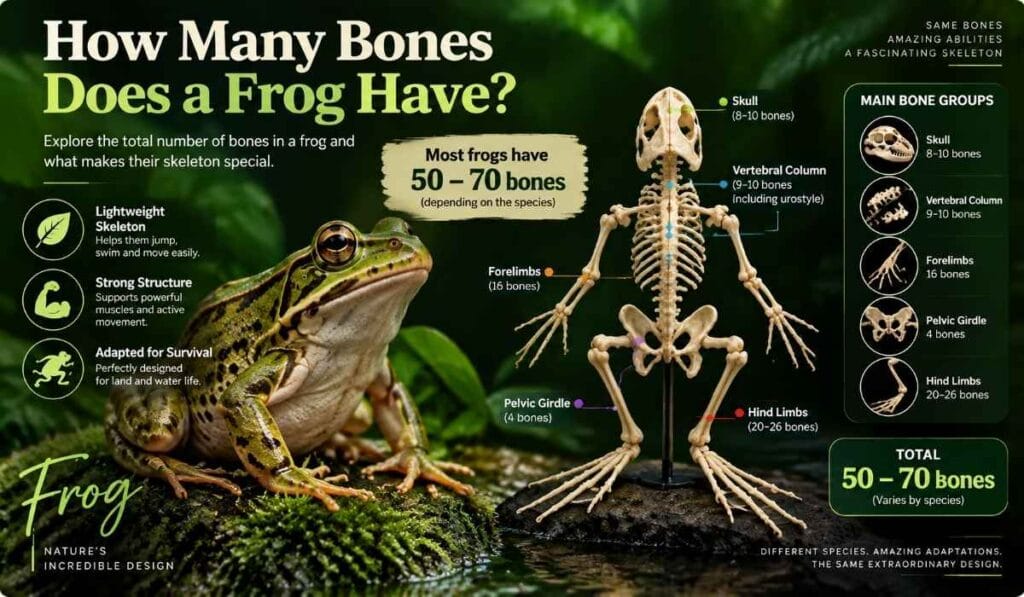
The frog skeleton may appear simple because of its small body size, but it contains a carefully organized collection of bones that support movement, protection, and survival. The exact number of bones in a frog can vary depending on the species, age, and evolutionary adaptations. Unlike mammals, frogs have a lightweight skeleton designed mainly for jumping, swimming, and quick movements. Each group of bones performs a specific function, from protecting the brain to creating powerful movements with the hind legs. Understanding the number and arrangement of frog bones helps explain how these amphibians are able to survive in different environments. he number of bones in frogs is connected with their overall body organization. Learn more about different frog structures in our guide on parts of a frog and their functions.
Average Number of Bones in Adult Frogs
An adult frog generally has around 40 to 50 major bones, although the exact number may differ among species. These bones form the skull, backbone, limbs, shoulder region, pelvic structure, and feet. Compared with humans, who have approximately 206 bones, frogs have fewer bones because their bodies are smaller and more specialized. Their skeleton is designed to reduce unnecessary weight while maintaining enough strength for powerful movements. The number of bones is also influenced by the frog’s lifestyle. Species that depend heavily on jumping may have stronger and more specialized limb bones, while aquatic species may have different foot and limb adaptations for swimming.
Major Bone Groups Found in Frogs
The frog skeleton is divided into several major bone groups, each with a specific role:
Skull Bones: The skull protects the frog’s brain and supports important structures such as the eyes, jaws, and sensory organs. Its lightweight design helps reduce body weight.
Vertebral Column: The backbone supports the body and protects the spinal cord. Frogs have fewer vertebrae compared with many vertebrates, along with a special fused bone called the urostyle, which helps with jumping.
Pectoral Girdle and Forelimbs: These bones support the front part of the body and help frogs maintain balance. The forelimbs also absorb shock when frogs land after jumping.
Pelvic Girdle and Hind Limbs: The pelvic bones connect the powerful hind legs to the spine. The femur, tibiofibula, ankle bones, and foot bones work together to produce strong jumping movements.
Why Bone Count Changes Between Frog Species
The number of bones can vary between frog species because each species has evolved according to its habitat and lifestyle. Tree frogs, aquatic frogs, and ground-dwelling frogs may have differences in their skeletal structures. For example, tree frogs often have specialized toe bones and structures that help them grip branches. Aquatic frogs may have modified foot bones and longer limbs for efficient swimming. Some species may have variations in skull shape or vertebral structure based on their survival needs. Age also affects the skeleton. Tadpoles have a very different skeletal structure compared with adult frogs because their bodies transform during metamorphosis. As they develop limbs and lose their tails, their bones become stronger and more specialized. The variation in frog bone structure shows how evolution creates different skeletal designs to help species survive in unique environments. Despite having fewer bones than many animals, frogs possess an efficient skeletal system perfectly adapted for movement and survival.
Frog Skull Bone Structure Explained
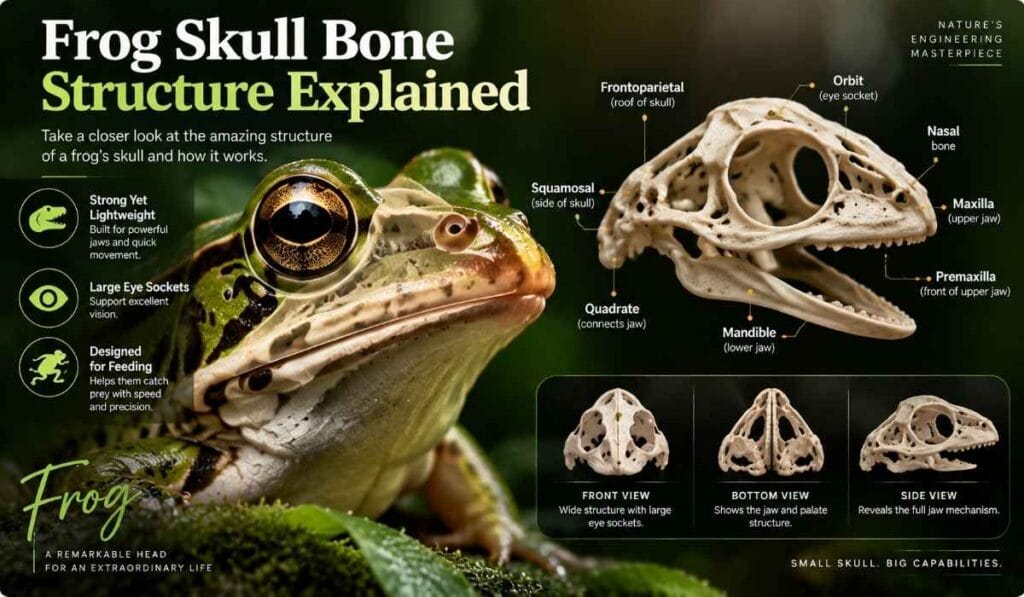
The frog skull is one of the most unique parts of the amphibian skeleton. Unlike mammals and reptiles, frogs have a lightweight and highly specialized skull designed for efficient movement, feeding, and protection. The skull provides support for the brain, eyes, jaws, and other sensory organs while maintaining a structure that reduces overall body weight. Because frogs depend on jumping and quick movements for survival, their skulls have evolved to be strong enough for protection but light enough to support their active lifestyle. The arrangement of frog skull bones also reflects their feeding habits and evolutionary adaptations. The frog skull is an important part of its complete anatomy. A labeled visual explanation can help identify different body structures through our frog anatomy diagram.
Main Bones Found Inside a Frog Skull
A frog skull contains several important bones that form a protective framework around the brain and support the mouth structure. Some of the major skull bones include the frontoparietal bones, maxilla, premaxilla, nasal bones, squamosal bones, and exoccipital bones. The frontoparietal bones cover and protect the upper part of the brain. The maxilla and premaxilla form parts of the upper jaw and support small teeth used for holding prey. The nasal bones are connected with the openings for breathing, while the exoccipital bones help protect the rear region of the brain. Compared with many other vertebrates, frogs have fewer skull bones because some bones have become reduced or fused during evolution. This simplified structure helps make the skull lighter while still maintaining necessary strength.
How Frog Skull Supports Feeding and Protection
The frog skull plays an important role in both feeding and protecting vital organs. The skull protects the brain from injury and provides support for the large eyes and sensory structures that help frogs detect movement and locate prey. Most frogs are insectivores, and their skull structure is adapted for catching and swallowing food. Frogs have a wide mouth opening that allows them to capture relatively large prey compared with their body size. Their upper jaws may contain small teeth called maxillary teeth and vomerine teeth, which help hold prey in place. Unlike mammals, frogs do not chew their food. Instead, they use their sticky tongue to capture insects and swallow them whole. The flexible arrangement of skull bones allows efficient mouth movement during feeding.
Why Frog Skulls Are Small and Lightweight
Frog skulls are small and lightweight because their lifestyle requires quick and energy-efficient movement. A heavy skull would increase body weight and make jumping more difficult. The reduction of unnecessary bones allows frogs to maintain balance during powerful jumps. Their lightweight head works together with strong hind limbs to create an efficient movement system. Despite being small, the frog skull provides excellent protection for the brain and supports important functions such as feeding, breathing, and sensing the environment. This combination of strength and lightweight design makes the frog skull a remarkable example of evolutionary adaptation.
Frog Backbone and Vertebral Structure

The frog backbone, also known as the vertebral column, is an important part of the axial skeleton that provides body support, protects the spinal cord, and connects the skull with the rest of the body. Unlike mammals, frogs have a short and specialized backbone that is adapted mainly for jumping, swimming, and maintaining balance. The structure of the frog spine reflects its unique lifestyle. Instead of requiring a long and flexible backbone for running, frogs need a strong and stable structure that can transfer energy from their powerful hind legs during movement. The backbone supports movement, but it is only one part of the frog’s internal structure. Explore more about hidden body systems in our article on internal frog anatomy.
Arrangement of Frog Vertebrae
The frog vertebral column contains a limited number of vertebrae compared with many other vertebrates. Most adult frogs have around nine vertebrae, followed by a specialized fused bone called the urostyle. The first vertebra, known as the atlas, connects directly with the skull and allows limited head movement. Unlike humans and many mammals, frogs do not have a distinct neck region because their body design does not require extensive neck flexibility. The remaining vertebrae support the trunk and provide attachment points for muscles. The reduced number of vertebrae creates a compact and strong body structure that helps frogs transfer energy efficiently during jumping. This simplified spinal arrangement reduces unnecessary weight while maintaining enough strength to support powerful movements.
Role of the Urostyle Bone in Movement
The urostyle is one of the most distinctive features of the frog skeleton. It is a long, rod-shaped bone located at the end of the vertebral column. It develops from fused vertebral elements and creates a strong connection between the backbone and pelvic region. The main function of the urostyle is to provide stability during jumping. When a frog pushes off the ground, the powerful muscles of the hind legs generate force that travels through the pelvis and spine. The urostyle helps transfer this energy efficiently, allowing frogs to achieve strong and controlled jumps. The urostyle also helps absorb stress during landing. By strengthening the connection between the spine and hind limbs, it reduces the risk of injury caused by repeated high-impact movements.
How the Spine Supports Balance and Flexibility
Although the frog spine is shorter and less flexible than that of many animals, it provides excellent balance and body control. The vertebral column supports the body while allowing enough flexibility for jumping, swimming, and adjusting movement. During a jump, the spine works with the pelvic bones and hind limbs to maintain proper body position. This coordination helps frogs control direction and land safely. The backbone also supports swimming movements by connecting the body muscles with the powerful hind legs. Its strong but lightweight design allows frogs to move efficiently in both water and on land. Overall, the frog vertebral structure is a highly specialized adaptation. The combination of fewer vertebrae, a strong urostyle, and efficient body support allows frogs to perform powerful movements while maintaining balance and flexibility in different environments.
Frog Leg Bone Structure and Jumping Ability

The frog leg bone structure is one of the most impressive adaptations in the animal world. Frogs are famous for their powerful jumps, and this ability comes from the unique design of their hind limbs. The combination of strong bones, flexible joints, and powerful muscles allows frogs to generate explosive force and move several times their body length in a single jump. Unlike animals that use their legs mainly for walking or running, frogs have evolved a specialized skeletal system designed for sudden bursts of movement. Their long hind legs act like a natural spring system, storing and releasing energy efficiently. Frog legs contain specialized bones and muscles that create powerful movement. Learn more about the complete external and internal structures in our frog body parts guide.
Function of Femur and Tibiofibula Bones
The femur is the upper leg bone of a frog and connects the pelvic structure to the lower leg. It is a strong and important bone that supports powerful muscle attachment. When the frog prepares to jump, muscles connected to the femur contract and create the force needed for movement. The tibiofibula is a unique fused bone found in the lower leg of frogs. It combines the tibia and fibula bones, creating a strong but lightweight structure. This fusion provides stability while allowing efficient transfer of force during jumping. Together, the femur and tibiofibula create a strong support system that helps frogs push against the ground with great power. These bones also help maintain balance during landing and other movements.
How Hind Leg Bones Create Powerful Jumps
Frog hind legs work as a highly efficient jumping mechanism. Before jumping, a frog bends its hind limbs and stores energy in its muscles, tendons, and joints. When released, this stored energy moves through the leg bones and creates a powerful forward force. The long structure of the hind limbs increases the distance over which the force is applied. The femur, tibiofibula, ankle bones, and elongated foot bones work together like a lever system, allowing frogs to jump far with minimal energy loss. The pelvic bones also play an important role by connecting the hind limbs to the spine. This connection allows energy from the body muscles to transfer smoothly into the legs. This specialized design helps frogs escape predators, catch prey, and move quickly between different environments.
Why Frog Legs Are Different From Other Animals
Frog legs are different from many other animals because they are adapted for explosive jumping rather than continuous movement. Mammals such as humans have legs designed mainly for walking, running, and supporting body weight, while frogs have legs designed for sudden powerful acceleration. Frog hind limbs are unusually long compared with their body size. Their extended ankle bones and strong muscles increase jumping efficiency. Their lightweight bones also reduce body mass, making movement easier. Another unique feature is the combination of strength and flexibility. Frog legs can produce large amounts of force while still allowing precise control during movement. The specialized structure of frog leg bones demonstrates how evolution has shaped anatomy according to survival needs. Through their powerful hind limbs, frogs have developed one of the most efficient natural jumping systems found in the animal kingdom.
Frog Foot and Toe Bone Adaptations
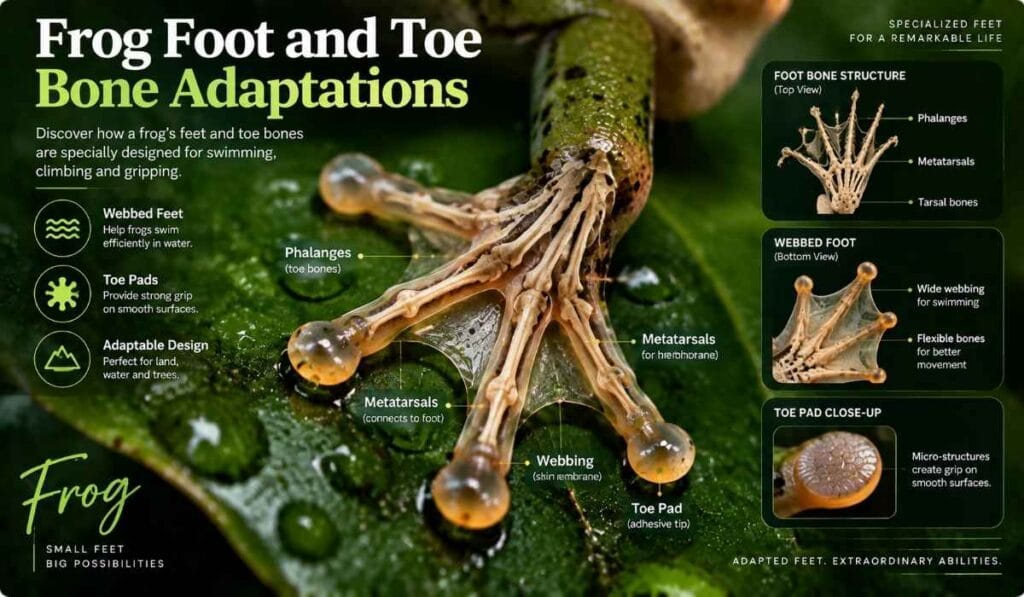
The frog foot and toe bone structure plays an important role in movement, balance, swimming, and climbing. Frogs have evolved specialized foot adaptations that allow them to survive in different habitats, from ponds and wetlands to forests and trees. The arrangement of their toe bones, ankle bones, and soft tissues helps them move efficiently on land and in water. Depending on the species, frog feet may be adapted for powerful jumping, underwater movement, or gripping surfaces. These specialized structures demonstrate how frog bones have evolved to match their environmental needs. Frog feet are specialized structures that help with swimming, climbing, and movement. Discover how different body features work together in our guide about structure of a frog.
Structure of Frog Feet and Toe Bones
A frog’s foot contains several important bone groups, including tarsal bones, metatarsals, and phalanges. These bones form the ankle, foot, and toes, working together to provide flexibility and movement control. The hind feet are larger and stronger than the front feet because they are mainly responsible for jumping and swimming. The elongated ankle bones increase the length of the leg, creating a longer lever that helps generate powerful movements. Most frogs have five toes on their hind feet and four fingers on their front limbs. The toe bones are flexible and allow frogs to adjust their grip, maintain balance, and control their direction during movement. In many species, the toes are connected by skin membranes called webbing, while tree-dwelling frogs may have specialized toe pads for climbing.
How Webbed Feet Help Frogs Swim
Webbed feet are one of the most important adaptations found in aquatic frogs. The thin layer of skin between the toes increases the surface area of the foot, allowing frogs to push against water more effectively. When a frog moves its hind legs backward during swimming, the webbed toes act like paddles. This creates greater force against the water and helps the frog move quickly and efficiently. Webbed feet also improve steering and balance while swimming. Aquatic frogs use this adaptation to escape predators, search for food, and move through ponds, lakes, and streams. The combination of strong leg bones and webbed feet makes frogs excellent swimmers despite their simple body design.
How Toe Pads Help Frogs Climb
Many tree frogs have specialized toe pads that allow them to climb vertical surfaces. These toe pads are supported by modified toe bones and contain structures that increase surface contact. The expanded shape of the toe pads helps frogs attach to leaves, tree bark, and smooth surfaces. Some species use these adaptations to move safely through forests and avoid predators. The flexible toe bones allow the pads to adjust to different surfaces, improving grip and stability. This combination of strong bones and specialized soft tissues gives climbing frogs excellent control in their environment.
Frog Pelvic Bone Structure and Movement
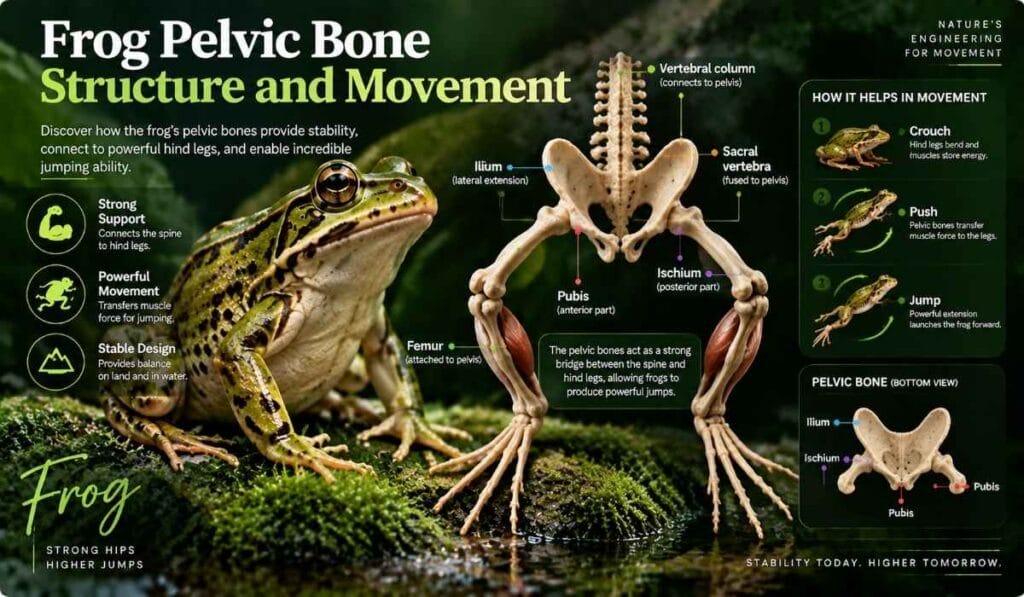
The frog pelvic structure is a highly specialized part of the skeleton that connects the powerful hind limbs with the backbone. It plays a major role in jumping, balance, and body support. Because frogs depend heavily on their hind legs for movement, their pelvic bones have evolved to transfer large amounts of force efficiently while maintaining stability. The pelvic bones connect with other important systems that control movement and body balance. Learn more about the complete biological systems in frogs through frog organ systems.
Anatomy of Frog Pelvic Girdle
The frog pelvic girdle consists mainly of three paired bones: the ilium, ischium, and pubis. These bones form a strong structure that connects the hind limbs to the vertebral column. The long ilium extends forward and connects with the backbone, creating a stable link between the body and the legs. This arrangement allows muscles attached to the pelvis to generate powerful movements. The pelvic girdle also connects with the femur, forming the hip joint. This connection allows frogs to move their hind legs effectively during jumping, swimming, and landing. A unique feature of the frog pelvis is its connection with the urostyle, which strengthens the rear part of the body and provides additional support during movement.
How Pelvic Bones Transfer Jumping Force
The pelvic bones act as a bridge between the body muscles and the powerful hind limbs. When a frog prepares to jump, muscles attached to the pelvis contract and create force. This force travels through the pelvic structure into the femur, tibiofibula, and foot bones. The strong connection between these bones allows energy to transfer efficiently, producing a powerful leap. During landing, the pelvis helps absorb and distribute impact forces, reducing stress on the spine and limbs. This ability is essential because frogs repeatedly perform high-energy jumps throughout their lives.
Why Frog Hips Are Specially Adapted
Frog hips are specially adapted because they support one of the most demanding movements in nature: explosive jumping. Unlike human hips, which are designed mainly for walking and standing, frog hips are built for rapid force generation. The elongated pelvic structure, strong connections, and lightweight design allow frogs to achieve impressive jumping ability while maintaining balance. The frog hip system also supports movement in different environments. Whether jumping on land, swimming in water, or climbing vegetation, the pelvic bones provide the stability and power needed for survival. These unique adaptations make the frog pelvic structure an excellent example of how evolution can modify bones to create highly efficient movement systems.
How Frog Bones Develop During Growth

The development of frog bones is a remarkable biological process that transforms a soft-bodied aquatic tadpole into a strong, land-adapted adult frog. Unlike mammals, frogs experience major skeletal changes during their life cycle. Their bones gradually form, strengthen, and become specialized for jumping, swimming, and surviving in different environments. The frog skeleton changes dramatically during growth because each life stage requires a different body structure. Tadpoles need a flexible body for swimming, while adult frogs need strong limbs and a stable skeleton for movement on land. During growth and metamorphosis, frogs experience major changes in their body structures and organs. Explore the complete list of internal organs of a frog and their functions.
Bone Formation From Tadpole to Adult Frog
A frog begins life as a tadpole with a simple skeletal structure. At this stage, most of the body is supported by cartilage rather than fully developed bones. The tadpole’s body is designed mainly for swimming, with a long tail and no functional limbs. As the tadpole grows, a process called ossification begins. During ossification, cartilage gradually changes into harder bone tissue. The skull, backbone, and limb structures slowly develop and become stronger. The hind limbs usually appear first, followed by the forelimbs. As the legs grow, the skeleton becomes more suitable for movement outside water. The development of strong leg bones, pelvic structures, and foot bones prepares the frog for jumping and walking. The transformation from cartilage-based support to a stronger bony skeleton allows frogs to successfully transition from an aquatic lifestyle to life on land.
Skeletal Changes During Metamorphosis
Metamorphosis is the stage when a tadpole transforms into an adult frog, and it involves major skeletal changes. During this period, the body structure is completely reorganized. One of the biggest changes is the development of powerful hind limbs. The femur, tibiofibula, ankle bones, and toe bones become stronger, creating the jumping system found in adult frogs. The tail, which helps tadpoles swim, gradually disappears. The nutrients from the shrinking tail are reused by the body during development. The skull also changes significantly. Tadpole skulls are adapted for aquatic feeding, while adult frog skulls become lighter and better suited for catching insects. The backbone becomes shorter and stronger, and the urostyle develops to support powerful jumping movements. These skeletal changes allow frogs to survive both in water and on land.
Factors That Influence Frog Bone Development
Several factors influence how quickly and successfully frog bones develop. Nutrition plays an important role because frogs require minerals such as calcium and phosphorus to build strong bones. Environmental conditions, including temperature, water quality, and habitat availability, can also affect skeletal growth. Tadpoles living in suitable environments usually develop healthier bones and stronger bodies. Genetics also determines differences in bone structure between frog species. Some species develop longer limbs for jumping, while others develop specialized feet for climbing or swimming. Hormones are another important factor during metamorphosis. Chemical signals in the body control the development of limbs, skull changes, and other skeletal transformations. Together, these factors shape the final structure of the adult frog skeleton.
Frog Bone Adaptations for Different Environments

Frogs live in many different habitats, including forests, rivers, wetlands, and grasslands. Their skeletal systems have developed unique adaptations that help them survive in these environments. Although all frogs share a similar basic bone structure, different species have modified bones suited to their lifestyle. Frog adaptations involve not only bones but also their complete body systems. Learn how different organs work together in our article about frog organ systems.
Bone Adaptations in Tree Frogs
Tree frogs have specialized skeletal features that help them climb and move through vegetation. Their bones are generally lightweight, allowing them to remain agile while jumping between branches. Their toe bones are especially adapted for climbing. Many tree frogs have expanded toe structures that support sticky toe pads, allowing them to grip smooth surfaces such as leaves and tree bark. Their flexible joints and lightweight limbs help them make accurate jumps and maintain balance at high positions. The pelvic structure provides stability while moving across uneven surfaces. These adaptations allow tree frogs to survive in forest environments where climbing ability is essential.
Bone Adaptations in Aquatic Frogs
Aquatic frogs have skeletal adaptations that improve swimming efficiency. Their hind limbs are often long and powerful, providing the force needed to move through water. Their foot bones and toes may be extended, and many species have webbed feet. The webbing increases the surface area of the feet, allowing frogs to push against water like paddles. The lightweight skeleton reduces energy use during swimming, while strong pelvic connections allow repeated powerful kicks. These adaptations help aquatic frogs escape predators, find food, and move efficiently in ponds, lakes, and streams.
Bone Adaptations in Ground Frogs
Ground frogs have skeletal structures adapted for movement across soil, grass, and forest floors. Their bones are often designed for strong jumping, walking, and quick escapes. Their hind limb bones provide powerful force for jumping away from predators. Strong pelvic bones and a stable backbone help them move effectively on uneven ground. Some ground frogs also have specialized limb structures that help them dig into soil for shelter. These adaptations allow them to survive in environments where hiding and quick movement are important.
Frog Bone Structure Compared With Other Animals

Frog bones provide an excellent example of how evolution creates specialized body structures. While frogs share basic skeletal features with other vertebrates, their bones have developed unique adaptations for their amphibious lifestyle. Comparing frog bones with other animals becomes easier when we understand the complete frog body structure. Explore more through our guide on frog organs labeled with diagrams.
Frog Bones Compared With Human Bones
Frogs and humans both have vertebrate skeletons containing a skull, backbone, limbs, and joints. However, their bones are adapted for very different movements. Humans have around 206 bones designed for upright posture, walking, running, and precise hand movements. Frogs have fewer bones and a lighter skeleton designed mainly for jumping and swimming. The frog skeleton contains specialized features such as the urostyle, elongated hind limbs, and reduced ribs. These structures help frogs create powerful movements while maintaining a lightweight body. Human legs support continuous movement, while frog legs are specialized for sudden bursts of force.
Frog Bones Compared With Reptile Bones
Frogs and reptiles are both vertebrates, but their skeletons show important differences. Reptiles usually have stronger rib systems and longer backbones designed for crawling and supporting body weight. Frogs have a lighter skeleton with fewer ribs and specialized hind limbs. Their bones are adapted for jumping rather than continuous crawling. The frog pelvis and urostyle create a unique connection between the spine and hind legs, allowing powerful leaps that are not common in reptiles.
What Makes Frog Bones Evolutionarily Unique
Frog bones are evolutionarily unique because they represent a balance between strength, flexibility, and lightweight design. Their skeleton has been shaped over millions of years to support an amphibious lifestyle. Features such as powerful hind limbs, a fused urostyle, lightweight skull, and specialized feet allow frogs to survive in diverse habitats. The frog skeleton demonstrates how evolution can modify existing structures to create highly efficient movement systems. From swimming in water to jumping on land and climbing trees, frog bones provide the perfect example of adaptation and survival through specialized anatomy.
Frogs Skeleton Explained: Most Important FAQs People Search For

Readers interested in frog skeletons also want to understand their complete anatomy, organs, and body functions. Continue exploring with our detailed frog anatomy guide.
How Many Bones Does a Frog Have?
The number of bones in a frog varies depending on the species, but most adult frogs have around 50–70 bones in their skeleton. This is much fewer than humans, who have 206 bones. The reduced number of bones helps frogs maintain a lightweight body structure that is ideal for jumping, swimming, and quick movement. A frog’s skeleton contains several important bone groups, including the skull, backbone, forelimbs, hind limbs, pelvis, and specialized bones such as the urostyle. Each bone has a specific role in supporting movement and protecting the body. The exact bone count can differ because different frog species have evolved unique skeletal structures depending on their habitat and lifestyle.
Why Are Frog Bones Lightweight but Strong?
Frog bones are designed to provide strength without adding unnecessary weight. A lightweight skeleton allows frogs to move quickly and use less energy while jumping or swimming. Although frog bones are relatively light, they are strong enough to support powerful muscles and repeated impacts during landing. The structure of their bones balances flexibility and durability, helping frogs survive in different environments. This special bone design is one reason frogs are excellent jumpers and successful amphibians.
Do Frogs Have Ribs?
Most frogs do not have true ribs like humans and many other animals. Instead, frogs have a simplified body structure with a flexible backbone and fewer chest bones. The absence of a traditional rib cage allows frogs to maintain a flexible body that is useful for jumping and swimming. However, this means their internal organs are not protected by ribs in the same way as mammals. This unique feature is an evolutionary adaptation that helps frogs maintain a lightweight and flexible body.
What Are the Main Parts of a Frog Skeleton?
A frog skeleton is divided into several major sections that work together to support movement and survival. The main parts include:
- Skull: Protects the brain and supports feeding structures.
- Vertebral column: Provides body support and flexibility.
- Forelimbs: Help with balance and landing.
- Hind limbs: Provide powerful jumping ability.
- Pelvic structure: Connects the legs to the body.
- Urostyle: A special bone that strengthens the lower spine.
Each part of the skeleton has adapted to help frogs survive both on land and in water.
Why Do Frogs Have Such Powerful Hind Legs?
Frogs have powerful hind legs because their skeleton is specially adapted for jumping. The long hind limbs contain strong bones such as the femur, tibiofibula, and elongated ankle bones. These bones work together with powerful muscles to create explosive movements. When a frog jumps, energy stored in its muscles and joints is released quickly, allowing it to travel many times its body length. This adaptation helps frogs escape predators, catch prey, and move efficiently through their environment.
What Is the Urostyle Bone in Frogs?
The urostyle is a unique rod-shaped bone located at the end of a frog’s backbone. It is one of the most important skeletal features that makes frogs different from many other animals. The urostyle connects the spine with the pelvic region and helps transfer force from the powerful hind legs during jumping. It also provides stability when frogs land after a jump. This specialized bone is a major adaptation that improves frog movement and balance.
How Does a Frog Skeleton Help It Swim and Climb?
A frog’s skeleton is adapted for multiple types of movement, including swimming and climbing. During swimming, the flexible body structure and strong hind limbs allow frogs to push against water efficiently. Their webbed feet increase surface area and improve movement through water. For climbing, many frogs have specialized toe structures and flexible joints that help them grip leaves, branches, and smooth surfaces. The combination of strong bones, flexible joints, and specialized feet allows frogs to survive in different habitats.
How Is a Frog Skeleton Different From a Human Skeleton?
Frog and human skeletons share some similarities because both are vertebrates, but their structures are adapted for different lifestyles. Humans have a skeleton designed for walking upright, using hands, and performing complex movements. Frogs have a lighter skeleton designed mainly for jumping, swimming, and quick movement. Important differences include:
- Frogs have powerful elongated hind limbs.
- Frogs have a urostyle bone instead of a tail.
- Humans have a protective rib cage, while most frogs do not.
- Frog bones are arranged for flexibility and rapid movement.
How Does a Frog Skeleton Change From Tadpole to Adult?
A frog’s skeleton changes dramatically during metamorphosis. Tadpoles begin life with structures designed for aquatic movement, including a tail and different body proportions. As they develop into adults:
- Hind legs begin forming.
- Forelimbs develop.
- The tail disappears.
- Bones become stronger.
- The skull changes shape.
These skeletal changes transform a swimming tadpole into a frog capable of living on land.
Why Is Studying Frog Skeletons Important?
Scientists study frog skeletons to understand evolution, movement, and animal adaptation. Frog bones provide valuable information about how animals develop specialized structures for survival. Research on frog skeletons helps scientists understand:
- How jumping evolved
- How animals adapt to different habitats
- How bones and muscles work together
- How amphibians changed through evolution
Final Thoughts: Understanding the Amazing Frog Bone Structure
The frog skeleton is a remarkable example of how nature designs structures perfectly suited for survival. Although frogs have a lightweight body and fewer bones compared to many other vertebrates, their skeletal system is highly specialized for movement, flexibility, and adaptation. From the powerful hind limb bones that create incredible jumps to the flexible spine and unique urostyle bone that provides stability, every part of a frog’s skeleton has an important role. Their skull structure, pelvic bones, and specialized feet show how evolution has shaped frogs for life in both aquatic and terrestrial environments. Studying frog bone structure helps us understand more than just anatomy. It reveals how animals adapt to their surroundings, how movement evolves, and how different body designs help species survive. The relationship between bones, muscles, and habitat demonstrates the incredible complexity of nature. Whether jumping across land, swimming through water, or climbing plants, frogs rely on a carefully evolved skeletal system that allows them to perform extraordinary movements. The frog skeleton is not simply a collection of bones—it is a masterpiece of biological engineering that reflects millions of years of evolution and adaptation.
relared guids
- Frog Organs Labeled: A Complete Guide With Diagram
- Parts of a Frog: Anatomy, Structure, and Functions Explained
- Frog Body Parts: Complete Guide to External and Internal Parts
- Structure of a Frog: External and Internal Features Explained
- Frog Organ Systems: How the Frog Body Works
- Internal Frog Anatomy: Understanding the Hidden Parts of a Frog
- Internal Organs of a Frog: Complete List and Their Functions
- Internal Anatomy of a Frog: Organs and Body Systems Explained
- Frog Anatomy Diagram: A Complete Labeled Guide to Frog Structure
- Frog Anatomy: Complete Guide to Frog Body Parts and Internal Organs
- Digestive System of a Frog: Organs, Functions, and Process Explained
- Digestive Organs of a Frog: Complete Guide to Frog Digestion
- Digestive Parts of Frog: Structure and Functions Explained
- Small Intestine Function in Frogs: Role in Digestion Explained