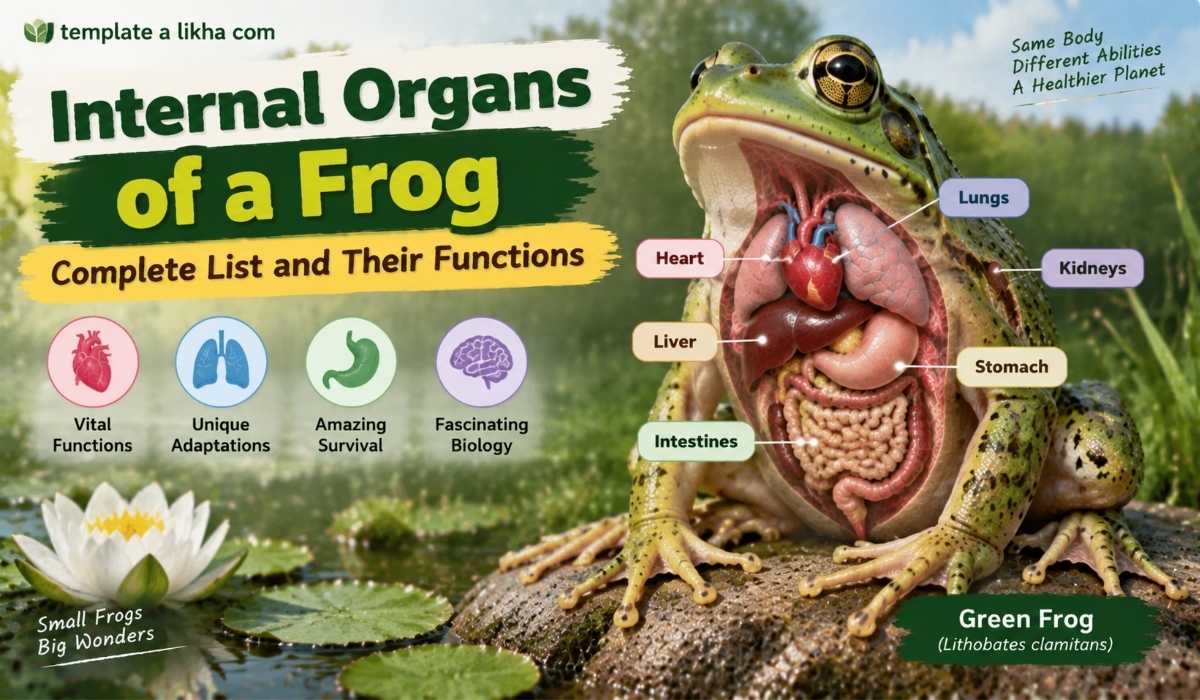
Frogs have a fascinating internal body structure that helps them survive both in water and on land. This complete guide to frog organs labeled with a diagram explains the major internal organs of a frog and their important functions in a simple and scientific way. From the heart, lungs, and digestive system to the kidneys, liver, reproductive organs, and nervous system, each organ plays a vital role in maintaining the frog’s life. A labeled frog organ diagram makes it easier to understand the position and connection of different body parts inside the frog. Whether you are a student, teacher, biology enthusiast, or someone curious about amphibian anatomy, this guide provides a clear overview of frog internal anatomy. You will learn how frogs digest food, breathe through lungs and skin, circulate blood using a three-chambered heart, remove waste through the kidneys, and reproduce through specialized organs. The article also explains how these organs are adapted for amphibious life, allowing frogs to function efficiently in aquatic and terrestrial environments.
Frog Heart: How the Frog Circulatory System Works

The frog circulatory system is a specialized system that transports oxygen, nutrients, hormones, and waste products throughout the body. Unlike mammals, frogs have a unique three-chambered heart that allows them to survive both in aquatic and terrestrial environments. The heart works together with blood vessels, lungs, and skin to maintain efficient circulation and oxygen supply. A frog’s heart is specially adapted to support life in both water and on land. The three-chambered heart helps circulate oxygen and nutrients throughout the body. To understand the complete structure of frog organs, explore our detailed frog anatomy diagram guide.
Frog Heart Structure and Blood Flow Explained
A frog’s heart is located in the upper part of the body cavity, protected by a thin membrane called the pericardium. The frog heart has three main chambers: two atria (right and left atrium) and one ventricle. The right atrium receives oxygen-poor blood from the body through large veins called the venae cavae. This blood then moves into the ventricle. The left atrium receives oxygen-rich blood from the lungs and skin through pulmonary veins. Both atria empty into the single muscular ventricle, where some mixing of oxygenated and deoxygenated blood occurs. From the ventricle, blood is pumped into the conus arteriosus, a special vessel that directs blood to different parts of the body. The spiral valve inside the conus arteriosus helps reduce excessive mixing and guides oxygen-rich blood toward the body while sending oxygen-poor blood toward the lungs and skin.
Why Does a Frog Have a Three-Chambered Heart?
Frogs have a three-chambered heart because their lifestyle does not require the same level of oxygen delivery as mammals. Since frogs can absorb oxygen through their moist skin as well as their lungs, their circulation system can function effectively with some mixing of blood. The single ventricle allows frogs to maintain a balance between pulmonary circulation (heart to lungs/skin) and systemic circulation (heart to body). This structure is an evolutionary adaptation that supports amphibians living between aquatic and terrestrial environments.
How Frog Blood Circulation Differs From Humans
The major difference between frog and human circulation is the number of heart chambers. Humans have a four-chambered heart with two atria and two ventricles, which completely separates oxygen-rich and oxygen-poor blood. This allows humans to deliver highly oxygenated blood efficiently for high-energy activities. Frogs, however, have a three-chambered heart where oxygenated and deoxygenated blood partially mix in the ventricle. Their circulation is less efficient than humans but is suitable for their slower metabolism and amphibious lifestyle. Another difference is that frogs can exchange gases through their skin, while humans depend mainly on their lungs. This unique ability helps frogs maintain oxygen supply when underwater or during periods of reduced activity.
Frog Lungs and Skin Breathing: The Science Behind Respiration
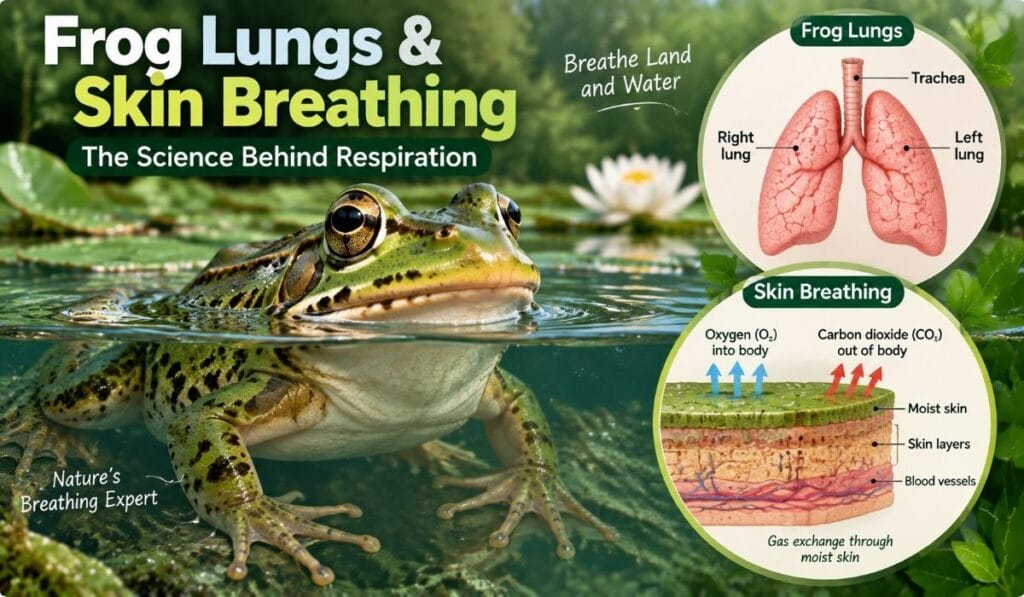
Frogs have one of the most interesting respiratory systems among vertebrates because they can breathe through both their lungs and skin. Unlike humans, who depend almost entirely on lungs for oxygen exchange, frogs use multiple methods of respiration depending on their environment, activity level, and life stage. This flexible breathing system allows frogs to survive in water, on land, and during periods of low oxygen availability. Adult frogs mainly use their lungs when they are active on land. However, their moist skin also plays a major role in absorbing oxygen directly from the surrounding environment. This combination of lung and skin respiration is one of the key adaptations that helps frogs live successfully as amphibians. Frogs use both their lungs and skin to exchange gases, which allows them to survive in different environments. Their unique breathing ability is explained in detail in our guide on how frogs breathe underwater.
How Frogs Breathe Through Their Skin
The process of breathing through the skin is called cutaneous respiration. A frog’s skin is thin, moist, and filled with many tiny blood vessels called capillaries. Oxygen from the surrounding water or air dissolves in the moisture on the skin surface and then moves through the skin into the bloodstream by diffusion. At the same time, carbon dioxide produced by body cells moves from the blood back through the skin and leaves the body. Because the skin must remain moist for efficient gas exchange, frogs often live in damp environments and produce mucus that keeps their skin wet. Skin breathing is especially important when frogs are resting, hiding, or underwater. During these times, they may receive most of their oxygen through their skin rather than their lungs. Because the skin plays an important role in respiration,
Why Frogs Need Both Lungs and Skin for Breathing
Frogs use lungs and skin together because each method works better in different situations. Their lungs provide a rapid supply of oxygen when they are active, jumping, hunting, or moving on land. However, frog lungs are relatively simple compared with mammalian lungs and cannot provide all the oxygen needed alone. Skin respiration provides a continuous oxygen supply even when frogs are underwater or inactive. This ability reduces the need to frequently come to the surface for air and helps frogs conserve energy. The combination of these two respiratory methods is an evolutionary adaptation that allows frogs to survive in changing environments, from dry land to freshwater habitats.
How Frogs Survive Underwater Without Normal Breathing
Frogs cannot breathe underwater using lungs like fish use gills, but many species can remain underwater for long periods by relying on their skin. Oxygen dissolved in water passes through their moist skin and enters their bloodstream. During winter or periods of inactivity, frogs slow their metabolism, reducing their oxygen requirements. Some aquatic frogs can stay submerged for hours or even longer because their bodies require less oxygen during these low-energy states. However, the ability to breathe underwater depends on factors such as water temperature, oxygen level, frog species, and activity. Warmer water with low oxygen levels makes survival more difficult. This unique respiratory system shows how frogs are specially adapted for life between two worlds—water and land. Their ability to breathe through both lungs and skin is one of the most remarkable features of amphibian biology.
Frog Digestive System: How Frogs Process Food

The frog digestive system is specially adapted for a carnivorous lifestyle, allowing frogs to capture, swallow, and digest a wide variety of small animals. Unlike humans and many other animals, frogs do not chew their food before swallowing. Instead, they rely on their sticky tongue, powerful jaws, and specialized digestive organs to process prey efficiently. The digestive system of a frog includes the mouth, esophagus, stomach, small intestine, large intestine, rectum, and cloaca. Additional organs such as the liver, gallbladder, and pancreas produce important substances that help break down food and absorb nutrients. This system provides frogs with the energy needed for movement, growth, and survival. The frog digestive system is designed to process insects and other small animals efficiently. Frogs swallow their prey whole, and their digestive organs break down food for energy. Learn more about frog feeding behavior in our what frogs eat and feeding habits guide.
How a Frog Eats and Swallows Prey
Frogs are opportunistic predators that mainly eat insects, worms, spiders, small fish, and other small animals. When a frog detects prey, it quickly extends its long, sticky tongue to capture it. The tongue is attached near the front of the mouth, allowing it to flip outward rapidly and pull prey back inside. Once the prey enters the mouth, the frog uses its small teeth mainly for gripping rather than chewing. The food is pushed toward the throat and swallowed through the esophagus into the stomach. Frogs often use their eyes to help swallow. When a frog closes its eyes during swallowing, the eyeballs move downward and push against the roof of the mouth, helping force food into the throat.
Why Frogs Swallow Food Without Chewing
Frogs do not chew because their teeth are not designed for grinding food. Their tiny upper jaw teeth and vomerine teeth mainly help hold prey securely so it cannot escape. Since most frog prey items are small and soft, breaking food into smaller pieces is unnecessary. Instead of mechanical digestion through chewing, frogs depend on powerful digestive enzymes and stomach acids to break down their prey. This method allows frogs to consume food quickly, which is important because they often hunt moving prey that can escape if they delay. The ability to swallow prey whole is also an adaptation that helps frogs survive with minimal energy expenditure.
The Role of Frog Stomach and Intestines in Digestion
The stomach is the first major site of digestion in frogs. After food enters the stomach, strong acids and enzymes begin breaking down proteins and other nutrients. The stomach temporarily stores food and prepares it for further digestion. Partially digested food then moves into the small intestine, where most nutrient absorption occurs. The pancreas releases digestive enzymes, while the liver produces bile that helps digest fats. Nutrients are absorbed through the intestinal walls and transported into the bloodstream. The remaining waste passes into the large intestine, where water is absorbed. Finally, waste materials leave the body through the cloaca, a common chamber used for digestive, urinary, and reproductive functions. This efficient digestive system allows frogs to transform various types of prey into energy while supporting their active predatory lifestyle.
Frog Brain and Nervous System: How Frogs Respond Quickly

The frog brain and nervous system control every important activity, from movement and hunting to detecting danger and escaping predators. Although a frog’s brain is much smaller and simpler compared with mammals, it is highly specialized for survival in its environment. The nervous system allows frogs to quickly respond to changes around them, making them efficient hunters and skilled survivors. A frog’s nervous system includes the brain, spinal cord, and peripheral nerves that connect to muscles and sensory organs. These structures work together to control body movements, process information from the environment, and coordinate rapid responses. The frog brain controls movement, hunting, and responses to danger. Its nervous system allows frogs to quickly detect prey and escape predators. The relationship between different organs can be better understood through our internal anatomy of a frog guide.
Frog Brain Functions Explained
The frog brain is divided into several major regions, including the forebrain, midbrain, and hindbrain. Each part performs specific functions necessary for survival. The forebrain controls behaviors such as smell detection, feeding responses, and basic decision-making. Frogs rely heavily on their sense of smell and visual information to identify prey and recognize their surroundings. The midbrain contains the optic lobes, which are responsible for processing visual signals. Since frogs depend greatly on vision for hunting, this region is highly developed compared with other brain areas. The hindbrain controls essential body functions such as balance, breathing, heart activity, and muscle coordination. The cerebellum in the hindbrain helps frogs perform precise movements, including jumping and swimming. The spinal cord carries messages between the brain and the rest of the body, allowing frogs to react quickly to environmental changes.
How Frogs Detect Movement and Catch Prey
Frogs are excellent at detecting movement because their eyes are specially adapted for spotting moving objects. Their large, bulging eyes provide a wide field of vision and allow them to notice even small movements of insects or other prey. When a frog detects movement, visual signals travel from the eyes to the brain, which quickly processes the information and sends signals to the muscles. This rapid response allows the frog to extend its sticky tongue and capture prey within fractions of a second. Frogs are especially sensitive to moving targets because their visual system is designed to recognize motion rather than stationary objects. This explains why a frog may ignore an insect that remains still but immediately react when it starts moving.
How Frog Senses Help Them Avoid Predators
Frogs use multiple senses to detect and escape threats. Their eyesight helps them identify approaching predators such as birds, snakes, and mammals. Their hearing system allows them to detect warning sounds and communicate with other frogs through calls. Their skin also contains sensory receptors that detect changes in temperature, moisture, and pressure. These signals help frogs choose safe habitats and avoid harmful conditions. When danger is detected, the frog’s nervous system triggers a rapid escape response. Powerful leg muscles receive signals from the brain and spinal cord, allowing the frog to jump away quickly or hide in vegetation or water. This combination of a specialized brain, sharp senses, and fast reflexes makes frogs highly effective survivors in complex ecosystems.
Frog Skin: The Unique Organ That Keeps Frogs Alive
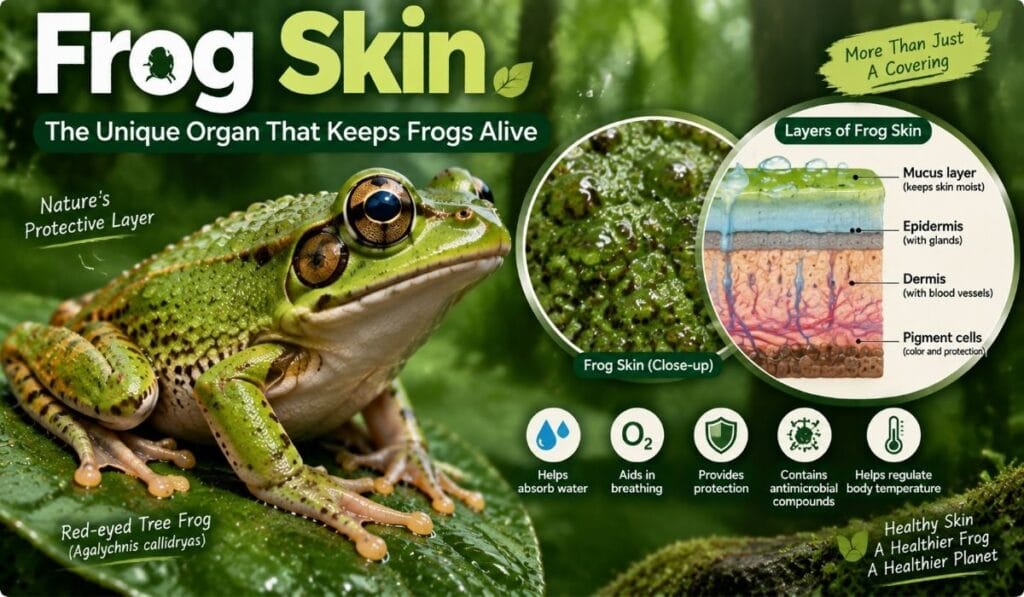
Frog skin is one of the most important and unique organs in amphibian biology. Unlike humans and many other animals, frogs depend on their skin for several essential functions, including breathing, absorbing water, regulating body temperature, and protecting themselves from predators. A frog’s skin is thin, sensitive, and specially adapted to support life both in water and on land. The skin contains numerous blood vessels, mucus glands, and specialized cells that allow frogs to exchange gases and maintain hydration. Because frogs do not drink water like humans, their skin plays a major role in absorbing and balancing water inside their bodies. Frog skin is not just a protective covering; it is also an important respiratory organ. It helps frogs breathe, absorb water, and survive in moist environments. Learn more about this unique adaptation in our article about why frogs shed their skin.
Why Frog Skin Must Stay Moist
A frog’s skin must remain moist because it is essential for cutaneous respiration, or breathing through the skin. Oxygen from the surrounding air or water dissolves in the moisture layer on the skin surface and passes into tiny blood vessels underneath. At the same time, carbon dioxide moves out of the bloodstream through the skin. If a frog’s skin becomes dry, gas exchange becomes less effective, making it difficult for the frog to obtain enough oxygen. Dry skin can also cause dehydration because frogs lose water easily through their thin body covering. To prevent drying, frogs produce mucus from special glands in their skin. This mucus keeps the skin moist, improves oxygen absorption, and protects the skin from damage.
How Frogs Absorb Water Through Their Skin
Frogs do not usually drink water by mouth. Instead, they absorb water directly through their skin using a specialized area called the pelvic patch, located on the underside of their body near the hind legs. When a frog sits in water or on wet surfaces, water moves through the skin by a process called osmosis. The skin allows water molecules to enter the body while helping maintain the frog’s internal water balance. This ability is especially important because frogs are highly vulnerable to dehydration. Their skin allows them to quickly restore lost water after exposure to dry conditions.
How Frog Skin Helps With Defense and Survival
Frog skin provides several protective adaptations that help frogs survive in the wild. Many frog species have skin colors and patterns that act as camouflage, allowing them to blend into leaves, soil, water, and vegetation. This makes it harder for predators to detect them. Some frogs also have specialized skin glands that produce harmful or unpleasant chemicals. These toxins can discourage predators from eating them. Poison dart frogs, for example, are known for powerful skin toxins that provide protection against threats. Frog skin also helps regulate body temperature because frogs are ectothermic animals that depend on external conditions to control their heat. By adjusting their location and using their skin, frogs can maintain suitable body conditions. From breathing and hydration to defense and camouflage, frog skin is a remarkable survival organ that allows frogs to thrive in diverse environments.
Frog Eyes and Vision: How Frogs See Their Environment

Frogs have highly specialized eyes that help them detect prey, recognize their surroundings, and escape predators. Their vision is adapted for survival in both aquatic and terrestrial environments. Although frogs do not see exactly like humans, their eyes are excellent at detecting movement and working in different lighting conditions. Frog eyes are specially designed to detect movement and help them capture prey. Their unique vision system is one of the many adaptations that make frogs successful amphibians. Explore more about frog body structures in our frog anatomy: complete guide to external and internal parts.
Frog Eye Structure and Function
A frog’s eye has several important structures, including the cornea, lens, retina, iris, and optic nerve. The large, rounded eyes are positioned on the top and sides of the head, giving frogs a wide field of view. This allows them to observe their surroundings while keeping most of their body hidden. The cornea and lens focus light onto the retina, where specialized photoreceptor cells detect visual information. The retina contains rod cells, which help frogs see in low-light conditions, and cone cells, which detect colors and details. Frogs have a protective transparent eyelid called the nictitating membrane. This thin layer covers the eye underwater, protects the eye from injury, and helps frogs see while swimming. Their eyes are especially sensitive to movement. A frog may ignore a stationary object but quickly react when it moves because its visual system is designed to detect motion. This ability is extremely useful when hunting insects and avoiding predators.
Can Frogs See Colors?
Yes, many frogs can see colors. Their eyes contain cone cells that allow them to detect different wavelengths of light. However, frog color vision varies between species and depends on their habitat and lifestyle. Many frogs can see colors in the visible light spectrum, and some species can even detect ultraviolet (UV) light. This ability may help them identify prey, recognize mates, and navigate their environment. Frogs that are active during the day usually have better color vision because they rely more on visual signals. Nocturnal frogs often depend more on rod cells, which provide better vision in dim conditions but less color detail.
Why Frogs Close Their Eyes When Eating
One of the most interesting frog behaviors is closing their eyes while swallowing food. This happens because a frog’s eyes help push food down its throat. When a frog catches prey with its sticky tongue, it pulls the food into its mouth. As the frog swallows, the eyeballs move downward into the mouth cavity and apply pressure against the food, helping push it toward the esophagus. Closing the eyes also protects them during feeding because struggling prey may damage the sensitive eye surface. This unique swallowing mechanism shows how different frog body systems work together for survival.
Frog Ear and Hearing System: How Frogs Detect Sound

Frogs have a highly developed hearing system that allows them to communicate, find mates, detect predators, and respond to environmental sounds. Although frogs do not have external ears like humans, their hearing organs are specially adapted for life in water and on land. Although frogs do not have visible external ears like humans, they have a specialized hearing system that helps them communicate and detect danger. Learn how frog hearing works in our detailed guide: do frogs have ears.
Do Frogs Have Ears?
Yes, frogs have ears, but they do not have visible outer ear structures. Instead of external ears, frogs have a circular membrane on each side of the head called the tympanum, which functions similarly to the human eardrum. The tympanum is usually located behind the eye and can often be seen as a round patch of skin. It captures sound vibrations from the environment and transfers them to the inner ear. Frogs also have internal ear structures that help them maintain balance and detect vibrations. Their hearing system allows them to hear sounds both above and below the water surface.
How Frog Tympanum Helps Them Hear
The tympanum is the key part of a frog’s hearing system. When sound waves reach the tympanum, it vibrates and transfers these vibrations through small bones to the inner ear. The inner ear converts these vibrations into nerve signals, which travel to the brain for processing. This allows frogs to identify different sounds, including mating calls, predator movements, and environmental changes. Frogs are especially sensitive to low-frequency sounds, which are useful for communication. Many frog species can detect calls from other frogs over long distances, even in noisy environments.
Why Male Frogs Produce Loud Calls
Male frogs produce loud calls mainly to attract females and establish territory. During breeding seasons, males gather near ponds, streams, or wetlands and use a vocal sac to amplify their sounds. Each frog species has a unique call pattern. Females recognize males of their own species by listening to these specific sounds. A stronger and louder call often indicates a healthy male with good reproductive ability. Frog calls also help males warn competitors to stay away from their territory. These communication signals are essential for reproduction and maintaining frog populations.
Frog Kidney and Waste Removal System

The frog kidney is an essential organ responsible for removing waste products, maintaining water balance, and regulating the internal environment of the body. Because frogs live in both aquatic and terrestrial habitats, their kidneys are adapted to handle changing levels of water availability. Frog kidneys help remove waste and maintain proper water balance inside the body. This adaptation is essential because frogs live in environments where water availability constantly changes. A complete overview of frog internal organs is available in our internal anatomy of a frog guide.
How Frog Kidneys Remove Waste
Frogs have two kidneys located near the backbone in the posterior part of the body cavity. The kidneys filter the blood and remove nitrogen-containing waste products, mainly in the form of urea in adult frogs. Blood enters the kidneys through blood vessels, where specialized structures called nephrons filter waste and excess substances. Useful materials are reabsorbed back into the bloodstream, while waste products are converted into urine. The urine travels from the kidneys through tubes called ureters and is stored temporarily in the urinary bladder before being released through the cloaca.
How Frogs Control Water Balance
Maintaining water balance is extremely important for frogs because their thin skin allows water to easily enter and leave the body. In freshwater environments, frogs constantly absorb water through their skin. Their kidneys help remove excess water by producing dilute urine. This prevents their body fluids from becoming too diluted. On land, frogs face the opposite problem because they can lose water through their skin. Their kidneys conserve water by producing more concentrated urine. Hormonal regulation helps adjust kidney function according to environmental conditions. This ability allows frogs to survive in both wet and dry habitats.
Why Frogs Produce Large Amounts of Urine
Frogs often produce large amounts of urine because they absorb significant amounts of water through their skin, especially in freshwater environments. Their kidneys remove this excess water while maintaining the correct balance of salts and minerals. Producing large amounts of dilute urine helps freshwater frogs prevent water overload. It is a necessary adaptation for animals that live in environments where water constantly moves into their bodies. The frog urinary system works closely with the skin, kidneys, and bladder to maintain hydration and remove waste efficiently. This complex system allows frogs to survive successfully across a wide range of habitats.
Frog Reproductive Organs and Life Cycle Connection
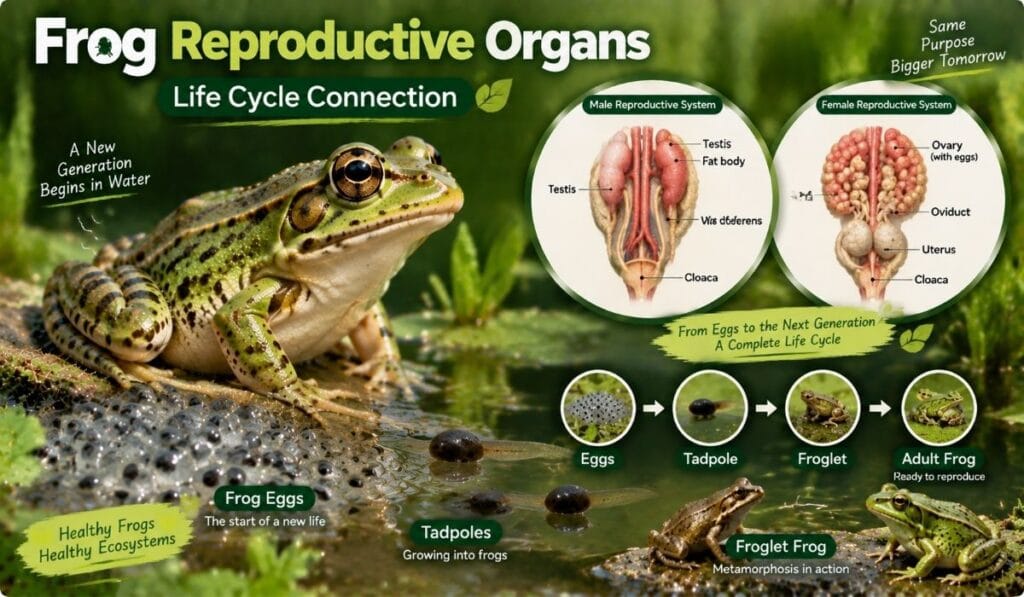
Frog reproductive organs are specially adapted to support reproduction in aquatic environments. Unlike mammals, frogs usually reproduce through external fertilization, where eggs and sperm combine outside the female’s body, generally in water. The reproductive system of frogs is closely connected with their unique life cycle, which includes a dramatic transformation from aquatic tadpole to land-dwelling adult. The reproductive organs of male and female frogs play essential roles in producing offspring and continuing the survival of their species. Understanding these organs also helps explain why frogs depend so strongly on freshwater habitats for reproduction. Frog reproductive organs play an important role in producing eggs and sperm during breeding seasons. After fertilization, frog eggs develop into tadpoles before becoming adult frogs. Learn about this transformation in our frog life cycle from egg to adult frog guide.
Male and Female Frog Reproductive Organs Explained
Male frogs have a pair of testes located near the kidneys inside the body cavity. The testes produce sperm cells, which are released through small tubes called vasa efferentia. These tubes connect to the kidneys and eventually transport sperm toward the cloaca. During the breeding season, male frogs develop behaviors that help them attract females. They produce loud mating calls using vocal sacs, and these calls help females identify suitable mates. Some male frogs also develop special structures called nuptial pads on their front limbs, which help them hold onto females during mating. Female frogs have a pair of ovaries that produce eggs. The ovaries contain thousands of immature eggs that develop and mature during the breeding season. When eggs are ready, they are released into the body cavity and pass through the oviducts. The oviducts produce a protective jelly-like coating around the eggs before they leave the body through the cloaca. During mating, the male frog grips the female in a position called amplexus. As the female releases eggs into the water, the male releases sperm over them, allowing fertilization to occur externally.
How Frog Eggs Develop Into Tadpoles
After fertilization, frog eggs begin a fascinating developmental process. A group of frog eggs is usually surrounded by a protective jelly layer that keeps them moist and provides some protection from predators. The first stage after fertilization is the embryo stage. The cells divide rapidly, forming a developing frog embryo inside the egg. Over time, the embryo develops into a tadpole. A newly hatched tadpole looks very different from an adult frog. It has:
- A long tail for swimming
- No legs
- Gills for breathing underwater
- A body adapted for aquatic life
As the tadpole grows, it undergoes metamorphosis, one of the most remarkable transformations in the animal world.
During metamorphosis:
- Hind legs develop first, followed by front legs
- Lungs develop and become functional
- Gills gradually disappear
- The tail is absorbed and used as an energy source
- The digestive system changes from a mostly plant-based diet to a carnivorous diet in many species
Eventually, the tadpole becomes a young frog capable of living on land while still depending on moist environments. This life cycle allows frogs to use different habitats during different stages of life. Tadpoles occupy aquatic environments, while adult frogs often live both on land and near water.
Why Frogs Reproduce in Water
Most frogs reproduce in water because their eggs lack a hard protective shell. Unlike bird eggs or reptile eggs, frog eggs are soft and require moisture to survive. Water provides several advantages for frog reproduction:
Protection from drying: The jelly coating around frog eggs can easily lose moisture on land. Water prevents dehydration and allows embryos to develop properly.
Suitable environment for tadpoles: Tadpoles are fully aquatic and depend on water for movement, feeding, and breathing through gills.
Easier fertilization: External fertilization works best in water because sperm can move through the surrounding environment and reach the eggs.
Temperature stability: Water environments usually provide more stable temperatures, helping developing embryos survive. Some frog species have evolved unusual reproductive strategies, including laying eggs on leaves above water or carrying eggs on their bodies. However, most frogs still depend on water because their early life stages require aquatic conditions.
Frog Muscles and Bones: The Secret Behind Powerful Jumps

Frogs are famous for their incredible jumping ability. Many species can jump several times their body length, allowing them to escape predators, capture prey, and move efficiently through their environment. This ability is the result of specialized muscles, strong bones, and unique skeletal adaptations. The frog’s body is designed like a natural spring, storing energy in its muscles and releasing it quickly to create powerful movement. Frogs are famous for their powerful jumps because of their strong hind legs and specialized skeleton. Their body structure allows them to move quickly and escape predators. Discover more about different frog adaptations in our guide to different types of frogs.
How Frog Legs Generate Powerful Force
The main source of a frog’s jumping power comes from its large and highly developed hind limb muscles. The muscles of the thighs, especially the gastrocnemius and other powerful extensor muscles, generate the force needed for jumping. Before jumping, a frog crouches down and stretches its muscles. This position stores elastic energy in the tendons and muscles. When the frog suddenly extends its legs, the stored energy is released rapidly, pushing the body forward and upward. The long hind legs act like powerful levers. Their extended length increases the distance over which force is applied, allowing frogs to achieve greater jumping distances. Frog muscles are also adapted for quick bursts of activity rather than long periods of endurance. This is why frogs can make explosive jumps but may become tired after repeated movements.
Frog Skeleton Adaptations for Jumping
The frog skeleton contains several adaptations that improve jumping efficiency. One major adaptation is the elongated hind limb bones. The femur, tibia, and fibula are modified to provide strong support and greater movement range. The lower leg bones are fused into a single strong structure called the tibiofibula, which provides stability during powerful jumps. The ankle bones are also elongated, forming a structure that increases leg length and improves jumping ability. The frog’s backbone is shortened and strengthened compared with many other animals. The pelvis is attached firmly to the spine, allowing force from the hind legs to transfer efficiently through the body. Frogs also have a lightweight skeleton, which reduces body weight and allows them to move through the air more easily.
Why Frogs Are Excellent Jumpers
Frogs are excellent jumpers because their entire body is adapted for rapid movement. Their combination of powerful muscles, flexible joints, strong bones, and lightweight body structure creates an efficient jumping system. Jumping provides several survival advantages:
- Escaping predators: Frogs can quickly jump away from snakes, birds, and mammals.
- Catching prey: Sudden movements help frogs capture insects and other small animals.
- Moving between habitats: Jumping allows frogs to travel between water sources and hiding places.
Some frog species have developed additional adaptations, such as webbed feet for swimming and expanded toe pads for climbing. These features allow frogs to survive in forests, wetlands, grasslands, and even urban environments.
How Frog Organs Work Together for Survival

A frog’s survival depends on the cooperation of all its internal organs and body systems. The heart, lungs, skin, brain, kidneys, digestive system, muscles, and reproductive organs do not work separately. Instead, they form an interconnected system that allows frogs to survive in changing environments. Frogs are successful amphibians because their organs are specially adapted for life both in water and on land. Every frog organ works together to maintain survival. The heart transports oxygen, the lungs and skin support breathing, and the brain controls body activities. To understand how these systems connect, explore our complete frog anatomy guide.
Coordination Between Heart, Lungs, Skin, and Brain
The frog heart, lungs, skin, and brain work together to maintain oxygen supply and body function. The lungs and skin perform respiration by bringing oxygen into the body and removing carbon dioxide. Oxygen-rich blood is then transported by the heart to different tissues. Although frogs have a three-chambered heart, their circulatory system efficiently supports their slower metabolism and amphibious lifestyle. The brain and nervous system coordinate these processes. The brain receives information from the environment and controls responses such as movement, breathing, hunting, and escaping danger.
For example, when a frog detects an insect moving nearby:
- The eyes detect movement.
- The brain processes the information.
- Nerve signals activate muscles.
- The tongue extends rapidly to capture prey.
- The digestive system processes the food for energy.
This shows how different organs cooperate during everyday survival activities.
How Internal Organs Help Frogs Live on Land and Water
Frogs are called amphibians because they live a life connected to both aquatic and terrestrial environments. Their organs contain adaptations that allow them to handle both conditions. The skin allows frogs to breathe and absorb water, which is especially useful underwater. The lungs provide additional oxygen when frogs are active on land. The kidneys regulate water balance by producing different amounts of urine depending on environmental conditions. This helps frogs prevent dehydration on land and avoid excess water absorption in freshwater habitats. The digestive system allows frogs to process various types of prey, providing energy for movement and reproduction. The reproductive system ensures that frogs can continue their life cycle, while the skeletal and muscular systems allow them to escape predators and search for food. Together, these adaptations allow frogs to survive in environments where many animals cannot.
Amazing Internal Adaptations of Frogs
Frogs possess many remarkable internal adaptations that make them highly successful amphibians.
Dual respiration: Frogs can breathe through both lungs and skin, allowing them to survive in different oxygen conditions.
Three-chambered heart: Their heart structure provides effective circulation while supporting a lower metabolic rate.
Efficient nervous system: Fast sensory responses help frogs detect prey and avoid predators.
Specialized digestive system: Their ability to swallow prey whole allows quick feeding and energy use.
Water-regulating kidneys: Their kidneys help maintain hydration in both wet and dry environments.
Powerful muscles and skeleton: Strong hind limbs allow rapid escape and movement.
Specialized reproductive system: External fertilization and aquatic egg development ensure successful reproduction. The frog is a perfect example of how anatomy and environment are connected. Every organ, from the smallest nerve to the powerful heart and muscles, contributes to survival. These adaptations allow frogs to thrive as one of the most fascinating groups of animals on Earth.
Frequently Asked Questions About Frog Organs (Frog Organs Labeled Guide)

Many readers have questions about frog organs, breathing, digestion, and reproduction. For a complete visual explanation of frog body structures, check our frog anatomy diagram.
What are the main organs of a frog?
A frog has many important internal organs that help it survive in both water and on land. The major organs include the heart, lungs, skin, brain, stomach, intestines, liver, kidneys, reproductive organs, and urinary bladder. Each organ performs a specific function. The heart circulates blood throughout the body, the lungs and skin help frogs breathe, the stomach and intestines digest food, the kidneys remove waste, and the brain controls body activities. These organs work together as a complete system to help frogs hunt, reproduce, avoid predators, and adapt to changing environments. A labeled frog organs diagram helps students and biology enthusiasts easily identify where each organ is located and understand its function.
How does a frog’s heart work?
A frog’s heart is a unique organ with three chambers: two atria and one ventricle. The right atrium receives oxygen-poor blood from the body, while the left atrium receives oxygen-rich blood from the lungs and skin. Both atria send blood into the single ventricle, where some mixing occurs. The ventricle then pumps blood to different parts of the body through major blood vessels. Although frogs do not have a four-chambered heart like humans, their circulatory system is suitable for their slower metabolism and amphibious lifestyle. The frog heart efficiently transports oxygen and nutrients while removing waste products from body tissues.
Can frogs breathe through their skin?
Yes, frogs can breathe through their skin through a process called cutaneous respiration. Their skin is thin, moist, and contains many small blood vessels that allow oxygen to pass directly into the bloodstream. When oxygen from the air or water reaches the skin surface, it dissolves in the moisture layer and moves into the blood. At the same time, carbon dioxide leaves the body through the skin. Skin breathing is especially important when frogs are underwater, resting, or inactive. This adaptation allows frogs to survive in environments where normal lung breathing is difficult.
Why do frogs have both lungs and skin for breathing?
Frogs use both lungs and skin because each method provides advantages in different situations. Their lungs help them obtain oxygen when they are active on land, such as jumping, hunting, or escaping predators. However, frog lungs are simpler than human lungs and cannot provide all the oxygen needed alone. Their skin provides an additional way to absorb oxygen, especially when they are underwater or resting. This combination of breathing methods is a special adaptation that allows frogs to live successfully in both aquatic and terrestrial environments.
How does the frog digestive system work?
The frog digestive system helps convert food into energy. Frogs are mostly carnivorous and eat insects, worms, spiders, small fish, and other small animals. Unlike humans, frogs do not chew their food. They use their long sticky tongue to catch prey and swallow it whole. Their small teeth only help hold prey and prevent it from escaping. Food passes through the mouth, esophagus, stomach, small intestine, large intestine, and cloaca. The stomach breaks down food using acids and enzymes, while the small intestine absorbs nutrients. The liver and pancreas produce substances that help digest fats, proteins, and carbohydrates.
Why do frogs close their eyes when eating?
Frogs close their eyes while swallowing food because their eyes help push food into the throat. When a frog catches prey, its eyeballs move downward into the mouth cavity and apply pressure on the food. This action helps move prey from the mouth toward the esophagus. It is a unique adaptation that makes swallowing easier, especially because frogs swallow food without chewing. Closing their eyes also protects their sensitive eyes from struggling prey during feeding.
How do frog kidneys remove waste?
The frog kidneys are responsible for filtering waste products from the blood and maintaining water balance. They remove nitrogen-containing waste, mainly in the form of urea, and produce urine. After filtration, urine travels through tubes called ureters and is stored in the urinary bladder before leaving the body through the cloaca. Frog kidneys are also important for survival because frogs live in environments where water availability changes. They can produce dilute urine in water-rich environments and conserve water when living on land.
How do frog organs help them survive on land and water?
Frogs are amphibians, meaning they can live both in water and on land. Their organs have special adaptations that support this lifestyle. Their skin allows underwater breathing and water absorption, while their lungs help them breathe on land. Their kidneys regulate body water levels, and their heart transports oxygen throughout the body. Their powerful muscles and skeleton allow them to jump away from predators, while their brain and senses help them find food and detect danger. The cooperation of all organs allows frogs to survive in ponds, forests, wetlands, and many other habitats.
How do frog reproductive organs work?
Frog reproductive organs help continue the species through reproduction. Male frogs have testes that produce sperm, while female frogs have ovaries that produce eggs. Most frogs reproduce through external fertilization. During mating, the male holds the female in a position called amplexus. The female releases eggs into the water, and the male releases sperm over them. The fertilized eggs develop into tadpoles, which later transform into adult frogs through metamorphosis. This life cycle is one of the most fascinating features of amphibians.
What makes frog anatomy different from human anatomy?
Frog anatomy differs from human anatomy in several important ways. Frogs have a three-chambered heart, while humans have a four-chambered heart. Frogs can breathe through their skin, but humans rely mainly on lungs. Frogs reproduce through external fertilization, while humans use internal fertilization. Frogs also undergo metamorphosis, changing from aquatic tadpoles into land-dwelling adults. These differences show how frog organs have evolved specifically for an amphibious lifestyle. Their unique anatomy allows them to survive in environments where many other animals cannot.
Final Thoughts: Frog Organs Labeled – A Complete Guide With Diagram
Understanding frog organs labeled with a diagram provides a clear view of how these fascinating amphibians survive and adapt to their surroundings. From the three-chambered heart that circulates blood to the lungs and skin that support respiration, every organ plays an essential role in maintaining a frog’s life. The frog’s digestive system helps process food efficiently, while the kidneys maintain water balance and remove waste. The brain and sensory organs allow frogs to detect movement, communicate, find prey, and avoid predators. Meanwhile, the reproductive organs support a unique life cycle that transforms a tiny aquatic tadpole into an adult frog capable of living on land.
A labeled frog organs diagram makes it easier to understand the position, structure, and function of each internal organ. Whether you are a student, researcher, teacher, or simply curious about animal biology, learning frog anatomy helps explain the incredible connection between body structure and survival. Frogs are excellent examples of evolutionary adaptation. Their ability to breathe through their skin, regulate water balance, reproduce in aquatic environments, and perform powerful jumps shows how perfectly their organs are designed for their lifestyle. By exploring frog internal anatomy, we gain a deeper appreciation of these remarkable amphibians and understand why protecting their habitats is important for maintaining biodiversity and healthy ecosystems
Related Guides: Frog Organs Labeled – A Complete Guide With Diagram
- Frog Anatomy: Complete Guide to External and Internal Parts
- Frog Anatomy Diagram: A Detailed Visual Guide
- Internal Anatomy of a Frog: Organs and Functions Explained
- Frog Life Cycle: From Egg to Adult Frog Explained
- How Do Frogs Breathe Underwater? Frog Respiration Explained
- Why Do Frogs Shed Their Skin? Complete Behavior Guide
- What Do Frogs Eat? Frog Diet and Feeding Habits Guide
- Do Frogs Have Ears? Frog Hearing System Explained
- 15 Best Pet Frogs for Beginners: Care and Species Guide
- Different Types of Frogs: Species, Facts, and Pictures