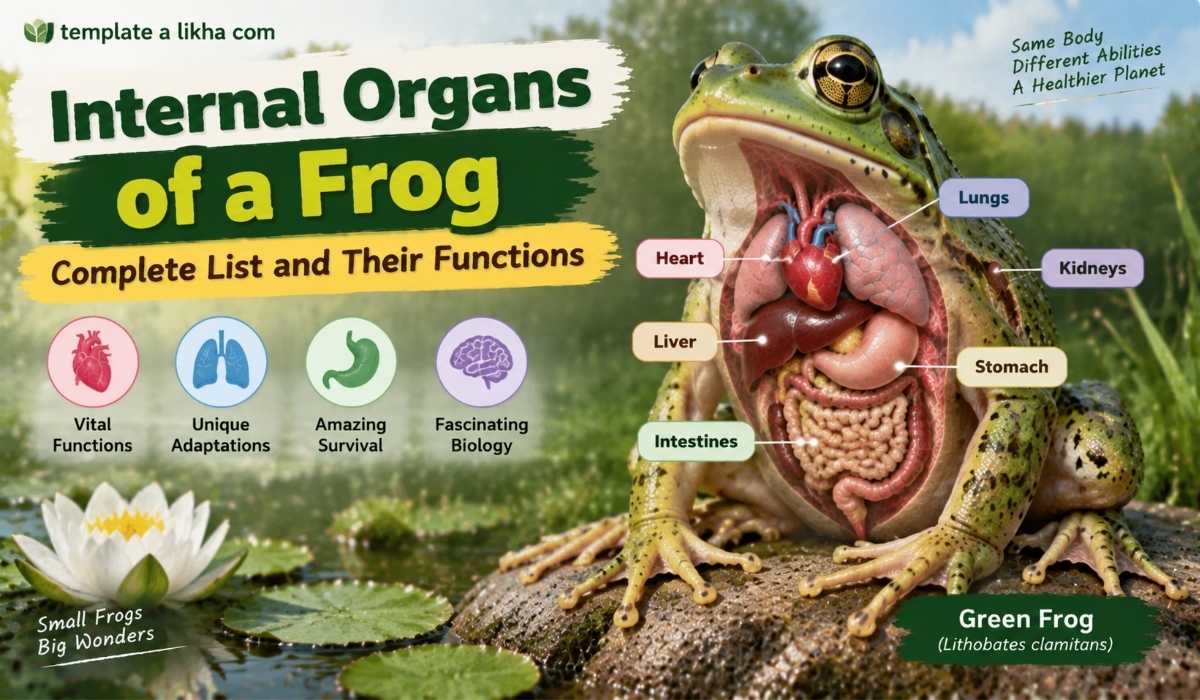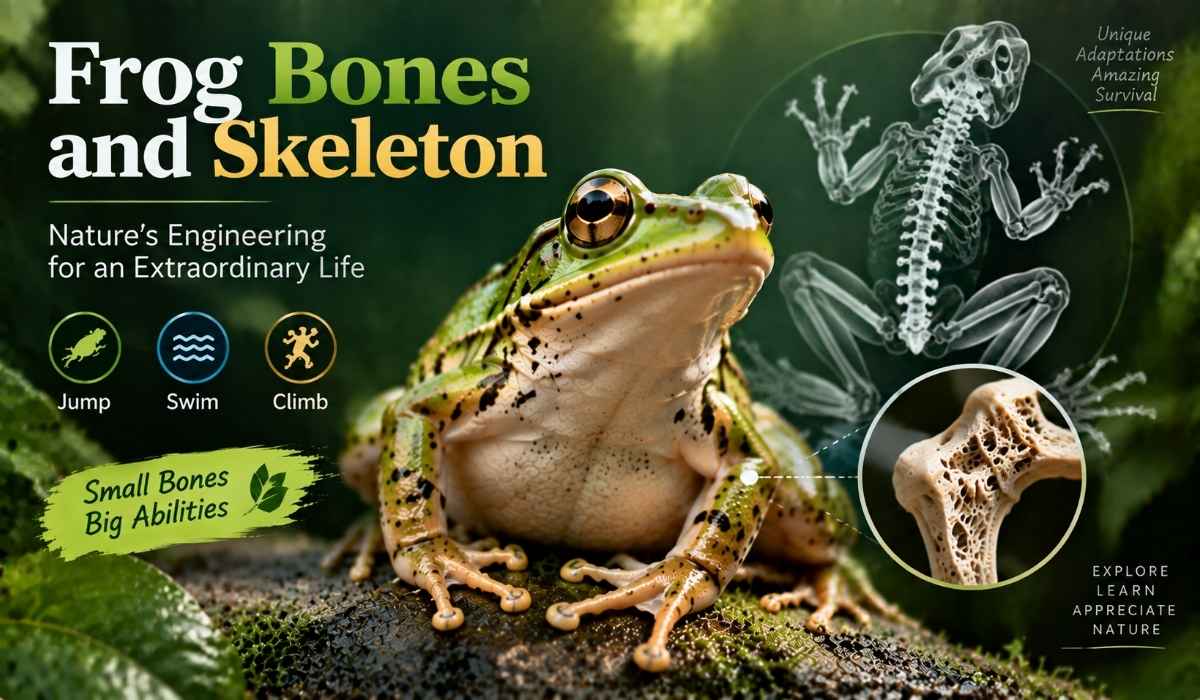
When people look at a frog, they often notice its soft, flexible body, smooth skin, and powerful jumping ability. Because frogs appear so different from animals like mammals or birds, many people wonder: Do frogs really have bones? The answer is yes. Frogs are vertebrate animals, which means they have a well-developed skeleton made of bones and a backbone that supports their body. The confusion about frog bones comes from their unique body structure. Unlike humans, frogs do not have large, heavy bones. Their skeleton is lightweight and specially adapted for jumping, swimming, and moving quickly through different environments. Some of their bones are thin, fused together, or shaped differently compared with other animals, making their skeleton appear less obvious. A frog’s skeleton plays a crucial role in its survival. The strong bones in its hind legs allow it to produce powerful jumps to escape predators and catch prey. Its backbone provides support while maintaining flexibility, and its limb bones help it swim efficiently in water. From the skull that protects the brain to the elongated leg bones designed for movement, every part of the frog skeleton has evolved to match its lifestyle. Understanding the frog skeleton reveals how these small amphibians are perfectly designed for life on land and in water. Their bones may look delicate, but they are essential for movement, protection, and survival. In this article, we will explore the structure, function, and unique adaptations of frog bones, including their backbone and skeletal system.
Do Frogs Have Bones? The Scientific Answer

Frogs are vertebrate animals, meaning they have an internal skeleton made of bones. Their bones support movement, protect internal organs, and help them survive in different environments. To understand the complete body structure of frogs, explore our detailed guide on Frog Anatomy: Complete Guide to Frog Body Parts and Internal Organs.
Are Frogs Vertebrates or Invertebrates?
Frogs are vertebrate animals, meaning they have a backbone and an internal skeleton made of bones. Vertebrates include animals such as humans, birds, fish, reptiles, and amphibians. In contrast, invertebrates are animals that do not have a backbone, such as insects, worms, and many types of mollusks. As members of the class Amphibia, frogs share important characteristics with other amphibians, including a life cycle that often begins in water and continues on land after metamorphosis. The presence of a backbone is one of the main features that separates frogs from invertebrate animals. A frog’s backbone, also called the vertebral column, provides structural support and connects the skull to the rest of the body. However, unlike the long and flexible backbone of humans, a frog’s spine is shorter and specially modified for powerful jumping movements. Some vertebrae are fused together to create a strong but lightweight structure that helps frogs transfer force from their powerful hind legs.
How Many Bones Does a Frog Have?
The exact number of bones in a frog depends on the species, but most frogs have approximately 50–60 bones in their adult skeleton. This number is much lower than the human skeleton, which contains 206 bones. The difference occurs because frogs have a highly specialized body structure. Many bones that are separate in humans are fused together in frogs to create a stronger and lighter framework. For example, parts of the frog’s spine and pelvic region are modified to improve jumping ability and body stability. Different frog species may have variations in bone number and structure due to differences in body size, habitat, and lifestyle. Tree frogs, aquatic frogs, and ground-dwelling frogs may have slightly different skeletal adaptations that help them survive in their specific environments.
Why Do Frog Bones Look Different From Human Bones?
Frog bones are designed for efficiency rather than strength through size. Their skeleton is lightweight but strong, allowing them to move quickly without carrying unnecessary weight. This is especially important for jumping, where a lighter body helps frogs achieve greater distance and speed. The proportions of frog bones are also very different from human bones. Frogs have extremely long hind limb bones, including an elongated femur, tibia, and ankle bones, which work together like a powerful spring during jumps. Their front limbs are shorter and mainly help with landing and supporting the body. Unlike humans, frogs do not need a skeleton designed for standing upright and walking on two legs. Instead, their bones have evolved for leaping, swimming, climbing, and escaping predators. These unique skeletal adaptations make the frog one of the most specialized jumpers in the animal world.
Understanding the Frog Skeleton Structure

A frog’s skeleton is a highly specialized framework that allows it to survive in both aquatic and terrestrial environments. Although frogs have fewer bones than many other vertebrates, each part of their skeleton has a specific function related to movement, feeding, protection, and survival. The frog skeleton is lightweight, flexible, and adapted mainly for jumping, swimming, and quick movements. The frog skeleton contains several important parts, including the skull, backbone, limbs, and pelvic structure. Each bone has a specific function that helps frogs move efficiently. You can explore a complete labeled explanation in Frog Anatomy Diagram: A Complete Labeled Guide to Frog Structure.
Main Parts of a Frog Skeleton
The frog skeleton can be divided into several major sections: the skull, vertebral column, pectoral girdle, pelvic girdle, forelimbs, and hind limbs.
Skull: The skull is the protective structure at the front of the frog’s body. It surrounds and protects the brain and supports important sensory organs such as the eyes and nostrils. Compared with many animals, a frog’s skull is relatively flat and lightweight, which helps reduce body weight and supports its feeding style.
Vertebral Column: The vertebral column, or backbone, provides support for the body and connects the skull with the rest of the skeleton. Unlike mammals, frogs have a short and specialized spine designed for powerful jumping movements. The backbone provides stability while allowing enough flexibility for movement.
Pectoral Girdle: The pectoral girdle supports the frog’s front limbs and helps absorb shock when the frog lands after jumping. It consists of bones that connect the forelimbs to the body and provide stability during movement.
Pelvic Girdle: The pelvic girdle is one of the most important parts of the frog skeleton because it supports the powerful hind limbs. It transfers force from the leg muscles to the body during jumping. The frog’s pelvis is specially adapted to handle the stress created by strong jumps.
Forelimbs: The forelimbs are shorter than the hind limbs and are mainly used for balance, support, and landing. When a frog jumps, its front legs extend forward to help control the landing position and reduce impact.
Hind Limbs: The hind limbs are the most distinctive part of the frog skeleton. They contain long, strong bones that act like a natural spring system. These powerful legs allow frogs to jump many times their own body length, escape predators, and capture prey.
Frog Skull Structure and Its Unique Features
The frog skull has several unique adaptations that make it different from the skulls of mammals and many other vertebrates. One important feature is its flat skull design. A flattened skull reduces weight while maintaining enough strength to protect the brain. This lightweight structure helps frogs remain agile and reduces the energy required for jumping and swimming. The placement of the eye sockets is another important adaptation. Frog eyes are positioned toward the top and sides of the skull, allowing them to see above the water surface while most of their body remains hidden. This helps frogs detect predators and locate prey more effectively. Frogs also have reduced jaw bones compared with many other animals. Their skull structure is designed to keep the head light rather than create a powerful biting mechanism. Instead of chewing food, frogs usually capture prey with their long, sticky tongues and swallow it whole. The frog skull also supports feeding by allowing a wide mouth opening. This enables frogs to catch insects and other small animals quickly. The combination of lightweight construction, large eye placement, and specialized jaw structure makes the frog skull perfectly suited for an amphibious lifestyle.
Frog Backbone (Vertebral Column) Explained
The frog backbone is a unique structure that provides support while allowing powerful movement. Unlike humans, frogs have a relatively short vertebral column with fewer vertebrae. Most frogs have around nine vertebrae in their backbone, followed by a specialized bone called the urostyle. The urostyle is a long, rod-shaped bone formed from fused vertebrae and plays an important role in strengthening the pelvic region. The urostyle helps transfer force from the hind legs to the body during jumping. When a frog pushes against the ground, the strong connection between the backbone, urostyle, and pelvis allows efficient movement. The frog vertebral column differs significantly from that of mammals. Humans and many mammals have numerous flexible vertebrae that allow bending, twisting, and upright movement. Frogs, however, have a shorter and more rigid spine because their bodies are adapted mainly for jumping rather than walking. This specialized backbone gives frogs a balance between strength and flexibility. Together with their powerful hind limbs and modified pelvis, the vertebral column allows frogs to perform some of the most impressive jumps among small animals.
How Frog Bones Help Them Jump So Far
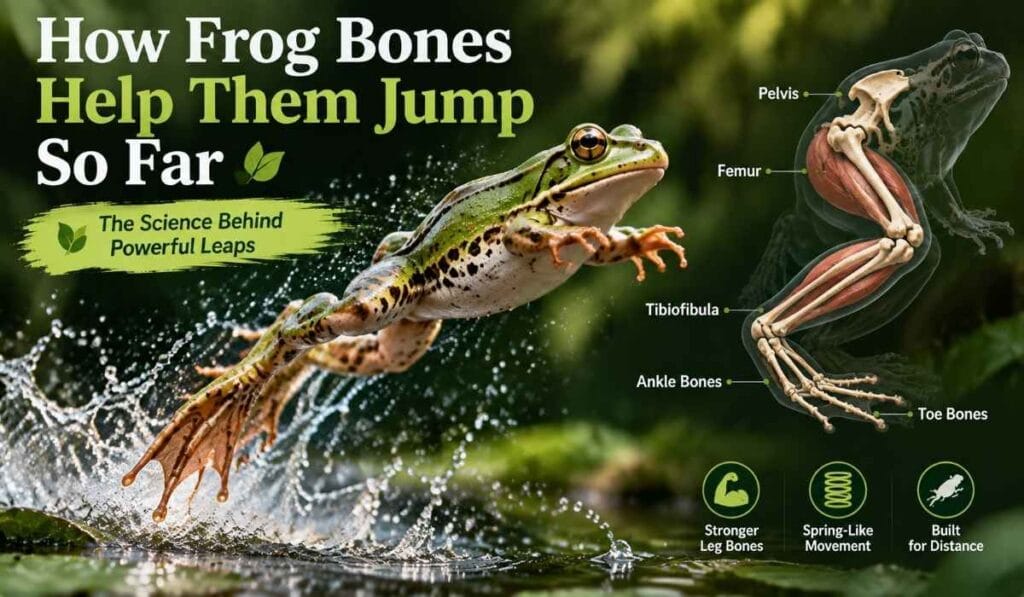
One of the most remarkable abilities of frogs is their powerful jumping performance. Some frogs can leap many times their own body length, allowing them to escape predators, catch prey, and move quickly between different environments. This impressive ability is not only the result of strong muscles; it also depends on the unique structure and arrangement of their bones. The frog skeleton works like a highly efficient mechanical system, combining strong bones, flexible joints, and specialized limb proportions. Frogs are known for their powerful jumping ability, which depends on their strong hind legs, flexible joints, and specialized skeletal structure. The relationship between bones and body movement is explained in Parts of a Frog: Anatomy, Structure, and Functions Explained.
The Role of Powerful Hind Leg Bones
The hind legs are the most important part of a frog’s jumping system. They contain several specialized bones that work together with powerful muscles to produce explosive movement. The femur, or thigh bone, is one of the strongest bones in the frog’s body. It connects the hip to the lower leg and provides a stable base for powerful muscle attachment. When a frog prepares to jump, muscles around the femur contract and generate force that is transferred through the rest of the leg. Another important bone is the tibiofibula, which is a fused bone formed from the tibia and fibula. In humans, these are two separate lower leg bones, but in frogs, they are combined into one strong and lightweight structure. This adaptation provides strength while reducing unnecessary weight, helping frogs move more efficiently. The ankle bones also play a major role in jumping. Frogs have elongated ankle bones called the astragalus and calcaneum, which increase the length of the hind limb. These extended bones act like additional segments of the leg, increasing the distance a frog can push against the ground and improving jump performance. The interaction between muscles and bones is essential. Strong leg muscles create the force, while the bones act as supporting levers that transfer this force into movement. Together, they allow frogs to launch their bodies into the air with remarkable speed.
Why Frog Legs Are Designed for Powerful Leaps
Frog legs are specially designed for jumping because of their long hind limbs and unique skeletal proportions. Compared with their body size, frogs have unusually large and extended back legs. These long limbs increase the range of motion and allow frogs to generate greater force during a jump. Before jumping, frogs often crouch down and compress their muscles and joints. During this preparation stage, energy is stored in the muscles and elastic tissues around the joints. When the frog suddenly extends its legs, this stored energy is released rapidly, creating a powerful push that sends the frog forward. This jumping ability is the result of millions of years of evolutionary adaptation. Frogs that could jump farther and faster had better chances of escaping predators and finding food. Over generations, their skeletons and muscles became specialized for efficient movement. Different frog species show variations in their jumping adaptations. Tree frogs may have lighter bones and specialized toe structures for climbing, while ground-dwelling frogs often have stronger leg bones for powerful leaps across land.
How Frog Skeleton Protects Their Body During Landing
Jumping creates a major challenge: landing safely. A frog’s skeleton includes several adaptations that help absorb impact and protect the body after a leap. The joints in a frog’s legs are highly flexible and help reduce the force created during landing. Instead of stopping suddenly, the legs bend and absorb energy, similar to a natural shock-absorbing system. The pelvic girdle and backbone also contribute to impact protection. These structures distribute forces throughout the body, preventing excessive stress on individual bones. The strong connection between the pelvis, urostyle, and hind limbs allows frogs to handle repeated jumps without damaging their skeleton. The lightweight but durable bone structure provides another advantage. Frog bones are strong enough to support movement but light enough to prevent unnecessary energy use. This balance allows frogs to jump frequently while reducing strain on their bodies. Overall, the frog skeleton is a perfect example of biological engineering. The combination of powerful hind leg bones, flexible joints, and specialized body structure allows frogs to perform incredible jumps while protecting themselves during movement and landing.
Frog Backbone and Spine: Why Is It Different From Other Animals?

The frog backbone is one of the most specialized parts of its skeleton. Although frogs are vertebrates like humans, birds, and reptiles, their spinal structure is uniquely adapted for a lifestyle based on jumping, swimming, and quick movements. Unlike animals that require a highly flexible spine for walking, climbing, or twisting, frogs have a shorter and more rigid backbone designed mainly for stability and efficient transfer of force. The frog backbone is specially adapted for jumping and body support. Unlike humans and many mammals, frogs have a unique vertebral structure and urostyle bone. To understand the hidden structures inside frogs, read Internal Frog Anatomy: Understanding the Hidden Parts of a Frog.
How Many Vertebrae Does a Frog Have?
Most adult frogs have a relatively short spinal column containing around nine vertebrae, followed by a specialized structure called the urostyle bone. This is much fewer than many other vertebrates. For example, humans have 33 vertebrae, including those that are fused in the lower spine. The short spinal column gives frogs greater body stability during powerful jumps. A long, flexible spine would reduce the efficiency of transferring force from the legs to the body. Instead, frogs have evolved a compact backbone that acts as a strong support system. Compared with reptiles and mammals, frog spines allow less bending and twisting movement. Many reptiles have longer bodies with numerous vertebrae that help them crawl, coil, and move in different directions. Mammals often have flexible spinal columns that support activities such as running, climbing, and maintaining body posture. Frogs, however, do not rely on a flexible spine for movement. Their main locomotion comes from their powerful hind limbs. The limited movement of their backbone provides a strong foundation for jumping by keeping the body stable when large forces are produced.
What Is the Urostyle Bone in Frogs?
The urostyle is a long, rod-shaped bone located at the end of the frog’s vertebral column. It develops from fused vertebrae and is one of the most distinctive features of the frog skeleton. The main purpose of the urostyle is to strengthen the connection between the backbone and the pelvic girdle. During a jump, powerful muscles in the hind legs create a large amount of force. The urostyle helps transfer this force efficiently from the legs through the pelvis and body, allowing the frog to launch itself forward. The urostyle also provides support during landing. By strengthening the rear part of the skeleton, it helps distribute impact forces and protects the frog’s body from stress caused by repeated jumping. From an evolutionary perspective, the urostyle represents an important adaptation that developed as frogs became specialized jumpers. Early amphibians had different body structures, but modern frogs evolved a compact and reinforced skeleton that improved their ability to move quickly on land and escape predators.
Frog Spine Compared With Human Spine
Frog and human spines share some basic similarities. Both are part of the vertebral column, protect the spinal cord, and provide support for the body. Both also connect the skull with the rest of the skeleton and play an important role in movement. However, there are major differences between them. The human spine is long and highly flexible, containing many vertebrae that allow bending, twisting, and upright posture. This flexibility is essential for walking on two legs and performing complex movements. The frog spine is much shorter and more rigid. Instead of supporting upright posture, it is designed to work with powerful hind legs and a specialized pelvis. The reduced number of vertebrae and the presence of the urostyle create a strong but lightweight structure optimized for jumping. These differences show how skeletons evolve according to an animal’s lifestyle. A human spine is adapted for walking, balance, and manipulation, while a frog spine is adapted for explosive movement, efficient jumping, and survival in changing environments. The frog backbone may appear simple compared with other animals, but its unique design makes it highly effective for amphibian life.
Frog Skull and Jaw Bones: How Frogs Eat Without Teeth Like Mammals

The frog skull is a fascinating example of how animals evolve specialized structures for survival. Unlike mammals that depend on strong jaws and different types of teeth for chewing food, frogs use a lightweight skull, powerful jaw muscles, and a fast-moving tongue to capture and swallow prey. Their feeding system is designed mainly for catching insects and other small animals quickly rather than processing food through chewing. The frog skull and jaw structure help frogs catch and swallow prey efficiently. Their feeding process depends on different organs working together. Learn more about frog internal structures in Frog Organs Labeled: A Complete Guide With Diagram.
Do Frogs Have Teeth?
The answer is: some frogs have teeth, but they are very different from human teeth. Most frogs do not have the large, strong teeth used by mammals for chewing. Instead, certain frog species have small, cone-shaped teeth that mainly help hold prey inside the mouth. These teeth are usually found along the upper jaw and are called maxillary teeth. They are attached to the edges of the upper jaw and help prevent captured prey from escaping. When a frog catches a slippery insect or small animal, these tiny teeth provide extra grip while the frog prepares to swallow. Some frogs also have vomerine teeth, which are small teeth-like structures located on the roof of the mouth. These structures also help hold prey securely. However, they are not used for chewing or tearing food like the teeth of many mammals. Interestingly, many frog species are completely toothless. Instead of relying on teeth, these frogs depend on their sticky tongues, quick reflexes, and strong swallowing muscles to capture food. After catching prey, a frog usually swallows it whole because its jaw structure does not allow chewing.
How Frog Skull Helps Them Catch Prey
A frog’s skull is specially designed to support fast and efficient feeding. One of its most important features is its wide mouth opening. Frogs can open their mouths widely, allowing them to capture prey that may be surprisingly large compared with their own body size. The frog’s most famous hunting tool is its fast tongue movement. A frog’s tongue is attached near the front of the mouth rather than deep inside the throat. This allows it to quickly extend the tongue outward, grab insects, and pull them back into the mouth within a fraction of a second. The sticky surface of the tongue helps trap prey effectively. The skull structure also provides a balance between strength and flexibility. Unlike heavy skulls designed for powerful biting, the frog skull is lightweight and adapted for speed. Some bones are reduced or fused, which decreases weight while maintaining enough support for feeding movements. The placement of the eyes also assists hunting. Because frog eyes are positioned on the top of the head, they provide a wider field of vision and help frogs detect movement from potential prey and predators. Overall, the frog skull and jaw system demonstrate a unique feeding strategy. Instead of chewing like mammals, frogs rely on a combination of specialized skull design, quick tongue action, and efficient swallowing mechanisms to survive.
Frog Limb Bones Explained: Front Legs vs Back Legs

The limbs of a frog are among the most specialized parts of its skeleton. Unlike animals that use all four limbs equally for walking, frogs have evolved a body structure where the front and back legs perform very different functions. The front legs mainly provide balance, support, and protection during landing, while the powerful back legs are designed for jumping, swimming, and rapid movement. The difference between frog forelimbs and hind limbs shows how their bones have adapted to their unique lifestyle. Every major bone in their legs contributes to their ability to move efficiently through water, land, and vegetation. Frog limbs are designed for jumping, swimming, climbing, and maintaining balance. The front and back legs have different structures and functions. Learn more about frog body structure in Frog Body Parts: Complete Guide to External and Internal Parts.
Structure of Frog Forelimb Bones
A frog’s forelimbs are shorter and less powerful than its hind limbs, but they play an essential role in movement and survival. The front legs help frogs maintain balance, absorb impact after jumping, and support the body when resting. The main bone of the upper forelimb is the humerus. This long bone connects the shoulder region to the lower arm and provides attachment points for muscles that control movement. Although the humerus is not as large as the bones in the hind legs, it provides the strength needed for pushing against surfaces and stabilizing the body. The lower arm contains a specialized bone called the radio-ulna. In frogs, the radius and ulna are fused together into a single bone. This fusion creates a stronger and more stable structure while reducing unnecessary weight. The radio-ulna helps control the movement of the front limb during landing and crawling. The frog wrist contains several small wrist bones, also known as carpal bones. These bones provide flexibility and allow the front feet to adjust their position. When a frog lands after a jump, the wrist and front limb joints help absorb some of the impact and protect the body from sudden stress. Although frog forelimbs are not designed for powerful movement like their back legs, they are important for controlled movement, balance, and safe landings.
Structure of Frog Hind Limb Bones
The hind limbs are the most powerful part of the frog skeleton. They are specially adapted for producing strong forces that allow frogs to jump long distances and move quickly away from danger. The upper hind limb contains the femur, which is the thigh bone. It connects the hip to the lower leg and supports powerful muscles responsible for generating movement. The femur acts as a strong lever during jumping, transferring muscle force through the rest of the leg. The lower leg contains the tibiofibula, a fused bone formed from the tibia and fibula. This structure provides strength while keeping the limb lightweight. The combination of durability and reduced weight allows frogs to produce powerful jumps without using excessive energy. The ankle region contains elongated tarsal bones, which are one of the most unique features of frog hind limbs. These long ankle bones increase the effective length of the leg and improve the frog’s ability to push against the ground. They function like an extended spring system, helping frogs achieve greater jumping distances. Together, the femur, tibiofibula, and tarsal bones create a highly efficient jumping mechanism.
Why Frog Hind Legs Are Much Longer Than Front Legs
The major difference between frog front and back legs is the length and strength of the bones. Frog hind legs are much longer because they have evolved specifically for powerful movement. Over millions of years, frogs that could jump farther and faster had advantages in avoiding predators and catching prey. This led to the development of longer hind limbs with specialized bones and stronger muscles. Long hind legs improve jumping efficiency by increasing the distance and force produced during each leap. The extended limb structure allows frogs to store and release energy effectively, creating explosive movement. These adaptations provide important survival advantages. A frog can quickly escape threats by jumping away, reach insects that are difficult to catch, and move between habitats such as ponds, forests, and grasslands. While the front legs focus on stability and landing, the hind legs act as the frog’s primary engine. The difference between these two limb systems demonstrates how frog bones have evolved to perfectly match their unique way of life.
How Frog Bones Develop From Tadpole to Adult Frog

The transformation of a frog from a tiny aquatic tadpole into a land-dwelling adult is one of the most remarkable processes in the animal world. During this journey, the frog’s entire body structure changes, including its skeleton. The simple body of a tadpole gradually develops into a complex bone system designed for jumping, swimming, and survival on land. Unlike adult frogs, tadpoles begin life with a very different skeletal structure. Their bodies are adapted mainly for swimming in water, while adult frogs require a strong skeleton for movement on land. During metamorphosis, frogs experience major changes in their body structure, including bone development and organ transformation. Learn more about these changes in Internal Anatomy of a Frog: Organs and Body Systems Explained.
Do Tadpoles Have Bones?
Newly hatched tadpoles do not have a fully developed bony skeleton like adult frogs. Instead, their early support system is mainly made of cartilage, a softer and more flexible tissue that provides structure while allowing growth and development. The cartilage-based skeleton is suitable for the tadpole stage because tadpoles mainly swim using their tails rather than walking or jumping. Their bodies do not yet require strong limb bones or a developed backbone like adult frogs. As tadpoles grow, their cartilage gradually begins to transform into stronger bone through a process called ossification. During this process, minerals such as calcium are deposited into developing skeletal tissues, making the bones harder and stronger. The early development of the skeleton prepares the tadpole for the dramatic changes that occur during metamorphosis.
Skeletal Changes During Metamorphosis
Metamorphosis is the process where a tadpole transforms into an adult frog. During this stage, major changes occur in the skeletal system, allowing the animal to transition from aquatic life to a combination of land and water living. One of the most noticeable changes is tail disappearance. A tadpole’s tail, which is essential for swimming, is gradually absorbed by the body as the frog develops. The materials from the disappearing tail are reused to support growth and energy needs during transformation. Another major change is limb formation. Hind legs usually appear first, followed by the development of front legs. As the limbs grow, the bones inside them become more developed and specialized. The hind limb bones become especially large and strong because adult frogs depend on them for jumping. The backbone also changes during metamorphosis. Vertebrae become more developed, and the specialized urostyle bone forms as parts of the vertebral structure fuse together. These changes create a stronger skeleton capable of supporting powerful movements. Bone growth continues after metamorphosis as young frogs mature into adults. Their skeleton becomes stronger and better adapted for their specific environment and lifestyle.
Factors That Affect Frog Bone Development
Several factors influence how successfully a frog’s bones develop. One of the most important factors is nutrition. Tadpoles and young frogs require essential nutrients, including proteins and minerals such as calcium and phosphorus, to build strong bones. Poor nutrition can slow skeletal growth and affect overall development. The environment also plays an important role. Water quality, temperature, availability of food, and exposure to pollutants can influence bone formation. Healthy environments provide the conditions needed for normal growth, while polluted habitats may interfere with development. Species differences also affect skeletal development. Different frog species have evolved unique bone structures depending on their habitats and behaviors. For example, tree frogs may develop specialized limb structures for climbing, while aquatic frogs may have adaptations that improve swimming ability. The development of frog bones from a soft cartilage-based tadpole skeleton to a strong adult framework demonstrates the incredible biological changes that occur during amphibian life. This transformation allows frogs to successfully move between aquatic and terrestrial environments.
Are Frog Bones Strong or Fragile?

At first glance, frogs may appear delicate because of their soft bodies and lightweight structure. However, frog bones are not simply fragile; they are specially designed to provide strength while keeping the body light and efficient. Their skeleton represents a balance between durability and flexibility, allowing them to jump, swim, climb, and survive in different environments. Although frog bones are lightweight, they are designed for strength, flexibility, and movement. Their skeleton works together with muscles and organs to support survival. Explore how the complete frog body works in Frog Organ Systems: How the Frog Body Works.
Why Frog Skeletons Are Lightweight
A frog’s skeleton is lightweight because its bones are adapted for efficient movement rather than carrying a heavy body structure. Unlike large mammals that require dense bones to support greater body weight, frogs need a lighter framework that allows quick movement and powerful jumps. The bone density of frogs is generally lower than that of many larger animals, but this does not mean their bones are weak. Their bones are structured to provide enough strength while reducing unnecessary weight. This lightweight design is especially important because jumping requires rapid acceleration. A heavier skeleton would require more energy and reduce movement efficiency. The frog skeleton also saves energy during daily activities. Because frogs rely heavily on jumping to escape predators and capture prey, having lighter bones allows them to move quickly without using excessive muscle power. Specialized structures, such as fused bones in the limbs and backbone, increase strength while maintaining a lightweight body. The tibiofibula and radio-ulna are examples of fused bones that provide stability without adding extra weight.
Can Frogs Break Their Bones?
Yes, frogs can break their bones, although their skeleton is adapted to handle repeated stress from jumping and movement. Injuries may occur due to falls, predator attacks, accidents, or environmental hazards. Common skeletal injuries in frogs include fractures in the legs, toes, or backbone. Since frogs depend heavily on their limbs for movement, injuries to their hind legs can significantly affect their ability to jump, hunt, and escape danger. Like many vertebrates, frogs have some ability to heal broken bones. Their bodies can repair damaged bone tissue through natural healing processes. However, the recovery time depends on factors such as the location of the injury, the frog’s age, species, health condition, and environmental conditions. A healthy environment with proper nutrition and suitable temperature can support better healing and bone regeneration.
How Frog Bones Adapt to Different Habitats
Different frog species have evolved unique skeletal adaptations based on where they live and how they move. Tree frogs often have lightweight skeletons and specialized limb structures that help them climb. Many tree frogs have expanded toe bones and pads that improve their grip on leaves, branches, and smooth surfaces. Aquatic frogs have skeletal adaptations that support swimming. Their bones and limbs are shaped to work efficiently in water, while their body structure reduces resistance during movement. Some aquatic species have stronger hind limbs for powerful swimming strokes. Ground frogs usually have stronger and more robust leg bones because they depend on jumping across land. Their skeletons are adapted for repeated impacts from jumping and landing on solid surfaces. These differences show that frog bones are not weak or fragile; they are highly specialized structures shaped by millions of years of evolution. A frog’s skeleton is a perfect example of how nature creates lightweight designs that remain strong, flexible, and efficient for survival.
Frog Skeleton Adaptations for Different Environments

Frogs live in a wide variety of habitats, including forests, ponds, rivers, grasslands, and even dry desert regions. To survive in these different environments, their skeletons have developed specialized adaptations that improve movement, feeding, and protection. Although all frogs share a basic skeletal structure, differences in their bones, limbs, and body proportions allow different species to perform unique activities such as climbing, swimming, and burrowing. The frog skeleton is not just a framework that supports the body; it is a highly adapted system that helps frogs interact with their surroundings. Different frog species have developed unique skeletal adaptations for forests, water, and dry environments. These adaptations are connected with their overall anatomy. Learn more from Frog Anatomy: Complete Guide to Frog Body Parts and Internal Organs.
Tree Frog Skeleton Adaptations
Tree frogs spend much of their lives climbing plants, branches, and leaves. Their skeletons have evolved several features that help them move safely in elevated environments. One important adaptation is found in their toe bones. Tree frogs often have elongated toe bones that provide greater flexibility and control while climbing. These specialized toes allow them to wrap around branches and maintain balance on narrow surfaces. Many tree frogs also have expanded toe structures connected with specialized pads. These sticky pads are located at the tips of their toes and help them attach to smooth surfaces such as leaves, tree bark, and even glass. Although the adhesive ability mainly comes from skin structures, the underlying toe bones provide support and movement control for these gripping surfaces. Their lightweight skeleton is another advantage for climbing. A lighter body places less stress on branches and allows frogs to move quickly through vegetation. Their flexible joints help them adjust their position while jumping between plants. The combination of specialized toe bones, flexible limbs, and gripping pads gives tree frogs excellent climbing ability. These adaptations allow them to avoid ground predators and search for insects in higher parts of forests.
Aquatic Frog Skeleton Adaptations
Aquatic frogs spend much of their time in water, so their skeletons are adapted for efficient swimming and underwater movement. One major adaptation is their powerful hind limbs. The long bones of the back legs provide strong propulsion, allowing frogs to push against the water and move forward quickly. The connection between the pelvis, backbone, and hind limbs helps transfer muscular force efficiently during swimming. Many aquatic frogs have webbed feet, which increase the surface area of their toes. Although the webbing is a soft tissue feature, it works together with the toe bones to create a larger paddle-like structure. This allows frogs to push more water backward and improve swimming speed. Their body shape also supports aquatic movement. Many water-dwelling frogs have streamlined bodies that reduce resistance while moving through water. A lightweight skeleton helps them remain agile and change direction quickly when escaping predators or catching prey. The skeletal structure of aquatic frogs provides a balance between movement efficiency and stability. Their bones support powerful swimming strokes while allowing flexibility needed for life in water.
Desert Frog Skeleton Adaptations
Living in dry environments creates unique challenges for frogs because they must conserve water and survive extreme conditions. Desert frogs have developed behavioral and physical adaptations that help them cope with limited moisture. One important survival strategy is water conservation. Many desert frogs spend most of their time hidden underground to avoid heat and dehydration. Their skeleton supports a body shape that allows them to move through soil and create shelters. Their strong limbs help with burrowing ability. Powerful front and hind limbs allow desert frogs to dig into loose soil, where temperatures are cooler and humidity levels are higher. Some species use their body and limbs to create underground chambers where they remain inactive during dry periods. Unlike aquatic frogs that need adaptations for swimming, desert frogs require skeletal features that support digging and stability on land. Their bones and muscles work together to create efficient movements for escaping harsh environmental conditions. The diversity of frog skeleton adaptations demonstrates how these amphibians have evolved to survive in different habitats. Whether climbing trees, swimming through water, or hiding beneath dry soil, frogs rely on specialized bones and body structures that match their environment and lifestyle. Their skeletons are examples of evolutionary design, showing how the same basic body plan can adapt to many different challenges.
Frog Skeleton Compared With Other Animals

The skeleton of a frog is a remarkable example of how animals evolve structures that match their way of life. Although frogs share the same basic vertebrate skeleton plan as humans, fish, and reptiles, their bones have developed unique features that support jumping, swimming, and living in both aquatic and terrestrial environments. Comparing the frog skeleton with other animals helps us understand how different evolutionary paths create specialized body designs. Comparing frog skeletons with humans, fish, and reptiles helps explain evolutionary differences. A complete visual explanation is available in Frog Anatomy Diagram: A Complete Labeled Guide to Frog Structure.
Frog Skeleton vs Human Skeleton
Frogs and humans share many basic skeletal features because both are vertebrates. Both have a skull, vertebral column, limb bones, and girdles that connect the limbs to the body. For example, frogs and humans both have:
- A skull that protects the brain
- A backbone that supports the body and protects the spinal cord
- Forelimb bones such as the humerus and forearm bones
- Hind limb bones such as the femur and lower leg bones
However, the functions of these bones are very different because frogs and humans move in completely different ways. The human skeleton is designed for upright posture, walking, running, and complex hand movements. Humans have a long, flexible spine that supports standing on two legs and allows a wide range of body movements. Their hands contain many small bones that provide precise control for activities such as writing and using tools. The frog skeleton, in contrast, is designed mainly for jumping and rapid movement. Frogs have a short backbone, powerful hind limbs, elongated ankle bones, and a specialized pelvis that helps generate strong jumps. Their front limbs are mainly used for balance and absorbing impact during landing. While the human skeleton focuses on stability and versatility, the frog skeleton focuses on lightweight design and efficient movement.
Frog Skeleton vs Fish Skeleton
Frogs and fish share an evolutionary connection because the earliest ancestors of amphibians evolved from ancient aquatic vertebrates. This history explains why both groups have features related to life in water. Fish skeletons are mainly designed for swimming. They usually have long bodies supported by a backbone with many vertebrae, flexible fins, and structures that allow efficient movement through water. Their skeleton helps control side-to-side body movements that push water backward. Frogs, however, represent a major transition from aquatic life to life on land. During evolution, their skeleton changed to support weight outside water. Their limbs developed into strong structures with bones that could support movement on solid surfaces. Unlike fish fins, frog limbs contain specialized bones similar to those found in other land vertebrates. Their strong pelvic girdle and powerful hind legs allow them to jump and move on land while still maintaining swimming ability. The frog skeleton therefore represents an important evolutionary stage between fully aquatic animals and land-dwelling vertebrates.
Frog Skeleton vs Reptile Skeleton
Frogs and reptiles are both vertebrates that evolved from earlier land-dwelling ancestors, but their skeletons show important differences based on their lifestyles. Reptiles generally have stronger, heavier skeletons adapted for crawling, walking, climbing, or other land movements. Many reptiles have long bodies with numerous vertebrae, strong ribs, and limbs positioned more to the side of the body. Frogs have a more specialized lightweight skeleton. Their bodies are compact, their spines are shorter, and their hind limbs are greatly enlarged for jumping. Instead of walking long distances, frogs rely on powerful bursts of movement. Another major difference is the structure of their limbs. Reptiles usually have limbs designed for controlled movement across surfaces, while frogs have elongated hind limbs that act like powerful springs. These differences reflect their evolutionary adaptations. Reptiles became highly adapted for life on land with strong protective body structures, while frogs evolved a skeleton optimized for quick movement, jumping, and survival in both water and land environments. The frog skeleton demonstrates how evolution can modify the same basic vertebrate body plan in different ways, creating animals perfectly suited to their unique habitats and behaviors.
Interesting Facts About Frog Bones

The frog skeleton may look simple compared with larger animals, but it contains many unique features that reveal millions of years of evolution. Every bone in a frog’s body has a specific purpose, from supporting powerful jumps to helping it survive in different environments. These small amphibians have developed some of the most specialized skeletal adaptations among vertebrate animals. Frog bones reveal fascinating information about evolution, movement, and survival. However, bones are only one part of their complex biological system. Discover more in Internal Organs of a Frog: Complete List and Their Functions.
Some Frogs Have Fewer Bones Than Others : Not all frogs have exactly the same number of bones. The total number can vary depending on the species, body size, and evolutionary adaptations. Most adult frogs have around 50–60 bones, but certain species may have fewer or slightly different skeletal arrangements. The difference occurs because some frog bones are fused together to create stronger and more efficient structures. For example, the radio-ulna in the front limb and the tibiofibula in the hind limb are formed by the fusion of two separate bones. These modifications reduce weight while maintaining strength. This specialized design allows frogs to move efficiently without carrying unnecessary skeletal mass.
Frog Bones Preserve Evolutionary History : Frog bones provide important clues about the evolutionary history of amphibians. Scientists study fossilized frog skeletons to understand how modern frogs developed from ancient amphibian ancestors. Changes in bone structure reveal how frogs adapted from early aquatic vertebrates into animals capable of living on land. Features such as stronger limbs, modified pelvises, and specialized backbones show the gradual development of jumping and terrestrial movement. The frog skeleton acts like a record of these evolutionary changes, helping researchers understand how amphibians survived and diversified over millions of years.
Some Frogs Have Unique Skull Structures : Frog skulls are highly specialized and vary between species. Some frogs have unusual skull shapes adapted for specific lifestyles. Certain species have reinforced skulls with thicker bones, while others have extremely lightweight skulls designed for climbing or jumping. Some frogs that live in trees have skull adaptations that help protect their heads during movement through vegetation. The position of the eyes, shape of the jaw, and arrangement of skull bones also differ among species depending on their feeding methods and habitats.
Skeleton Helps Frogs Survive Millions of Years : The frog skeleton is a perfect example of evolutionary adaptation. Its lightweight structure, powerful limbs, flexible joints, and specialized backbone have allowed frogs to survive through dramatic environmental changes for millions of years. Their bones help them perform essential survival activities, including escaping predators, catching prey, swimming, climbing, and moving between habitats. Although frogs may appear fragile, their skeletons are highly efficient biological systems. The unique design of frog bones demonstrates how evolution can create structures that balance strength, flexibility, and energy efficiency, allowing these amphibians to remain successful survivors in ecosystems around the world.
Frequently Asked Questions About Frog Bones and Skeleton
Do frogs have bones?
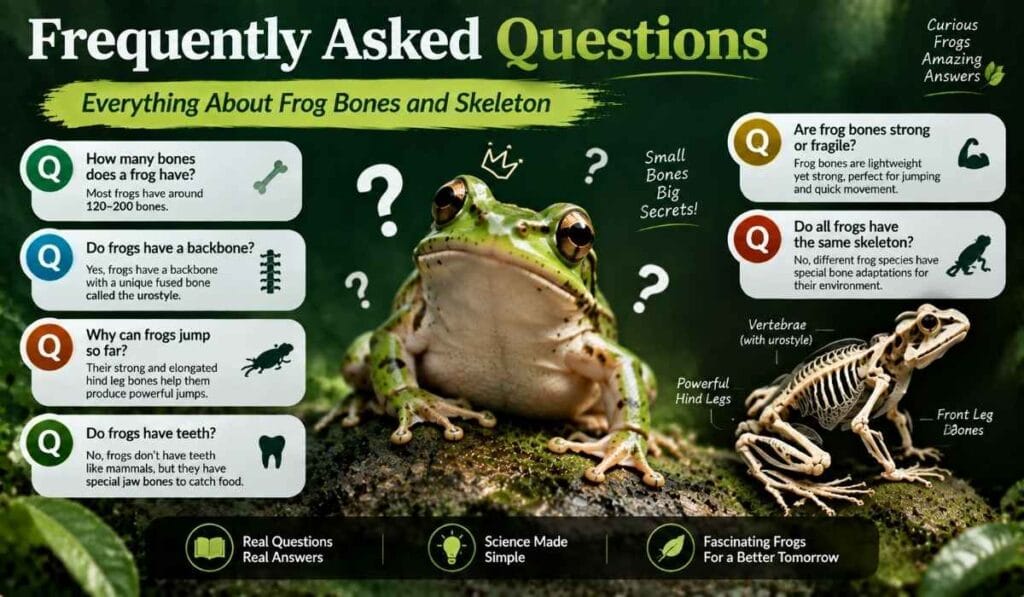
Yes, frogs have bones. Frogs are vertebrate animals, which means they have a backbone and an internal skeleton made of bones. Although many people think frogs have soft bodies without bones because they can jump, swim, and move flexibly, their bodies are supported by a complex skeletal system. A frog’s skeleton contains important structures such as the skull, backbone, ribs, shoulder bones, hip bones, and limb bones. These bones provide support, protect internal organs, and help frogs perform movements like jumping, swimming, climbing, and catching prey. However, frog bones are different from human bones. They are generally lightweight and specially adapted for survival. Their skeleton is designed to reduce body weight while maintaining enough strength for powerful movements.
Do frogs have a backbone?
Yes, frogs have a backbone, which is one of the main characteristics of vertebrate animals. The frog’s backbone is called the vertebral column and it supports the body while protecting the spinal cord. Unlike humans and many mammals, frogs have a relatively short spine with fewer vertebrae. Their backbone is specially adapted for jumping rather than bending and twisting movements. One unique structure in a frog’s backbone is the urostyle, a long rod-like bone formed from fused vertebrae. The urostyle strengthens the lower spine and helps transfer force from the powerful hind legs during jumping. The frog’s backbone plays an important role in movement, balance, and protection of the nervous system.
How many bones does a frog have?
The exact number of bones in a frog depends on the species, but most frogs have approximately 40 to 50 major bones in their skeleton.
A frog’s skeleton includes:
- Skull bones
- Vertebrae
- Shoulder bones
- Hip bones
- Arm and leg bones
- Toe bones
Compared with humans, who have 206 bones, frogs have fewer bones because their body structure is simpler and more specialized for their lifestyle. Some frog species may have variations in bone numbers due to differences in habitat, evolution, and body size. For example, frogs that live in trees may have different limb and toe structures compared with frogs that spend most of their lives in water.
Do frogs have teeth and jaw bones?
Yes, some frogs have teeth, but they are very different from human teeth. Many frogs have small teeth along the upper jaw called maxillary teeth, and some also have teeth on the roof of their mouth called vomerine teeth. However, not all frogs have teeth. Some species, such as many common frogs, have few or no teeth at all. Frog teeth are not mainly used for chewing because frogs usually swallow their prey whole. Instead, their teeth help grip slippery insects, small animals, and other food items before swallowing. Their jaw bones are designed for quickly opening their mouths and catching prey with their long, sticky tongues.
Are frog bones strong or fragile?
Frog bones are lightweight but surprisingly strong. Their skeleton is designed to provide enough support without adding unnecessary weight. This lightweight structure helps frogs jump efficiently because a heavier skeleton would require more energy to move. At the same time, their bones must handle strong forces during jumping and landing. However, frog bones can still break due to injuries, falls, attacks from predators, or environmental stress. Like other vertebrates, frogs can repair damaged bones through natural healing processes. The strength of frog bones depends on the species, age, health, and living environment.
Why do frogs have such powerful leg bones?
Frogs have powerful hind legs because their survival depends heavily on jumping. Their long and strong leg bones allow them to escape predators, catch prey, and move quickly between habitats. Important frog leg bones include:
- Femur (thigh bone)
- Tibiofibula (lower leg bone)
- Ankle bones
- Toe bones
The combination of strong bones and powerful muscles creates a spring-like mechanism that allows frogs to jump several times their body length. This special skeletal adaptation is one reason frogs are considered some of the most efficient jumping animals in nature.
Do tadpoles have bones?
Most tadpoles do not have a fully developed bony skeleton like adult frogs. During the early stages of life, tadpoles mainly have a structure made of cartilage, which is softer and more flexible than bone. As tadpoles grow and transform into adult frogs through metamorphosis, their skeleton changes. Their legs develop, their tail disappears, and many parts of their body become strengthened with bones. This transformation allows them to move from an aquatic lifestyle to life on land. The development of bones during metamorphosis is one of the most fascinating processes in amphibian biology.
How is a frog skeleton different from a human skeleton?
Although frogs and humans are both vertebrates, their skeletons are adapted for different lifestyles. Humans have a skeleton designed for walking upright, holding objects, and performing complex movements. Frogs have a skeleton specialized for jumping, swimming, and surviving in different environments. Major differences include:
- Frogs have fewer vertebrae than humans.
- Frogs have extremely long hind limbs compared with their body size.
- Frogs have a fused lower spine called the urostyle.
- Human hands have more complex finger structures for gripping objects.
These differences show how evolution shapes bones according to an animal’s needs.
Can frogs break their bones?
Yes, frogs can break their bones, although their flexible bodies help reduce some injuries. Bone fractures can happen due to falls, predator attacks, accidents, or environmental hazards. A broken bone can seriously affect a frog’s ability to move, hunt, and escape predators. Since frogs rely heavily on jumping, injuries to their legs or backbone can be especially dangerous. However, frogs have natural healing abilities. Their bodies can repair damaged tissues, and younger frogs often recover faster than older individuals.
Why are frog skeletons important for scientists?
Frog skeletons provide valuable information about evolution, adaptation, and animal movement. Scientists study frog bones to understand how amphibians evolved from ancient aquatic animals and adapted to life on land. The structure of frog bones also helps researchers study:
- Evolution of jumping ability
- Development of amphibian species
- Relationship between different animals
- Adaptations to different environments
By studying frog skeletons, scientists can learn more about biodiversity, evolution, and how animals survive in changing habitats.
Final Thoughts: The Remarkable Design of the Frog Skeleton
Frogs may appear soft, fragile, and simple from the outside, but their internal skeleton tells a very different story. Their bones are highly specialized structures that have evolved over millions of years to support survival in diverse environments. From the powerful hind leg bones that allow incredible jumps to the lightweight skull that helps them capture prey, every part of the frog skeleton has an important role. Unlike humans and many other animals, frogs do not rely on strength through heavy bones. Instead, their skeleton is designed for efficiency, flexibility, and rapid movement. Their short backbone, fused bones, specialized pelvis, and extended limbs work together to create one of nature’s most effective jumping systems. The differences between tree frogs, aquatic frogs, and ground-dwelling frogs show how skeletons can adapt to different challenges. Whether climbing trees, swimming through water, or surviving in dry environments, frogs have developed unique bone structures that match their lifestyles. Studying frog bones also helps scientists understand evolution and the connection between ancient aquatic animals and modern land-dwelling vertebrates. Their skeletons provide valuable evidence about how animals change over time to survive. In the end, frog bones are not just a framework for movement—they are a remarkable example of natural engineering. The tiny bones inside a frog reveal a story of adaptation, survival, and millions of years of evolutionary innovation.
relared guids
- Frog Organs Labeled: A Complete Guide With Diagram
- Parts of a Frog: Anatomy, Structure, and Functions Explained
- Frog Body Parts: Complete Guide to External and Internal Parts
- Structure of a Frog: External and Internal Features Explained
- Frog Organ Systems: How the Frog Body Works
- Internal Frog Anatomy: Understanding the Hidden Parts of a Frog
- Internal Organs of a Frog: Complete List and Their Functions
- Internal Anatomy of a Frog: Organs and Body Systems Explained
- Frog Anatomy Diagram: A Complete Labeled Guide to Frog Structure
- Frog Anatomy: Complete Guide to Frog Body Parts and Internal Organs
- Digestive System of a Frog: Organs, Functions, and Process Explained
- Digestive Organs of a Frog: Complete Guide to Frog Digestion
- Digestive Parts of Frog: Structure and Functions Explained
- Small Intestine Function in Frogs: Role in Digestion Explained
- Frogs Skeleton Explained: Understanding the Frog Bone Structure
- Frog Skeleton: Bones, Structure, and Skeletal System Explained