


Frog anatomy can be complex because these small amphibians have body structures that are specially adapted for life both on land and in water. A labeled frog anatomy diagram makes it easier to understand where different body parts are located, how they are connected, and what role each structure plays in survival. Instead of learning isolated names, diagrams allow readers to visualize the complete frog body and understand how different systems work together. Frog anatomy can be divided into two major areas: external anatomy and internal anatomy. External anatomy includes visible features such as the eyes, nostrils, tympanum (external eardrum), skin, limbs, webbed feet, and mouth. Internal anatomy includes important organs and systems such as the heart, lungs, digestive tract, brain, kidneys, reproductive organs, and skeletal structure. Every part of a frog’s body has an evolutionary purpose. Powerful hind legs help frogs jump and escape predators, moist skin allows gas exchange, specialized eyes improve vision in different environments, and internal organs support their unique amphibious lifestyle. In this complete frog anatomy guide, readers will explore detailed labeled diagrams of frog structures, learn the functions of major body parts, understand how frogs differ from other animals, and discover how their anatomy helps them survive in diverse habitats around the world.
Frog Anatomy Diagram: Complete Labeled Overview

A frog anatomy diagram provides a detailed visual overview of the different structures that make up a frog’s body. By studying a labeled diagram, readers can easily identify important body parts, understand their locations, and learn how each structure helps frogs survive. Frogs are amphibians with unique adaptations that allow them to live both in water and on land, and their anatomy reflects this special lifestyle. Frog anatomy can be divided into two main categories: external anatomy and internal anatomy. External anatomy includes visible structures such as the head, eyes, mouth, limbs, feet, and skin. These features help frogs sense their surroundings, move efficiently, capture prey, and adapt to different habitats. Internal anatomy includes organs such as the heart, lungs, liver, stomach, intestines, kidneys, and reproductive organs, which control essential processes including circulation, breathing, digestion, waste removal, and reproduction. A labeled frog anatomy diagram is especially helpful for students because it connects anatomical names with their exact locations. Instead of memorizing separate terms, learners can understand how different body parts work together as a complete biological system. A frog anatomy diagram helps us understand the different parts of a frog’s body, including external features and internal organs. If you want to explore the complete details of frog body systems, read our guide on Frog Anatomy: Complete Guide to Frog Body Parts and Internal Organs.
External Frog Anatomy Labels
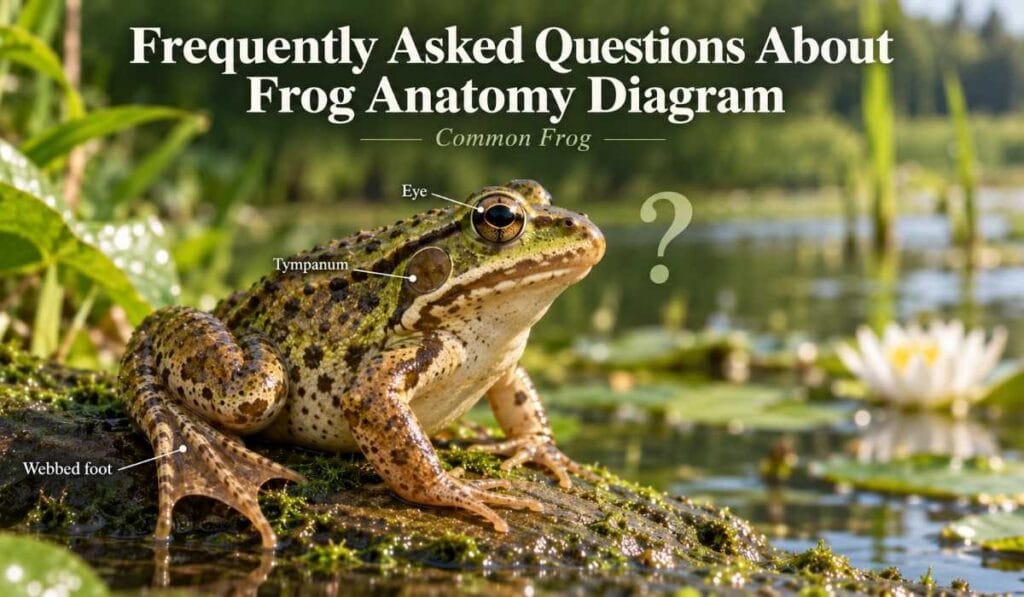
The head is the front region of a frog’s body and contains several important sensory structures. The eyes are large and positioned on the upper surface of the head, allowing frogs to observe their surroundings while staying partially hidden in water. Their elevated position provides a wider field of vision to detect predators and locate prey. Behind each eye is the tympanum, a circular membrane that functions as an external eardrum. It detects sound vibrations and helps frogs communicate with other frogs, especially during breeding seasons. The mouth is wide and adapted for catching insects, worms, and other small animals. Frogs usually swallow their prey whole because they do not chew food. The nostrils are small openings near the front of the head that allow frogs to breathe air. The forelimbs are shorter front legs used for balance, support, and absorbing shock during landing. The powerful hind limbs contain strong muscles that enable frogs to jump long distances and escape predators. The feet often have webbed toes that improve swimming ability. The skin is thin, moist, and essential for respiration, water balance, and protection.
Internal Frog Anatomy Labels
Inside a frog’s body are several organs that perform vital functions. The heart pumps blood throughout the body and has three chambers: two atria and one ventricle. This structure supports circulation and is a characteristic feature of amphibians. The lungs allow frogs to breathe air when they are on land, while their moist skin also contributes to gas exchange. The large liver plays important roles in digestion, nutrient storage, and removing harmful substances from the body. The stomach stores food and begins breaking it down after the frog swallows its prey. The intestines absorb nutrients from digested food and transport waste materials through the digestive system. The kidneys filter waste products from the blood and help regulate water balance. The reproductive organs produce eggs in females and sperm in males, allowing frogs to reproduce during breeding periods.
How to Read a Frog Anatomy Diagram
To read a frog anatomy diagram correctly, first identify the frog’s body position, such as side view, top view, or internal view. Follow the labels carefully to match each name with the correct structure. Understanding the location of organs helps learners visualize how different body systems are arranged. For students, the best learning method is to study one section at a time, connect each structure with its function, and review diagrams regularly. Learning both the name and purpose of each body part makes frog anatomy easier to understand and remember.
External Frog Anatomy Diagram Explained

A frog’s external anatomy includes all the visible body structures that help it survive, move, communicate, and adapt to different environments. Unlike many animals, frogs have specialized external features that allow them to live both in water and on land. A labeled external frog anatomy diagram helps readers identify important body parts and understand how each structure contributes to survival. The major external features of frogs include the head, eyes, nostrils, tympanum, mouth, skin, limbs, and feet. Each structure performs a specific function, from detecting predators and capturing prey to breathing, maintaining moisture, swimming, and escaping danger. These adaptations show how frog body design has evolved to support an amphibious lifestyle. Frog skin is one of the most unique features of amphibians. It helps frogs breathe, absorb water, and protect their bodies from environmental changes. Because frogs depend heavily on their surroundings, understanding their habitat is important. Learn more in our guide about Frog Habitat: Where Do Frogs Live and How Do They Survive?.
Frog Head Anatomy and Important Features
The frog head contains several important sensory structures that help frogs interact with their surroundings. One of the most recognizable features is the pair of large eyes located on the upper surface of the head. These eyes provide frogs with excellent vision and help them detect movement from both predators and prey.
Why do frogs have eyes on top of their heads? : Frogs have eyes positioned on top of their heads because this adaptation helps them survive in aquatic environments. When a frog floats in water, most of its body can remain hidden while only its eyes and nostrils stay above the surface. This allows the frog to observe its surroundings while reducing the chance of being detected by predators. The upper eye position also provides a wider field of vision, which helps frogs locate prey and respond quickly to danger. Since frogs often catch insects using a rapid tongue movement, accurate vision is essential for successful hunting.
Why are frog eyes so large? : Frog eyes are large because many frog species are active during nighttime or in low-light conditions. Larger eyes allow more light to enter, improving their ability to detect movement and locate prey. Large eyes also help frogs identify predators quickly and increase their chances of survival. Frogs have protective eyelids that keep their eyes moist and prevent damage. They also have a special transparent third eyelid called the nictitating membrane. This thin membrane covers the eye while allowing frogs to see underwater. It protects the eyes from dirt, debris, and injury during swimming. The external nostrils, also called nares, are small openings located near the front of the frog’s snout. They allow frogs to breathe air while their bodies remain partially submerged in water. These nostrils connect to the mouth cavity and support respiration. Behind each eye is the tympanum, a circular membrane that functions as an external eardrum. Frogs do not have visible external ears like humans, but the tympanum allows them to detect sound vibrations.
How can frogs hear without external ears? : Frogs can hear without external ears because their tympanum receives sound waves and transfers vibrations to the inner ear. This system helps frogs detect environmental sounds, predator movements, and communication calls from other frogs. Male frogs especially rely on hearing to recognize mating calls during the breeding season. The mouth structure of frogs is designed for catching and swallowing food. Frogs have a wide mouth opening that helps them capture insects, worms, and other small prey. Their sticky tongue can quickly extend outward to catch food, which is then swallowed whole because frogs do not chew.
Frog Skin Anatomy and Its Functions
A frog’s skin is one of its most important external structures. Unlike mammals, frogs have thin, moist skin that performs several essential functions, including respiration, water regulation, protection, and defense.
Why do frogs need wet skin? : Frogs need wet skin because moisture allows gases such as oxygen and carbon dioxide to pass through the skin. Their moist skin helps them absorb oxygen from the environment, especially when they are underwater or resting. Dry skin reduces their ability to exchange gases and can be harmful to their survival. Frog skin contains many mucus glands that produce a slippery coating. This mucus keeps the skin moist, reduces water loss, and helps frogs move smoothly through water. It also provides protection against harmful microorganisms.
Can frogs breathe through their skin? : Yes, frogs can breathe through their skin through a process called cutaneous respiration. Oxygen passes through the moist skin into tiny blood vessels underneath, while carbon dioxide moves out. This ability is especially important when frogs are underwater or when their lungs are not actively being used. Frogs also absorb water through their skin instead of drinking it like humans. Specialized areas of their skin allow them to take in moisture directly from their surroundings, helping maintain hydration. Some frog species have defense chemicals in their skin that protect them from predators. Poison dart frogs, for example, produce toxins that discourage predators from attacking. These chemical defenses are an important survival adaptation.
Frog Limb Anatomy: Front Legs, Back Legs, and Feet
A frog’s limbs are specially adapted for movement in different environments. Their legs allow them to jump, swim, climb, and escape predators effectively. The forelimbs are the shorter front legs of frogs. They contain bones, muscles, and joints that provide support and balance. During jumping, the forelimbs help absorb impact when the frog lands and keep the body stable. The hind legs are the most powerful external structures of a frog. They contain large muscles that generate the force required for jumping. These legs work like springs by storing and releasing energy, allowing frogs to make powerful leaps.
Why do frogs have long back legs? : Frogs have long back legs because they provide the strength and flexibility needed for powerful jumps. Long hind limbs help frogs escape predators, catch prey, and move quickly between land and water. This adaptation is one of the main reasons frogs are excellent jumpers. Many frogs have webbed feet, especially species that spend much of their time in aquatic environments. The skin between their toes increases the surface area of the feet, allowing frogs to push against water more effectively. This improves swimming speed and movement control. Some frogs, especially tree frogs, have specialized toe pads at the ends of their toes. These structures help them attach to leaves, branches, and smooth surfaces.
Why can tree frogs climb walls? : Tree frogs can climb walls because their toe pads contain microscopic structures that create strong attachment forces. These pads allow them to grip smooth surfaces without claws. This adaptation helps tree frogs move safely through trees, avoid predators, and find suitable resting places. The combination of powerful hind legs, flexible limbs, webbed feet, and adhesive toe pads makes frog limb anatomy highly adapted for survival. These external features allow frogs to thrive in forests, wetlands, ponds, and many other habitats.
Frog Internal Anatomy Diagram: Major Organs and Functions

A frog internal anatomy diagram shows the major organs located inside a frog’s body and helps explain their arrangement and basic functions. Unlike external anatomy, internal structures cannot be seen directly, so labeled diagrams are especially useful for understanding where organs are located and how they connect with each other. The main internal systems of a frog include the circulatory system, respiratory system, digestive system, excretory system, and reproductive system. Each organ has a specific role that helps frogs survive in aquatic and terrestrial environments. This section focuses on diagram-based identification of major organs rather than detailed physiological processes. Frogs have a specialized digestive system that allows them to eat insects and other small animals. Their sticky tongue helps them capture prey quickly. You can learn more about their feeding habits in our detailed guide: What Do Frogs Eat? Complete Frog Diet and Feeding Guide.
Frog Heart Anatomy and Blood Circulation
The frog heart is a central organ in the internal anatomy diagram and is located in the upper part of the body cavity, between the lungs. Unlike mammals, frogs have a three-chambered heart consisting of two atria and one ventricle. The two atria are the upper chambers of the heart. The right atrium receives blood from the body, while the left atrium receives oxygen-rich blood from the lungs and skin. The lower chamber, called the ventricle, pumps blood to the rest of the body.
Why does a frog have a three-chambered heart? : Frogs have a three-chambered heart because their amphibious lifestyle requires a circulation system that works with both lungs and skin respiration. Although this structure allows some mixing of oxygen-rich and oxygen-poor blood, it is suitable for their lower energy needs compared with mammals.In a frog anatomy diagram, blood flow can be understood as a continuous pathway. Blood from the body enters the heart, moves through the chambers, and is then pumped toward the lungs and body tissues.
Frog Respiratory Organs: Lungs and Skin Breathing
The respiratory system of frogs includes the lungs and skin, which work together to exchange gases. The lungs are located inside the body cavity near the heart and appear as small sac-like structures in internal anatomy diagrams. Adult frogs use their lungs to breathe air, especially when they are active on land. However, their thin, moist skin also plays an important role in respiration. Oxygen can pass through the skin into blood vessels, allowing frogs to exchange gases even when they are underwater or resting. Young frogs, called tadpoles, have a different respiratory system. Tadpoles mainly use gills to breathe because they live completely in water. As they develop into adult frogs, their gills disappear, and lungs become the primary breathing organs along with skin respiration.
Can frogs breathe underwater? : Yes, frogs can breathe underwater, but not in the same way as fish. They absorb oxygen through their moist skin rather than using lungs. This ability allows them to remain underwater for extended periods.
Frog Digestive System Diagram
The frog digestive system includes several organs that work together to process food and remove waste. In a frog anatomy diagram, the digestive tract begins at the mouth and continues through a series of connected organs. The mouth is the entry point where frogs capture prey. Frogs use their long, sticky tongue to catch insects and other small animals. The tongue is attached near the front of the mouth, allowing it to quickly extend outward and pull prey inside.
How do frogs swallow food without chewing? : Frogs swallow food without chewing because they do not have teeth designed for grinding food. Instead, they catch prey with their tongue, use their jaws to hold it, and push the food toward the throat before swallowing it whole. After entering the mouth, food moves through the esophagus, a tube that connects the mouth to the stomach. The stomach stores food and begins digestion. From the stomach, partially digested food moves into the intestines, where nutrients are absorbed. The intestines are an important part of the digestive system because they help provide energy needed for movement and survival. At the end of the digestive tract is the cloaca, a common chamber where digestive waste, urinary waste, and reproductive materials leave the body. This structure is a unique feature found in many amphibians.
Frog Excretory System: Kidney and Urinary Organs
The excretory system of frogs removes waste products and helps maintain water balance. The main organs shown in a frog internal anatomy diagram are the kidneys, urinary tubes, and urinary bladder. The kidneys are located near the back wall of the body cavity and filter waste materials from the blood. They help remove unwanted substances and regulate the amount of water and salts inside the body.The urinary bladder stores urine before it leaves the body through the cloaca. This system is especially important for frogs because they frequently move between aquatic and terrestrial environments where water balance can change.
Frog Reproductive Organs
The reproductive organs of frogs are responsible for producing eggs and sperm. In male frogs, the main reproductive organs are the testes, which produce sperm during the breeding season. Female frogs have ovaries, which produce eggs. Mature eggs move through reproductive pathways before being released into water during reproduction. Frog reproduction is closely connected with their aquatic lifestyle because most species lay eggs in water. A labeled internal anatomy diagram helps identify these reproductive structures and understand their location inside the frog’s body.
Frog Skeleton Anatomy Diagram: Bones Behind Frog Movement
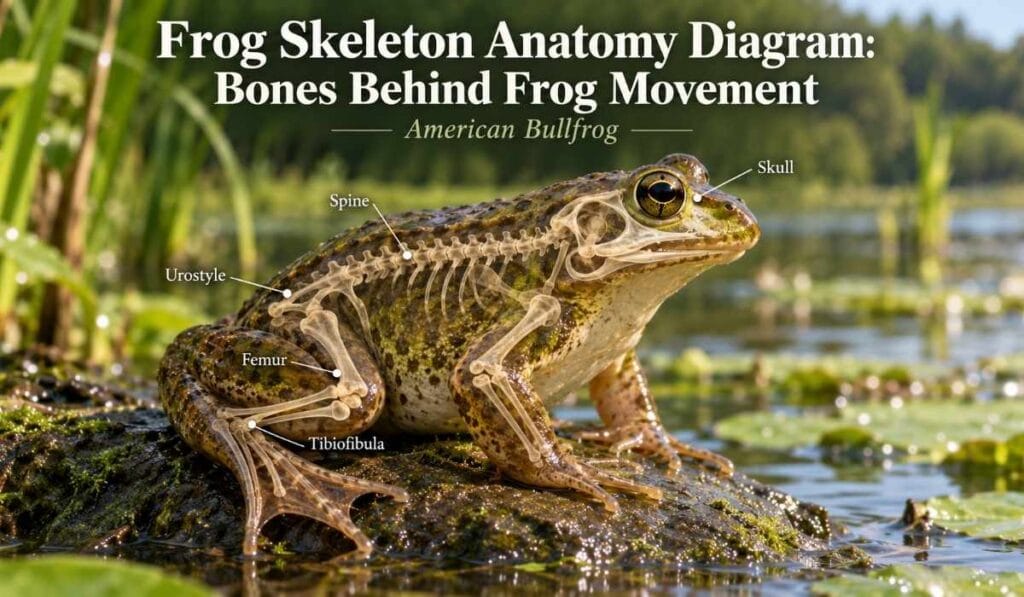
A frog skeleton anatomy diagram shows the internal bone structure that supports a frog’s body, movement, and survival. Although frogs have a small and lightweight skeleton, their bones are highly adapted for jumping, swimming, and landing safely. Unlike mammals, frogs have a body design specialized for powerful movement with fewer bones and a unique arrangement of skeletal structures. The frog skeleton includes the skull, backbone, urostyle, and specialized limb bones. Each part contributes to balance, flexibility, and efficient movement. Understanding frog bones helps explain why these small amphibians can perform impressive jumps and survive in different environments. Frogs have powerful hind legs that allow them to jump long distances and escape predators. These adaptations vary among species, which is why different frogs have unique body designs. Explore more examples in Types of Frogs: 25 Species With Pictures, Identification and Facts.
Frog Skull Structure
The frog skull is lightweight and specially designed to support quick movement. Compared with many animals, frogs have a relatively flat and simple skull structure with fewer bones. This lightweight design reduces the overall body weight, making movement and jumping easier. The frog skull protects the brain and contains openings for important sensory structures such as the eyes, nostrils, and mouth. The large eye sockets allow frogs to have their characteristic large eyes, which improve vision and help detect predators and prey. The jaw structure of frogs is adapted mainly for catching and swallowing food. Unlike mammals, frogs do not have strong chewing teeth designed for breaking down food. Instead, their jaws help hold prey while their sticky tongue captures insects and other small animals.
Frog Spine and Urostyle Bone
The spine of a frog provides support and connects the skull with the rest of the body. Compared with humans and many other vertebrates, frogs have a relatively short vertebral column. This shorter backbone helps create a compact body shape that supports powerful hind limb movement. A unique feature of the frog skeleton is the urostyle bone. The urostyle is a long, rod-like bone located at the end of the backbone. It is formed by fused vertebrae and provides extra support to the pelvic region.The urostyle plays an important role during jumping by helping transfer force from the powerful hind legs through the body. It also improves stability when frogs land after a jump. This specialized bone is one of the important skeletal adaptations that makes frog movement efficient.
Frog Leg Bones and Jumping Adaptation
A frog’s powerful jumping ability depends on its specialized leg bones and strong muscles. The hind limbs contain several important bones that work together to produce forceful movements. The femur is the upper leg bone connected to the hip. It is strong and supports the large muscles responsible for generating jumping power. The tibiofibula is a fused lower leg bone that combines the tibia and fibula. This structure provides strength while maintaining a lightweight design. The ankle bones are also important in frog movement. These elongated bones help increase the length of the hind limbs and improve the force produced during jumping. The arrangement of these bones allows frogs to extend their legs quickly and efficiently. Strong muscle attachment points on frog bones provide areas where powerful leg muscles connect. These muscles store and release energy, allowing frogs to jump several times their body length.
Why are frogs such powerful jumpers despite their small size? : Frogs are powerful jumpers because their skeleton and muscles are specially adapted for explosive movement. Their long hind limbs, strong leg muscles, flexible joints, and lightweight bones work together like a spring system. This combination allows frogs to generate large amounts of force and escape predators quickly.
Frog Anatomy Diagram Compared With Human Body
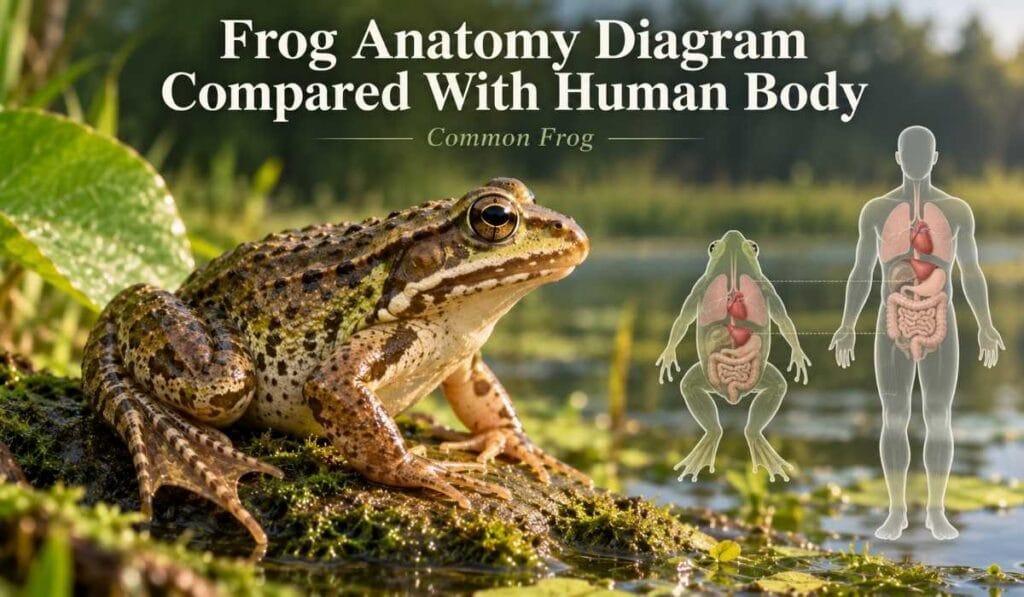
Comparing frog anatomy with human anatomy helps explain how different animals are adapted to their environments. Although frogs and humans share many basic body structures because both are vertebrates, their anatomy has evolved differently based on their lifestyles. Frogs are designed for jumping, swimming, and amphibious living, while humans have adaptations for walking upright and performing complex movements. A comparison of their skeleton, heart, breathing system, and body structures reveals both similarities and important differences. Frogs and humans share many similarities because both are vertebrates. However, their body systems have evolved differently. These adaptations begin during early development, from eggs to adult frogs. Learn more in Frog Life Cycle: From Egg to Tadpole to Adult Frog Explained.
Frog Skeleton vs Human Skeleton
Both frogs and humans have skeletons made of bones that provide support, protect organs, and allow movement. However, their skeletal structures are adapted for different purposes. Frogs have a lightweight skeleton with specialized bones such as the urostyle, which supports jumping. Their long hind limbs are designed for powerful leaps, while their shorter forelimbs help with balance and landing. Humans have a more complex skeleton designed for upright posture and walking on two legs. The human spine is longer and more flexible, and the limbs are adapted for walking, grasping, and fine movements rather than jumping.
Frog Heart and Breathing System vs Humans
Both frogs and humans have hearts that pump blood throughout the body, but their structures are different. Frogs have a three-chambered heart with two atria and one ventricle, while humans have a four-chambered heart that completely separates oxygen-rich and oxygen-poor blood.Frogs use both lungs and skin for breathing, while humans depend mainly on lungs for gas exchange. This skin respiration allows frogs to survive in aquatic environments where humans cannot.
Major Similarities and Differences
Frogs and humans share several similarities because both are vertebrates. They have a brain, heart, lungs, kidneys, digestive organs, and reproductive systems. However, their body designs reflect their different lifestyles.Frogs are adapted for amphibious survival with moist skin, powerful hind legs, and aquatic reproduction. Humans are adapted for terrestrial life with advanced skeletal structures, complex movement abilities, and specialized body systems. Understanding these similarities and differences helps explain how evolution shapes animal anatomy.
Frog Anatomy Diagram for Students and Biology Learning

A frog anatomy diagram is an important learning tool for students studying biology, zoology, and animal science. It helps learners identify the major external structures and internal organs of frogs and understand how each part contributes to survival. Instead of memorizing isolated names, students can use diagrams to connect each structure with its location and function. Frog anatomy is commonly studied because frogs represent an important group of amphibians and show unique adaptations for living both on land and in water. Learning the basic anatomy of frogs also helps students understand broader biological concepts such as vertebrate structure, organ systems, and evolutionary adaptations. Frogs and humans share many similarities because both are vertebrates. However, their body systems have evolved differently. These adaptations begin during early development, from eggs to adult frogs. Learn more in Frog Life Cycle: From Egg to Tadpole to Adult Frog.Explained.
Important Frog Anatomy Parts to Remember
For exams and biology learning, students should focus on the most important frog anatomy parts that frequently appear in diagrams and questions. External structures such as the head, eyes, tympanum, nostrils, mouth, forelimbs, hind limbs, and skin are essential to remember. Internal organs including the heart, lungs, liver, stomach, intestines, kidneys, and reproductive organs are also important for understanding frog body systems.An easy way to memorize frog anatomy is to group structures by function. Sensory organs such as the eyes, tympanum, and nostrils help frogs detect their environment. Movement structures such as the hind legs, feet, and muscles help with jumping and swimming. Internal organs can be remembered by connecting them with body systems, such as the digestive system, respiratory system, and circulatory system.
How to Label a Frog Anatomy Diagram Correctly
Correctly labeling a frog anatomy diagram requires understanding the position and location of each structure. Students should first identify the frog’s body orientation, whether it is shown from the side, top, or internal view. Common mistakes include confusing the forelimbs with hind limbs, incorrectly placing the heart or lungs, and mixing up digestive organs such as the stomach and intestines. Careful observation of organ location helps avoid these errors. Regular diagram practice is one of the best ways to improve accuracy. Students should practice labeling without looking at notes, then compare their answers with a correctly labeled diagram. Learning both the name and function of each part makes remembering frog anatomy easier.
7. Frog Anatomy Differences Among Frog Species

Although all frogs share basic anatomical features, different frog species have developed unique adaptations based on their habitats and lifestyles. A tree frog, bullfrog, and poison dart frog may have similar body structures, but their external anatomy shows special features that help them survive in different environments. These adaptations affect movement, defense, hunting, and interaction with their surroundings. Tree frogs have special toe pads that allow them to climb smooth surfaces and live above the ground. These are examples of how frog species develop different adaptations. See more examples in Types of Frogs: 25 Species With Pictures, Identification and Facts.
Tree Frog Anatomy Adaptations
Tree frogs have specialized anatomical adaptations that help them live in trees and other elevated habitats. Their most noticeable feature is their toe pads, which provide strong grip on leaves, branches, and smooth surfaces. Many tree frogs also have a lightweight body that makes climbing and jumping between plants easier. Their flexible limbs and specialized feet allow them to move efficiently through forest environments.
Bullfrog Anatomy Adaptations
Bullfrogs have adaptations suited for their large size and aquatic lifestyle. They have a large body, strong muscles, and powerful hind legs that help them move quickly through water and land. Their strong legs allow them to make powerful jumps and escape predators. Their larger size also helps them capture bigger prey compared with many smaller frog species.
Poison Dart Frog Anatomy Adaptations
Poison dart frogs have unique defensive adaptations that protect them from predators. Their most important feature is their toxic skin, which contains chemical compounds that can make predators avoid them.Many poison dart frogs also have bright warning colors, such as vivid patterns of red, blue, yellow, or orange. These colors act as a signal to predators that the frog may be dangerous or unpalatable. Their combination of toxic skin and warning coloration makes them highly specialized amphibians.
Frequently Asked Questions About Frog Anatomy Diagram
Frogs have different body structures because each species adapts to its environment, diet, and predators. For example, tree frogs have climbing adaptations, while aquatic frogs have features that help them survive in water. Explore more frog diversity in our guide on Types of Frogs: 25 Species With Pictures, Identification and Facts.
What are the main body parts of a frog?
A frog’s body is divided into several important external parts that help it survive in both aquatic and terrestrial environments. The main body parts include the head, eyes, nostrils, mouth, tympanum, trunk, forelimbs, hind limbs, feet, and skin. The head contains important sensory organs. Frogs have large eyes that provide a wide field of vision, helping them detect predators and locate prey. Their nostrils, also called external nares, allow them to breathe while their eyes remain above the water surface. Behind each eye is the tympanum, a circular membrane that works like an external ear and helps frogs detect sounds. The frog’s mouth is adapted for catching prey. Most frogs have a sticky tongue that can extend quickly to capture insects and small animals. Their front legs help with movement and landing, while their powerful hind legs are specialized for jumping and swimming.The skin is one of the most important body parts of a frog. Unlike many animals, frogs use their skin for breathing, water absorption, and protection. Their moist skin contains glands that produce mucus, keeping the body hydrated and allowing oxygen exchange.
What organs are inside a frog?
A frog has many internal organs that perform essential life functions. The major internal organs include the heart, lungs, liver, stomach, intestines, kidneys, urinary bladder, and reproductive organs. The heart pumps blood throughout the body. Unlike humans, frogs have a three-chambered heart consisting of two atria and one ventricle. The lungs help frogs breathe on land, while their skin also plays an important role in respiration. The digestive system includes the mouth, esophagus, stomach, small intestine, large intestine, and cloaca, which help process and remove food waste. The liver is one of the largest organs in a frog and performs several functions, including producing bile for digestion and storing energy. The kidneys remove waste from the blood and help maintain water balance. Male and female frogs also have different reproductive organs. Males have testes that produce sperm, while females have ovaries that produce eggs.A frog anatomy diagram helps identify where these organs are located and how they are arranged inside the body.
What does a frog anatomy diagram show?
A frog anatomy diagram is a labeled illustration that shows the different external and internal structures of a frog. It helps students, researchers, and animal enthusiasts understand how a frog’s body is organized. An external anatomy diagram usually shows visible body parts such as the eyes, nostrils, tympanum, mouth, limbs, toes, and skin. These labels help explain how frogs interact with their environment. An internal anatomy diagram shows hidden organs, including the heart, lungs, liver, stomach, intestines, kidneys, and reproductive organs. These diagrams are especially useful because many important frog structures cannot be seen from the outside.A detailed frog anatomy diagram also explains the relationship between different body systems. For example, it shows how the lungs and skin work together for breathing, or how the digestive organs process food.
How do you label a frog anatomy diagram?
To label a frog anatomy diagram correctly, it is important to identify the location and function of each body part. For an external frog diagram, common labels include:
- Eye
- Nostril
- Tympanum
- Mouth
- Forelimb
- Hind limb
- Webbed feet
- Skin
For an internal frog diagram, common labels include:
- Heart
- Lungs
- Liver
- Stomach
- Small intestine
- Large intestine
- Kidney
- Urinary bladder
- Cloaca
When labeling, students should follow the diagram carefully and place labels near the correct structures. Learning the function of each part makes memorization easier because the names become connected with their biological roles.
Do frogs have lungs?
Yes, frogs have lungs, but their respiratory system is different from humans. Adult frogs use their lungs to breathe on land, but they do not depend on lungs alone. A frog’s lungs are simple compared with mammalian lungs. They have fewer internal divisions and rely partly on movements of the mouth and throat to push air into the lungs. Frogs can also breathe through their skin, which is especially important when they are underwater or inactive. This ability allows frogs to survive in environments where normal breathing is difficult.
Can frogs breathe through their skin?
Yes, frogs can breathe through their skin through a process called cutaneous respiration. A frog’s skin contains many small blood vessels close to the surface. Oxygen from the surrounding water or air passes through the moist skin and enters the bloodstream, while carbon dioxide leaves the body. This is why frogs must keep their skin moist. If their skin becomes dry, gas exchange becomes difficult, which can threaten their survival. Skin respiration is especially important during winter, underwater periods, or when frogs are resting.
Do frogs have ears?
Frogs do not have external ears like humans, but they can hear using a structure called the tympanum. The tympanum is a circular membrane located behind the frog’s eye. It receives sound vibrations and transfers them to the inner ear. Frogs use hearing mainly for communication, especially during mating season when males produce calls to attract females.
Do frogs have teeth?
Yes, some frogs have teeth, but their teeth are very different from human teeth. Most frogs have small teeth called maxillary teeth along the upper jaw. These teeth are mainly used to hold prey rather than chew food. Frogs usually swallow their food whole because they do not chew like mammals. Their sticky tongue helps capture insects and other small animals quickly.
Why do frogs have long back legs?
Frogs have long and powerful hind legs because these structures help them jump, escape predators, and move efficiently through water. The hind legs contain strong muscles that store and release energy during jumping. Their long femur, tibiofibula, and ankle bones work together to create powerful movements. This adaptation allows some frogs to jump many times their own body length, making them excellent escape artists.
How is frog anatomy different from human anatomy?
Frog anatomy and human anatomy share many similarities because both are vertebrates, meaning they have backbones and similar organ systems. Both frogs and humans have:
- A heart
- Lungs
- Kidneys
- A digestive system
- A nervous system
However, there are major differences. Frogs have a three-chambered heart, while humans have a four-chambered heart. Frogs can breathe through their skin, whereas humans depend mainly on lungs. Frogs have powerful hind legs designed for jumping, while humans have legs adapted mainly for walking and running. Frogs also have a cloaca, a common opening used for digestive, urinary, and reproductive functions, while humans have separate openings.These differences show how frog anatomy has evolved specifically for survival in both water and land environments.
Conclusion: What Frog Anatomy Reveals About Survival and Evolution
Frog anatomy reveals how every body structure has a specific role in helping frogs survive and adapt to their environment. From the large eyes that improve vision to the moist skin that allows breathing and water absorption, each feature represents an important evolutionary adaptation. The powerful hind limbs, lightweight skeleton, and specialized feet allow frogs to jump, swim, climb, and escape predators effectively. Internal structures such as the three-chambered heart, lungs, digestive organs, and reproductive system support essential life processes and help frogs maintain their amphibious lifestyle. Studying frog anatomy shows how evolution shapes organisms according to their surroundings. Different frog species have developed unique adaptations, such as toe pads in tree frogs, strong bodies in bullfrogs, and toxic skin in poison dart frogs, allowing them to survive in different habitats. Understanding frog anatomy is valuable not only for biology education but also for wildlife conservation. By learning how frogs function and adapt, scientists and students can better understand the importance of protecting amphibian species and their ecosystems. A frog anatomy diagram is more than just a labeled picture; it is a window into the remarkable relationship between structure, function, survival, and evolution.
Related Frog Guides
- Frog Anatomy: Complete Guide to Frog Body Parts and Internal Organs
- Frog Life Cycle: From Egg to Tadpole to Adult Frog Explained
- What Do Frogs Eat? Complete Frog Diet and Feeding Guide
- Frog Habitat: Where Do Frogs Live and How Do They Survive?
- Why Do Frogs Croak at Night? Frog Sounds and Communication Explained
- How Long Do Frogs Live? Frog Lifespan and Survival Factors
- Types of Frogs: 25 Species With Pictures, Identification and Facts
- Difference Between Male and Female Frogs: Easy Identification Guide
- Can You Touch Frogs? Safety Guide for Kids and Beginners
- What Eats Frogs? Frog Predators and Defense Mechanisms Explained

