


The frog life cycle is a fascinating biological process in which frogs undergo metamorphosis, transforming from aquatic eggs into fully developed adult frogs. This remarkable journey consists of five main stages: egg, tadpole, tadpole with legs, froglet, and adult frog. The cycle begins when female frogs lay eggs, usually in water, where developing embryos receive protection from a jelly-like coating. After hatching, tadpoles breathe primarily through gills and swim using their tails. As they grow, hind legs and then front legs develop, lungs become functional, and their tails gradually shrink. During the froglet stage, young frogs begin transitioning from aquatic to terrestrial life. Finally, adult frogs reach reproductive maturity and can begin the cycle again. However, development time varies depending on species, temperature, food availability, and environmental conditions. Interestingly, some frog species bypass the typical free-swimming tadpole stage entirely, demonstrating the extraordinary diversity of amphibian development.
What Is the Frog Life Cycle?

The frog life cycle is the series of developmental stages through which a frog grows from an egg into a reproductive adult. Most familiar pond-breeding frogs experience metamorphosis, a remarkable biological transformation involving major changes in body structure, breathing, movement, and feeding.
What Are the Five Stages of a Frog’s Life Cycle?
The five commonly recognized stages are egg, tadpole, tadpole with legs, froglet, and adult frog. Each stage prepares the animal for different environmental conditions and survival challenges.
Why Do Frogs Change Their Body Shape as They Grow?
Frogs undergo metamorphosis because tadpoles and adults have different ecological requirements. Aquatic tadpoles typically swim using tails and breathe through gills, while adult frogs primarily use lungs and skin for respiration and developed limbs for movement.
How Is the Frog Life Cycle Different From Other Animals?
Unlike mammals, which generally retain the same basic body structure as they grow, frogs undergo extensive anatomical remodeling. Their skull, digestive system, limbs, respiratory structures, and tail change dramatically, allowing different life stages to exploit different food sources and habitats. Scientific Reference: Gilbert, S. F. (2000). Developmental Biology, 6th edition, “The Frog Life Cycle” and “Metamorphosis: The Hormonal Reactivation of Development.” NCBI Bookshelf.
Stage 1: Frog Eggs — How Does a Frog’s Life Begin?
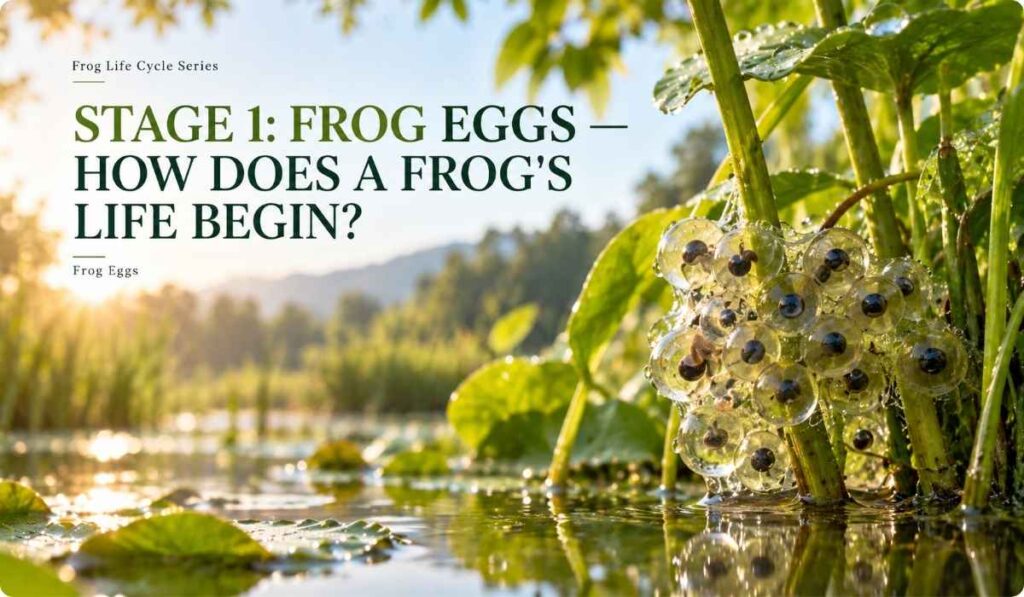
The frog life cycle begins with eggs, usually deposited in freshwater habitats. After fertilization, each egg develops into an embryo through a series of carefully coordinated biological processes.
Where Do Frogs Lay Their Eggs?
Most pond-breeding frogs lay eggs in ponds, wetlands, or slow-moving water. However, some species deposit eggs on leaves, in foam nests, or in moist terrestrial environments. Fertilization is typically external, occurring as the female releases her eggs.
What Happens Inside a Fertilized Frog Egg?
Embryonic development begins with cleavage, when the fertilized egg divides into smaller cells. During gastrulation, these cells organize into tissue layers. Neurulation establishes the early nervous system, while organogenesis produces developing organs, including the heart and digestive system.
Why Are Frog Eggs Covered in Jelly?
A protective jelly coating helps maintain moisture, cushions developing embryos, and provides some protection against physical damage. However, it cannot prevent every predator or environmental threat.
How Long Does It Take Frog Eggs to Hatch?
Many aquatic frog eggs hatch within several days to a few weeks, depending on species, temperature, and environmental conditions. Remarkably, red-eyed treefrog embryos (Agalychnis callidryas) can detect predator-associated vibrations and hatch early to escape danger, even before completing their usual developmental period.
Scientific References
- NCBI Bookshelf — The Frog Life Cycle — Explains fertilization, cleavage, gastrulation, and embryonic development.
- Jung et al. (2025) — The Role of Vibration Amplitude in the Escape-Hatching Response of Red-Eyed Treefrog Embryos — Demonstrates how embryos combine vibration characteristics to assess predation risk.
Stage 2: Tadpole — How Does a Baby Frog Survive Underwater?

The tadpole stage begins when a developing frog hatches from its egg and enters an aquatic larval phase. Unlike adult frogs, tadpoles have specialized body structures that help them survive, feed, and move underwater.
What Does a Newly Hatched Tadpole Look Like?
Newly hatched tadpoles typically have rounded bodies, elongated tails, and no visible legs. Some initially attach themselves to underwater vegetation before becoming active swimmers.
How Do Tadpoles Breathe Underwater?
Tadpoles initially use external gills, which are generally replaced or covered by internal gill structures as they develop. Many species also use their skin for gas exchange, while lungs develop or become functional at different stages.
What Do Tadpoles Eat Before They Develop Legs?
Tadpole diets vary significantly between species. Many consume algae, microorganisms, and decaying organic matter, while others eat insects, small aquatic animals, or even other tadpoles.
Why Do Tadpoles Have Long Tails but No Legs?
Their muscular tails generate propulsion, allowing efficient swimming and escape from predators. Legs develop later as their bodies prepare for metamorphosis. For example, the lemur leaf frog (Agalychnis lemur) feeds on algae and organic detritus during its tadpole stage. According to the Smithsonian National Zoo, its froglets subsequently transition to hunting live insects, illustrating how metamorphosis changes feeding behavior. Scientific Reference: Smithsonian National Zoo — New at the Zoo: Lemur Leaf Frogs
Stage 3: Tadpole with Legs — Why Do Tadpoles Grow Legs?

During the tadpole with legs stage, the developing frog undergoes remarkable anatomical changes as it prepares for life beyond water. This transformation involves limb growth, skeletal remodeling, muscle development, and gradual changes in respiration.
Which Legs Do Tadpoles Grow First?
In typical frog development, hind legs become externally visible first, emerging near the base of the tail. Front legs develop beneath surrounding tissues and usually become visible later.
Why Do Tadpoles Develop Back Legs Before Front Legs?
This developmental sequence reflects how frog limbs form and emerge during metamorphosis. Growing hind limbs gradually prepare the animal for jumping and other adult movements, while its tail continues supporting swimming.
How Do Tadpoles Begin Developing Lungs?
Many tadpoles develop lungs before completing metamorphosis. As development progresses, lungs become increasingly important for breathing air, while larval gills gradually disappear.
Can Tadpoles Still Swim After Growing Legs?
Yes. Tadpoles continue swimming primarily through tail-powered propulsion, even after their hind legs appear. Their developing limbs gradually become more useful for movement. These changes are coordinated largely by thyroid hormones, particularly T3 and T4, which regulate gene activity and tissue remodeling. Other hormones, including corticosteroids, also influence developmental timing. Research demonstrates that disrupting thyroid hormone signaling can delay or prevent normal metamorphosis.
Scientific References:
- NCBI/PubMed Central — Amphibian Metamorphosis
- Thyroid and Corticosteroid Signaling in Amphibian Metamorphosis (2022)
Stage 4: Froglet — What Happens When a Tadpole Becomes a Frog?
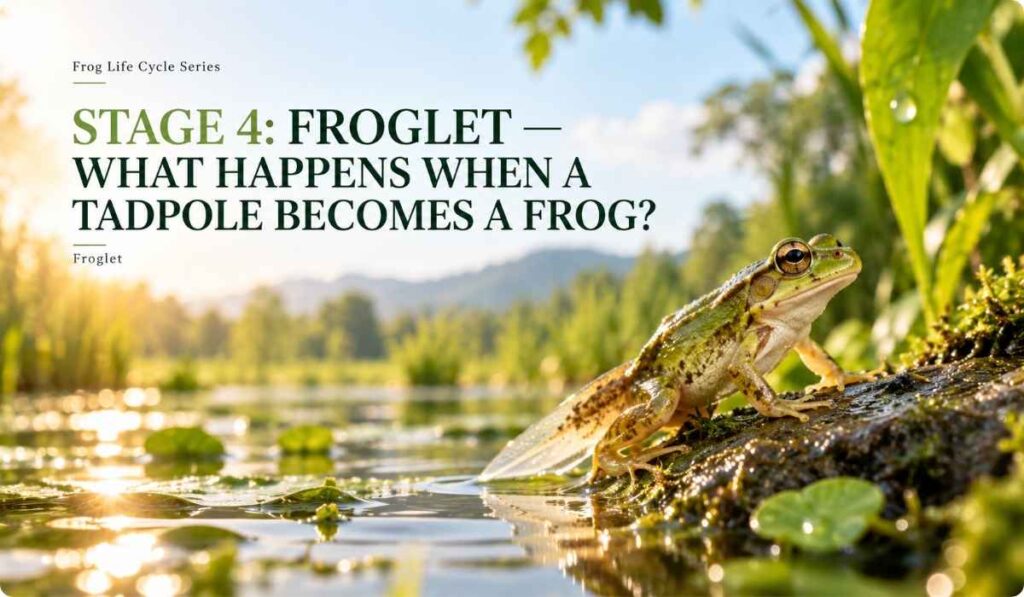
The froglet stage marks the final phase of frog metamorphosis, when a tadpole develops a frog-like body while completing important anatomical and physiological changes.
What Is a Froglet?
A froglet is a juvenile frog that has developed four functional limbs but may still retain a small tail. Its body increasingly resembles an adult frog, although it has not reached reproductive maturity.
Why Does a Froglet Still Have a Small Tail?
The remaining tail gradually disappears through tail resorption, a controlled biological process involving programmed cell death and tissue breakdown. The body recycles many of the tail’s components as metamorphosis progresses.
How Does a Froglet Adapt to Life on Land?
Froglets develop stronger limbs, functional lungs, and modified mouthparts. Their digestive systems also undergo remodeling as many species transition from plant-rich tadpole diets to eating small invertebrates.
What Is the Difference Between a Froglet and an Adult Frog?
Froglets are smaller, sexually immature, and still developing. Adult frogs possess mature reproductive structures and can eventually breed. According to NCBI’s Developmental Biology, metamorphosis involves extensive remodeling of the skull, jaws, intestines, respiratory structures, and tail. Scientific Reference: NCBI Bookshelf — Metamorphosis: The Hormonal Reactivation of Development
Stage 5: Adult Frog — When Does a Frog Become Fully Grown?
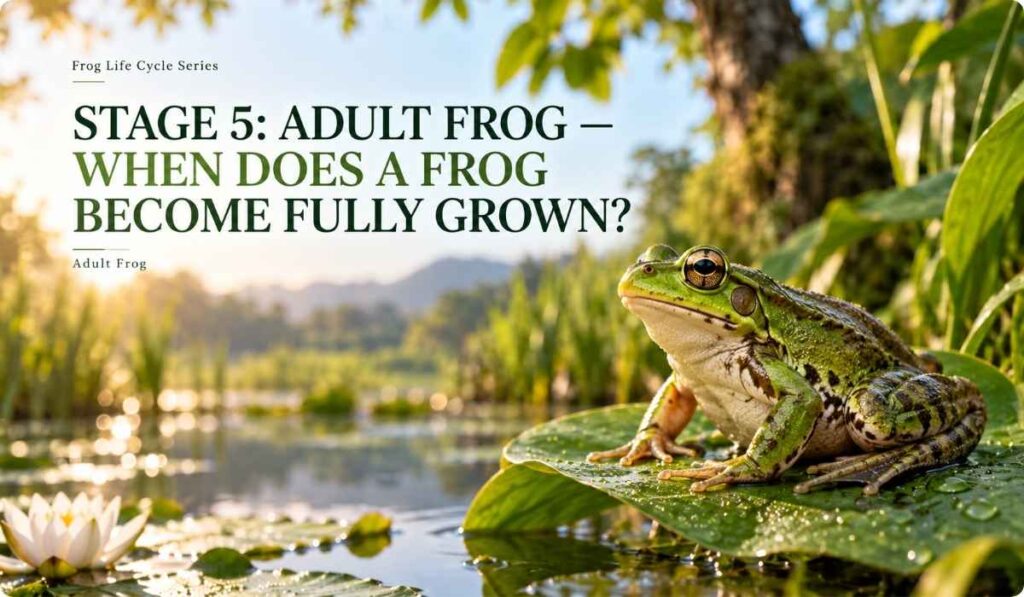
The adult frog stage represents the reproductive phase of the frog life cycle. However, completing metamorphosis does not mean a young frog immediately reaches its full size or sexual maturity.
What Happens When a Frog Becomes an Adult?
Adult frogs possess fully developed limbs, specialized feeding structures, and reproductive organs. Most species primarily consume insects and other small animals, although feeding habits vary.
How Do Adult Frogs Breathe on Land and in Water?
Adult frogs breathe through lungs and moist skin, a process called cutaneous respiration. Their skin absorbs dissolved oxygen, allowing gas exchange in aquatic and terrestrial environments.
When Do Frogs Become Sexually Mature?
Sexual maturity varies considerably among species. For example, African clawed frogs (Xenopus laevis) typically reach reproductive maturity around 10–12 months, well after metamorphosis.
How Do Adult Frogs Begin the Life Cycle Again?
During breeding, reproductive hormones coordinate mating behavior and egg production. In most species, males fertilize eggs externally as females release them. These fertilized eggs develop into embryos, beginning the next generation of the frog life cycle. Scientific Reference: Smithsonian National Zoo — African Clawed Frog
How Long Does the Frog Life Cycle Take From Egg to Adult?
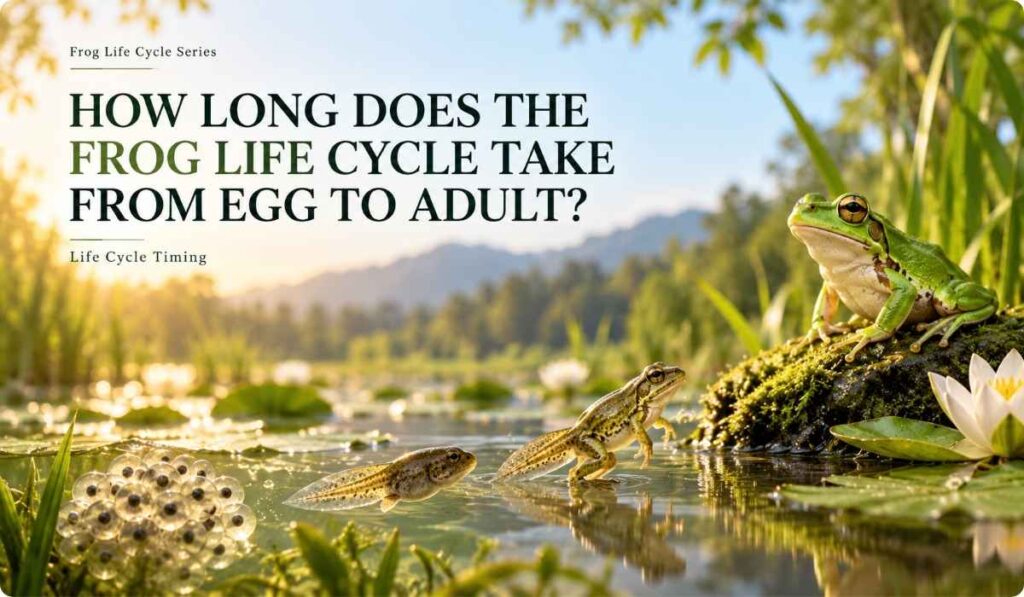
The frog life cycle can take several weeks to many months, depending on the species, water temperature, food availability, and environmental conditions. Importantly, completing metamorphosis and reaching sexual maturity are separate developmental milestones.
How Many Days Do Frog Eggs Take to Hatch?
Many aquatic frog species hatch within a few days to two weeks. For example, gray tree frog eggs generally hatch in 3–7 days, while lemur leaf frog eggs hatch in approximately 7–14 days.
How Long Does a Tadpole Take to Turn Into a Frog?
Tadpole development varies considerably. African clawed frogs may complete their transformation from egg to small frog in approximately 6–8 weeks, whereas some other species require several months.
How Long Does the Froglet Stage Last?
There is no universal froglet duration. Tail resorption typically occurs near the end of metamorphosis, but juvenile frogs continue growing for months or longer before reaching sexual maturity.
Why Do Some Frog Species Develop Faster Than Others?
Species-specific genetics, evolutionary adaptations, food resources, and environmental conditions influence developmental speed.
How Do Temperature and Environment Affect Development Time?
Warmer conditions within a species’ suitable temperature range often accelerate growth and metamorphosis. However, extreme heat, inadequate nutrition, pollution, or other environmental stresses can disrupt normal development.
Frog Life Cycle Duration by Species
| Frog species | Egg hatching | Development to froglet or small frog |
|---|---|---|
| Gray tree frog (Hyla versicolor) | 3–7 days | Metamorphosis typically 45–65 days |
| African clawed frog (Xenopus laevis) | Within 1 week | 6–8 weeks from egg |
| Lemur leaf frog (Agalychnis lemur) | 7–14 days | 69–98 days after hatching |
| Golden mantella frog (Mantella aurantiaca) | About 14 days | Around 70 days after hatching |
Sources: Smithsonian National Zoo species profiles. Developmental durations have different reported starting points and should not be interpreted as directly equivalent egg-to-adult timelines. These examples demonstrate why no single development time applies to every frog species. Some complete metamorphosis within weeks, while others remain tadpoles for months. Scientific Sources: Smithsonian National Zoo — Gray Tree Frog, African Clawed Frog, Lemur Leaf Frog, and Golden Mantella Frog.
How Does Frog Metamorphosis Work Scientifically?

Frog metamorphosis is a hormonally regulated developmental process that transforms an aquatic tadpole into a juvenile frog. It involves coordinated changes in gene activity, tissue structure, organ function, and behavior.
What Triggers Metamorphosis in Frogs?
Metamorphosis is primarily triggered by increasing thyroid hormone activity. The hypothalamic-pituitary-thyroid axis regulates hormone production, while environmental conditions influence developmental timing.
What Role Does Thyroid Hormone Play in Frog Development?
The thyroid produces thyroxine (T4), which can be converted into the more biologically active triiodothyronine (T3). T3 binds thyroid hormone receptors, regulating genes responsible for tissue growth, differentiation, and remodeling.
How Do Tadpoles Transform Their Gills, Lungs, and Digestive Systems?
As metamorphosis progresses, larval gills disappear, lungs become increasingly important, and the intestine remodels to accommodate changing feeding habits. These processes occur at different rates across tissues.
Why Do Tadpoles Lose Their Tails During Metamorphosis?
Tail disappearance involves programmed cell death (apoptosis), tissue degradation, and the recycling of cellular materials. Meanwhile, developing limbs progressively replace the tail’s role in movement.
Can Metamorphosis Stop or Become Delayed?
Yes. Inadequate nutrition, unsuitable temperatures, endocrine-disrupting chemicals, and disrupted thyroid signaling can delay or interfere with metamorphosis. A 2019 review in Frontiers in Endocrinology explains that glucocorticoids interact with thyroid hormones, affecting tissue sensitivity and developmental progression. This demonstrates that metamorphosis is not controlled by one simple hormonal switch. Scientific References:
- Sachs & Buchholz (2019) — Insufficiency of Thyroid Hormone in Frog Metamorphosis and the Role of Glucocorticoids
- Thambirajah et al. (2019) — Contaminant and Environmental Influences on Thyroid Hormone Action in Amphibian Metamorphosis
What Do Frogs Eat at Each Stage of Their Life Cycle?
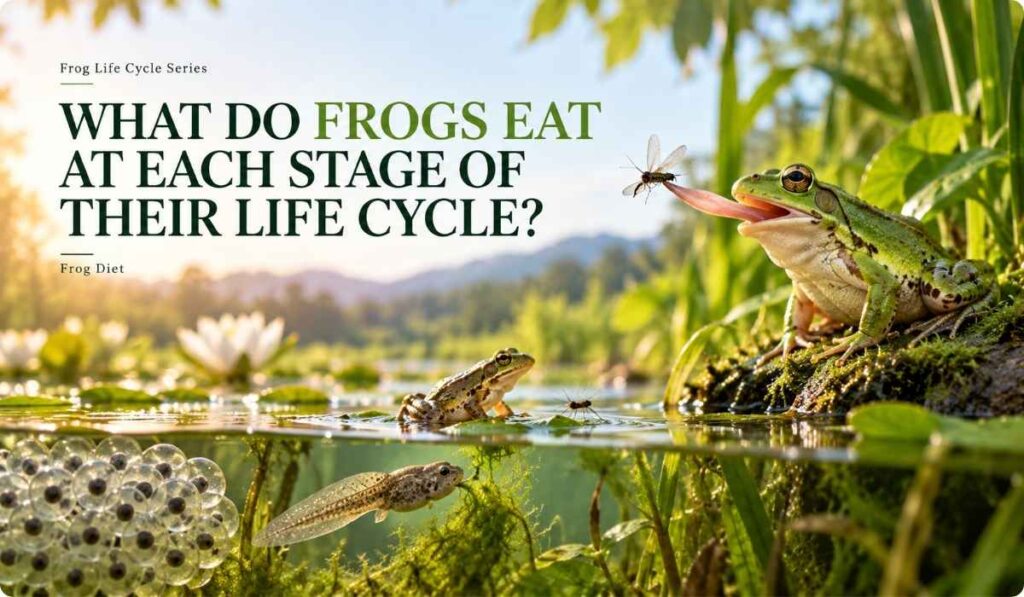
The frog’s diet changes throughout its life cycle, reflecting major differences in digestive anatomy, feeding behavior, and nutritional requirements.
Do Frog Embryos Need Food Before Hatching?
Frog embryos obtain nutrients from yolk stored inside their eggs. This energy supports cell division, organ formation, and growth before hatching.
What Do Newly Hatched Tadpoles Eat?
Newly hatched tadpoles initially rely on remaining yolk reserves. Many later feed on algae, microorganisms, and decaying organic matter, while some species consume animal material.
Why Do Tadpoles and Adult Frogs Often Eat Different Foods?
Metamorphosis transforms the digestive tract, mouthparts, and feeding mechanisms. Many tadpoles graze or filter food, whereas adult frogs typically capture insects and other small animals using specialized jaws and tongues.
What Do Froglets Eat After Leaving Water?
Most froglets hunt small live invertebrates, including tiny insects. For example, Smithsonian researchers report that lemur leaf frog tadpoles consume algae, detritus, and supplemental protein, while froglets transition to hunting small live insects. Scientific Reference: Smithsonian National Zoo — New at the Zoo: Lemur Leaf Frogs
Do All Frogs Follow the Same Life Cycle?
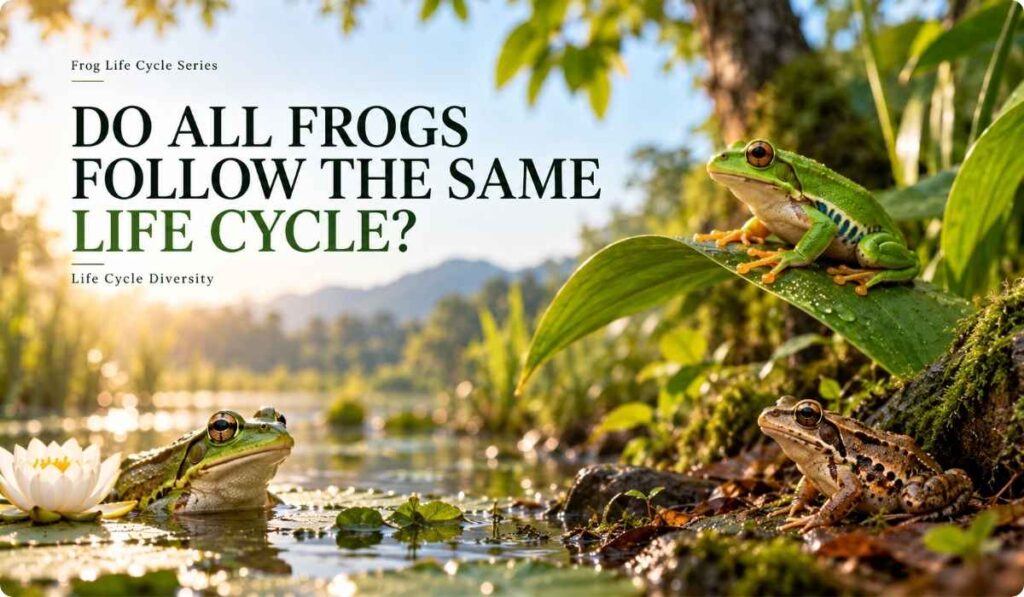
Not all frogs follow the familiar egg-to-tadpole-to-adult life cycle. Although aquatic metamorphosis is widespread, some species have evolved alternative developmental strategies.
Do All Frogs Go Through a Tadpole Stage?
No. Many frogs develop through free-swimming tadpoles, while others undergo direct development, completing major developmental changes inside their eggs.
Which Frog Species Hatch Directly as Froglets?
The Puerto Rican coquí (Eleutherodactylus coqui) hatches as a miniature frog rather than an aquatic tadpole. Its terrestrial eggs support development without a free-swimming larval stage.
How Do Tree Frogs and Aquatic Frogs Differ in Their Life Cycles?
Many tree frogs deposit eggs on vegetation above water, while aquatic frogs commonly lay eggs directly in water. However, reproductive strategies vary considerably within both groups.
Why Have Some Frogs Evolved Unusual Reproductive Strategies?
Different environments favor adaptations such as terrestrial eggs, direct development, and parental care, which can reduce particular environmental risks. Research published in PNAS demonstrates that thyroid hormone-dependent remodeling still occurs in coquí embryos before hatching. Scientific Reference: Callery & Elinson (2000) — Thyroid Hormone-Dependent Metamorphosis in a Direct Developing Frog
What Factors Affect Frog Growth and Survival?
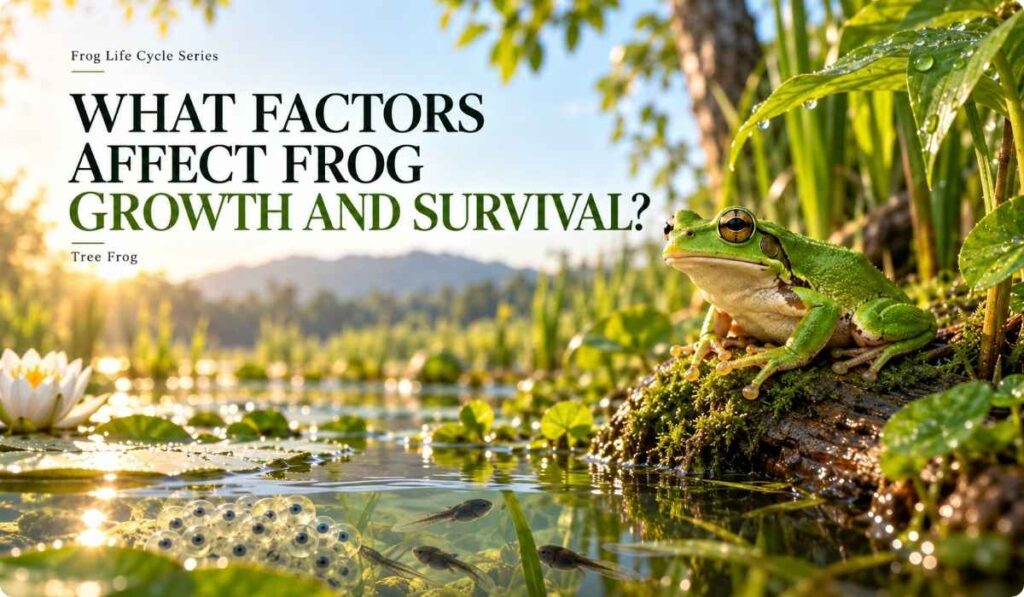
Frog growth and survival are influenced by several environmental and biological factors, including water temperature, food availability, pollution, predators, and disease. These conditions affect embryonic development, tadpole growth, metamorphosis, and the chances of reaching adulthood.
How Does Water Temperature Affect Tadpole Growth?
Water temperature plays a crucial role in tadpole development and metamorphosis. Warmer temperatures within a species’ suitable range generally accelerate metabolism, growth, and developmental processes. However, excessively high temperatures can cause physiological stress, reduce dissolved oxygen levels, and increase mortality. Colder conditions may slow development, causing tadpoles to remain in their aquatic stage longer.
Can Pollution Affect Frog Development?
Yes. Environmental pollutants, including certain pesticides, industrial chemicals, and agricultural contaminants, can interfere with normal frog development. Some chemicals disrupt thyroid hormone signaling, which regulates metamorphosis. Depending on the substance and exposure level, pollution may cause delayed development, abnormal growth, or reduced survival.
How Do Predators Influence Frog Eggs and Tadpoles?
Frog eggs and tadpoles face numerous predators, including fish, aquatic insects, birds, and other amphibians. Interestingly, predator presence can influence tadpole behavior even without direct attacks. Some tadpoles reduce their swimming activity, seek shelter, or develop different body shapes in response to chemical cues released by predators. These adaptations may improve survival but can also affect feeding opportunities and growth rates.
Why Do Some Frog Eggs and Tadpoles Fail to Survive?
Many frog eggs and tadpoles never reach adulthood because of environmental challenges such as:
- Poor water quality: Pollution and low dissolved oxygen can impair development.
- Food shortages: Insufficient nutrients can slow growth and delay metamorphosis.
- Habitat drying: Temporary ponds may disappear before tadpoles complete development.
- Predation and disease: Predators, parasites, and infectious organisms can increase mortality.
Scientific research demonstrates that environmental contaminants can interfere with hormone-regulated amphibian development, highlighting the importance of healthy aquatic ecosystems for successful frog reproduction and survival. Scientific Reference: Contaminant and Environmental Influences on Thyroid Hormone Action in Amphibian Metamorphosis (2019).
Fascinating Frog Life Cycle Facts That May Surprise You
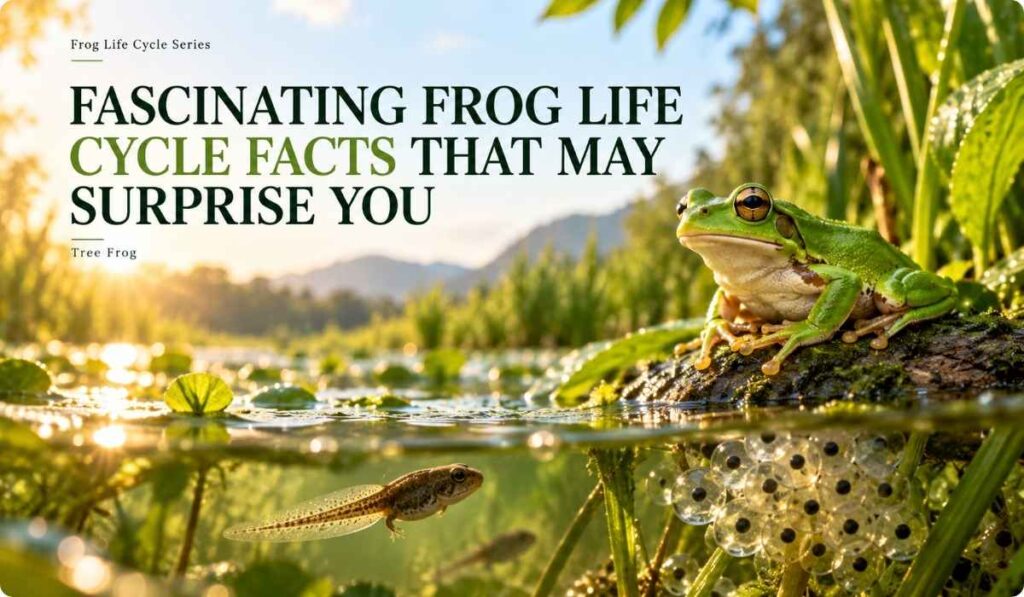
The frog life cycle is full of extraordinary biological adaptations that go far beyond the familiar transformation from tadpole to adult frog. Different species have evolved remarkable survival strategies involving reproduction, feeding, parental care, and metamorphosis.
Some Frogs Skip the Free-Living Tadpole Stage
Not all frogs develop into swimming tadpoles. The Puerto Rican coquí (Eleutherodactylus coqui) undergoes direct development, meaning its embryos complete their transformation inside terrestrial eggs and hatch as miniature froglets. This adaptation allows reproduction without requiring ponds or other permanent aquatic breeding habitats.
Frog Embryos Can Respond to Predator Attacks
Remarkably, red-eyed treefrog (Agalychnis callidryas) embryos can detect vibrations associated with approaching predators. When threatened by snakes, embryos may hatch prematurely and escape into the water below. This remarkable defense mechanism demonstrates that frog embryos can respond to environmental danger before hatching.
Tadpole Diets Can Differ Dramatically Between Species
Although many tadpoles consume algae, microorganisms, and decaying organic matter, others are carnivorous or omnivorous. Some species even consume smaller tadpoles. These feeding differences reflect adaptations to available food resources and competition within aquatic habitats.
Some Frogs Carry Their Tadpoles on Their Backs
Certain poison dart frogs demonstrate extraordinary parental care. Adults transport newly hatched tadpoles on their backs to small water-filled locations, including plant cavities. In some species, mothers regularly deposit unfertilized eggs to nourish their developing offspring.
Frog Metamorphosis Reorganizes Internal Organs
Metamorphosis involves much more than growing legs and losing a tail. Tadpoles undergo extensive changes in their digestive systems, skulls, muscles, and respiratory organs. Thyroid hormones coordinate much of this transformation, allowing aquatic larvae to develop into frogs adapted for different habitats and feeding behaviors. Scientific Sources:
- Smithsonian National Zoo — Poison Frogs.
- NCBI — Thyroid Hormone-Dependent Metamorphosis in a Direct-Developing Frog
- PubMed — Escape-Hatching Responses of Red-Eyed Treefrog Embryos (2025)
Frequently Asked Questions About the Frog Life Cycle (FAQs)

What Are the Five Stages of a Frog’s Life Cycle?
The five commonly illustrated stages of a frog’s life cycle are egg, tadpole, tadpole with legs, froglet, and adult frog. The process begins when a female lays fertilized eggs, usually in water or another moist environment. Embryos develop inside protective egg membranes before hatching into tadpoles. Tadpoles generally live underwater, swimming with their tails and using gills for respiration. As development continues, they grow hind legs, followed by the appearance of front legs. During metamorphosis, their bodies change dramatically, including the reduction of their tails and changes to their respiratory and digestive systems.
How Long Does It Take for a Tadpole to Become a Frog?
A tadpole may take several weeks to several months to become a frog, depending on its species, water temperature, nutrition, and environmental conditions. Some species develop quickly in temporary ponds, while others remain in the tadpole stage for much longer. Warm water within a species’ suitable temperature range can accelerate development, whereas colder conditions may slow growth. However, excessively high temperatures can cause stress or mortality.
Why Do Tadpoles Lose Their Tails During Metamorphosis?
Tadpoles lose their tails because their bodies are transforming from aquatic larvae into froglets adapted for a different way of life. During metamorphosis, thyroid hormones activate biological processes that gradually break down tail tissues. The body reabsorbs many of the materials released during this process, helping support development. Meanwhile, the frog’s growing limbs become increasingly important for movement.
How Do Tadpoles Breathe Underwater Before Developing Lungs?
Tadpoles primarily breathe underwater using gills that extract dissolved oxygen from surrounding water. Many species initially develop external gills, which are later covered by protective tissues as the larvae grow. Their respiratory systems gradually change as they approach metamorphosis. Lungs become increasingly functional, allowing developing frogs to obtain oxygen from air. Frogs can also exchange gases through their skin, although the importance of each respiratory method varies with species and developmental stage.
What Do Tadpoles Eat, and How Does Their Diet Change?
Many tadpoles feed on algae, microorganisms, decaying plant material, and organic particles found in aquatic habitats. However, feeding habits differ considerably among species. Some tadpoles are omnivorous, predatory, or even cannibalistic under particular conditions. As metamorphosis progresses, the digestive system undergoes major structural and functional changes. After developing into froglets, many species begin hunting small insects and other invertebrates.
Do All Frogs Go Through a Tadpole Stage?
No, not all frogs experience a free-swimming tadpole stage. Although most familiar frog species develop from eggs into aquatic tadpoles, certain species reproduce through a process called direct development. For example, the Puerto Rican coquí (Eleutherodactylus coqui) develops inside its egg and hatches as a miniature frog rather than an aquatic tadpole. This reproductive adaptation allows some frogs to reproduce without depending on ponds or other permanent bodies of water. However, developing eggs still require suitable environmental moisture.
How Long Does It Take for Frog Eggs to Hatch?
Frog eggs may hatch within a few days or take several weeks, depending on species, temperature, oxygen availability, and environmental conditions. For example, Smithsonian National Zoo reports that White’s tree frog eggs may begin hatching approximately 28–36 hours after laying under suitable conditions.
Can Tadpoles Survive Without Water?
Most aquatic tadpoles cannot survive for long outside water because their bodies are adapted to underwater life. Their gills require a suitable aquatic environment for oxygen exchange, and their delicate tissues are vulnerable to dehydration. However, tadpole adaptations vary among frog species. Some specialized larvae tolerate unusual habitats or periodically encounter conditions very different from permanent ponds. As tadpoles develop legs and functional lungs, many become increasingly capable of moving into terrestrial environments.
What Factors Can Speed Up or Slow Down Frog Metamorphosis?
Frog metamorphosis is influenced by temperature, nutrition, water availability, environmental stress, and hormonal activity. Thyroid hormones play a central role in controlling developmental changes, including limb formation, digestive remodeling, and tail resorption. Under suitable conditions, warmer temperatures may accelerate development, while colder temperatures often slow biological processes. Food shortages can restrict growth, and drying ponds may alter metamorphic timing in species adapted to temporary aquatic environments.
Can Frogs Complete Their Life Cycle Without Living in a Pond?
Yes. Some frogs complete their life cycles without using traditional ponds. Species with direct development may lay eggs in moist terrestrial locations, where embryos develop into froglets before hatching. Other frogs use specialized breeding habitats, including water-filled tree holes, leaf axils, or small pools formed inside tropical plants. For example, certain poison frogs transport newly hatched tadpoles to tiny water reservoirs in bromeliads. In some species, females return to feed tadpoles with unfertilized eggs.
Scientific Sources for the FAQs
- AmphibiaWeb — Frog species, reproductive diversity, and developmental biology.
- Smithsonian National Zoo — Frog reproduction, egg hatching, and metamorphosis.
- Journal of Experimental Biology — Research on predator-induced early hatching in red-eyed treefrog embryos.
- NCBI Bookshelf: The Frog Life Cycle — Scientific explanations of embryonic development and metamorphosis.
These FAQs are ready to place after the main content and before your article’s Final Thoughts section.
Related Guides: Explore More About Frogs
Discover more about frog development, reproduction, anatomy, and fascinating biological adaptations through these related guides on FrogDetails.com.