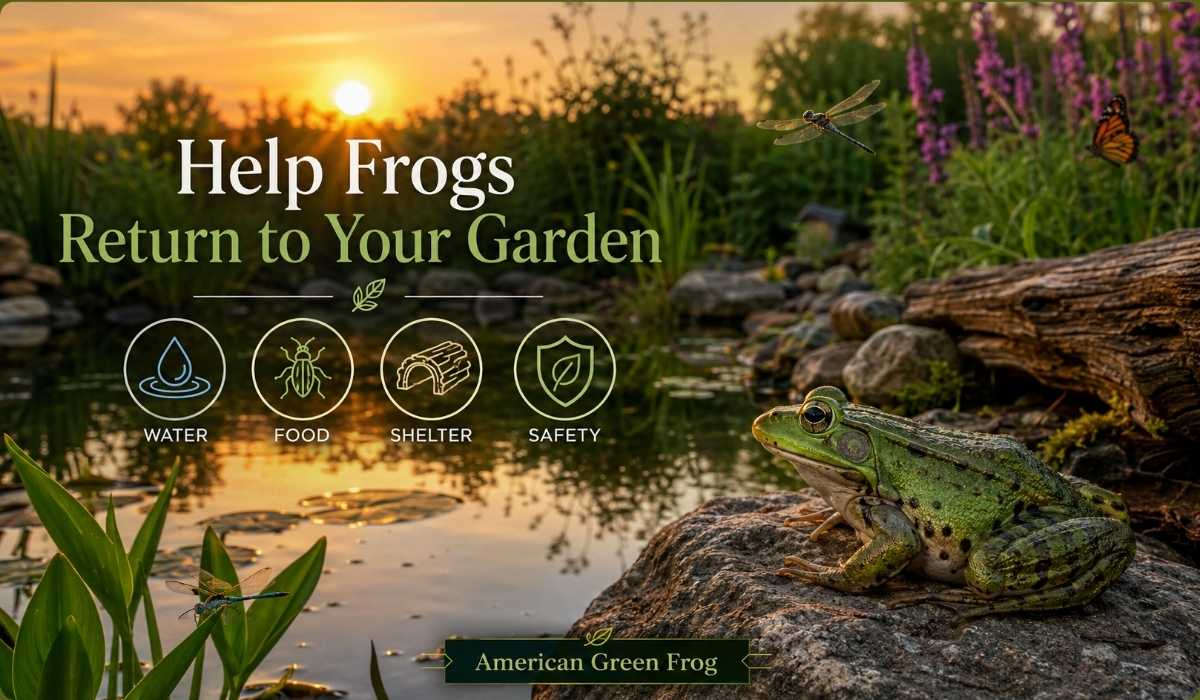
Frogs live in an incredible variety of habitats, from tropical rainforests and freshwater ponds to mountains, grasslands, deserts, underground burrows, and even urban gardens. Frog Habitat: Where Do Frogs Live and How Do They Survive? explores the environments frogs depend on and the remarkable adaptations that help them stay alive. Readers will learn how frogs use moisture, camouflage, webbed feet, sticky toe pads, burrowing behavior, seasonal activity, and specialized breeding strategies to survive. The guide also explains how habitat loss, pollution, climate change, and disappearing wetlands threaten frog populations, while offering practical ways people can help protect local frogs and their ecosystems.
What Is a Frog Habitat?
A frog habitat is the complete environment in which a frog finds the resources needed to live, grow, reproduce, and avoid danger. It includes more than a pond or other visible water source. Temperature, humidity, vegetation, soil, shelter, prey, predators, breeding sites, and connections between different areas all influence whether a location can support a frog population. Because frogs have permeable skin and are ectothermic, they depend strongly on surrounding moisture and temperature. However, different species have evolved to live in environments ranging from humid rainforests and permanent wetlands to dry grasslands, deserts, mountains, and underground burrows.
The Meaning of Habitat for Frogs
In ecology, habitat refers to the broader place where a species lives. A frog’s habitat might be described as a tropical forest, freshwater wetland, grassland, mountain stream, desert floodplain, or woodland pond. A suitable habitat must provide all the resources needed throughout the frog’s life. A pond may be ideal for laying eggs but unsuitable for feeding, sheltering, or surviving winter. Likewise, a forest may provide excellent adult shelter but still require nearby water for species with aquatic tadpoles.
Habitat vs Microhabitat
A habitat is the larger environment, while a microhabitat is the exact small location used by an individual frog. For example, a rainforest is a habitat, but the underside of a wet leaf, a moss-covered rock, or a water-filled tree cavity is a microhabitat. Microhabitats often have slightly different moisture, temperature, light, and protection levels from the surrounding landscape. These small differences can determine whether a frog remains hydrated, avoids predators, or survives extreme heat and cold. Frogs may use leaf litter, logs, animal burrows, rock cracks, and other protected locations depending on the season.
Why Frogs Need Both Land and Water
Many frogs begin life as aquatic eggs and tadpoles before becoming partly or mainly terrestrial adults. This means one population may depend on breeding water, feeding grounds on land, sheltered resting areas, and safe migration routes connecting them. Research on pond-breeding frogs shows that protecting only the breeding pond may not be enough. Nonbreeding habitat and movement corridors can be equally important because adults may travel away from water after reproduction. Not every frog follows the familiar egg-to-tadpole-to-adult pattern in open water. Some species lay eggs on moist land, inside plants, or in underground chambers, and direct-developing species hatch as small froglets without a free-swimming tadpole stage.
How Habitat Needs Differ Between Species
Aquatic frogs may spend nearly their entire lives in water, while tree frogs depend on branches, leaves, and climbing surfaces. Stream frogs need flowing, oxygen-rich water, whereas burrowing frogs may remain underground until seasonal rain arrives. Habitat requirements may also change with age, sex, season, and breeding condition. Tadpoles need suitable water depth, food, temperature, and enough time to complete metamorphosis. Adults may require entirely different areas for hunting, shelter, hibernation, or avoiding dry weather.
Where Do Frogs Live Around the World?

Frogs have one of the broadest distributions of any amphibian group. They occur in tropical forests, wetlands, temperate woodlands, mountains, grasslands, deserts, agricultural landscapes, gardens, and even regions close to the Arctic Circle. frog species around the world
Continents Where Frogs Are Found
Native frogs are found on every continent except Antarctica. Their global distribution includes North America, South America, Europe, Asia, Africa, and Australia, as well as many oceanic and continental islands. Amphibians are especially concentrated in warm, moist tropical areas but have also developed adaptations for cold and seasonally dry environments. Different continents support distinctive frog communities. South America contains enormous numbers of rainforest and mountain species, Africa supports reed frogs, rain frogs, and giant river frogs, while Australia has many highly specialized burrowing and tree-dwelling species.
Regions with the Greatest Frog Diversity
The greatest frog diversity is found in the tropics, particularly in Central America, northern and western South America, the Amazon Basin, Tropical Andes, Southeast Asia, New Guinea, Madagascar, and parts of Central Africa. The New World tropics contain the strongest overall concentration of anuran diversity. Countries such as Brazil, Colombia, and Ecuador are especially species-rich, while Indonesia, Papua New Guinea, India, Sri Lanka, and Madagascar also support major centers of amphibian diversity.
Warm temperatures, frequent rainfall, varied elevations, dense vegetation, and numerous streams and wetlands create many ecological niches. A single rainforest may contain canopy frogs, leaf-litter frogs, burrowing species, stream specialists, and frogs that breed inside tiny pools held by plants.
Why Antarctica Has No Native Frogs
Antarctica has no native frogs because its extreme cold, prolonged ice cover, limited liquid freshwater, and lack of vegetation cannot support normal amphibian feeding, breeding, and development. Frogs are ectothermic, meaning their body temperature depends largely on environmental conditions. Some species can tolerate freezing for limited periods, but no living frog is adapted to complete its entire life cycle under permanent Antarctic conditions. AmphibiaWeb describes amphibians as globally distributed except in the polar regions of Antarctica and Greenland.
Endemic Frogs Found Only in One Region
An endemic frog is naturally restricted to one country, island, mountain range, forest, river system, or other limited geographic area. Isolation prevents populations from mixing with frogs elsewhere, allowing them to evolve independently. Islands and isolated mountains often contain particularly unusual endemic species. New Zealand’s native Leiopelma frogs, for example, are unique to the country and include terrestrial forest species and frogs associated with shaded stream edges. Endemic frogs can be especially vulnerable because a single fire, disease outbreak, introduced predator, drought, or habitat development project may affect much of their total range.
Essential Things Every Frog Habitat Needs

Although frog species have different ecological requirements, most suitable habitats provide several essential resources. what frogs eat
Moisture and Humidity
Moisture helps protect a frog’s permeable skin and supports normal skin-based gas exchange. Damp soil, shaded vegetation, rainfall, fog, moss, ponds, and humid shelters can all reduce water loss. Frogs living in dry climates may avoid dehydration by becoming active at night, hiding beneath the ground, forming protective skin layers, or emerging only during rainy periods.
Freshwater Access
Many species require freshwater for egg laying and tadpole development. Suitable water may come from ponds, marshes, streams, temporary pools, flooded grasslands, tree holes, or water collected between leaves. Water quality and duration are important. Tadpoles must usually complete development before temporary pools disappear, while excessive pollution, introduced fish, or unsuitable vegetation can reduce breeding success.
However, permanent open water is not essential for every species. Some frogs lay terrestrial eggs, use tiny plant-held pools, or complete direct development in moist nests.
Food Availability
A habitat must contain enough food for both adults and developing young. Adult frogs commonly eat insects, spiders, worms, slugs, and other small animals, while larger species may capture fish, reptiles, rodents, or other frogs.
Tadpole diets vary widely. Depending on the species, they may consume algae, plant material, microorganisms, detritus, eggs, or other tadpoles. A habitat that supports only adult prey but lacks suitable larval food may still be unable to maintain a breeding population.
Shelter from Predators and Weather
Frogs need places where they can hide from birds, snakes, mammals, fish, extreme temperatures, direct sunlight, and dry wind. Dense plants, fallen wood, leaf litter, muddy banks, tree hollows, rock cracks, and underground burrows provide important protection.
Shelter also creates stable microclimates. A moist space beneath a log can remain cooler and more humid than exposed soil, helping a frog survive during hot or dry weather.
Suitable Temperature
Because frogs rely on external heat, temperature affects their metabolism, movement, feeding, calling, breeding, and tadpole development. Each species has a preferred temperature range and limits beyond which normal activity becomes difficult.
Forest shade, water depth, elevation, soil burrows, and seasonal movement allow frogs to regulate their body temperature behaviorally. During severe heat or cold, many species become inactive and retreat into protected microhabitats.
Safe Breeding Areas
A breeding site must provide the correct water depth, temperature, vegetation, rainfall pattern, and protection from predators. Some frogs attach eggs to aquatic plants, while others lay them on leaves above streams, in foam nests, in tree cavities, or beneath the ground.
The length of time water remains in a pond, known as its hydroperiod, can determine whether tadpoles survive long enough to transform into froglets.
Frog Microhabitats—Where Frogs Actually Hide

A broad habitat description rarely reveals where a frog spends most of its day. Many species occupy very small, carefully selected hiding places.
Under Leaves and Fallen Logs
Leaf litter and fallen wood provide shade, moisture, insects, and protection. Ground-dwelling frogs may hide beneath decomposing leaves during daylight and emerge at night to feed. Logs also create damp spaces underneath them and gradually support fungi, insects, and other prey. These sites are especially valuable in forests where exposed soil dries quickly.
Inside Tree Hollows and Bark Crevices
Arboreal frogs may shelter in hollow trees, cracks in bark, folded leaves, bamboo stems, or water-filled plant cavities. These locations protect them from sunlight and predators while maintaining higher humidity. Some species also breed in tree holes or transport tadpoles to small pools collected inside plants.
Beneath Rocks and Moss
Rocks create cool, shaded spaces, particularly beside streams and in mountain habitats. Moss absorbs water and provides a humid surface where small frogs can rest without being easily noticed. Streamside frogs may retreat into narrow cracks when water levels rise or temperatures become unsuitable.
Among Aquatic Plants
Reeds, floating leaves, submerged vegetation, and grasses provide calling sites, egg-attachment surfaces, hunting areas, and cover from predators. Vegetation near the water’s edge is often especially important because it connects aquatic breeding areas with terrestrial shelter.
Inside Soil Burrows
Burrowing frogs use loose soil, sand, mud, or abandoned animal burrows to escape heat and drought. Some possess hardened structures on their hind feet that help them dig backward. During dry periods, these frogs may remain inactive underground for weeks or months before rainfall triggers feeding and breeding activity.
Why Microhabitats Prevent Dehydration
Small shelters reduce exposure to sunlight, wind, and dry air. They can retain moisture long after the surrounding surface becomes dry. Because frog skin loses water easily, access to humid refuges can determine how long a frog can remain away from open water. Surface moisture has been shown to strongly influence habitat use in species such as the Wood Frog.
Rainforest Frog Habitats

Rainforests contain several vertical and aquatic habitat layers, allowing many frog species to live within the same forest without using exactly the same resources.
Tropical Rainforest Floor
The forest floor contains wet leaves, roots, fallen branches, mud, fungi, insects, and shaded pools. Poison frogs and many small terrestrial species search through leaf litter for food and may deposit eggs in protected terrestrial sites. Some poison frogs later carry their tadpoles to streams, tree holes, or small plant-held pools.
Shrubs and Understory Vegetation
The understory includes low plants, vines, saplings, and shrubs beneath the canopy. It provides perches for hunting and calling while remaining humid and protected from direct sunlight. Small tree frogs may move between leaves to catch insects, hide from predators, or reach temporary breeding water after rain.
Forest Canopy Habitats
The canopy contains branches, leaves, vines, tree cavities, and pools of collected rainwater. Arboreal frogs are often lightweight and possess enlarged toe pads that help them climb smooth, wet vegetation. Red-Eyed Tree Frogs are strongly associated with humid tropical forests and use vegetation around breeding water. Their climbing ability allows them to spend much of their adult lives above the forest floor. Amazon Milk Frogs also use elevated rainforest environments and may shelter or reproduce around water-filled tree cavities.
Rainforest Streams and Temporary Pools
Streams are essential for species whose tadpoles develop in moving water. Glass frogs commonly place eggs on leaves or rocks above streams; after hatching, the larvae fall into the water below. Temporary pools create another important habitat. Because they may contain fewer fish, they can offer safer breeding conditions, but tadpoles must develop before the water dries.
How Rainforest Frogs Survive High Humidity
High humidity reduces dehydration risk, but rainforest frogs still face heavy rain, flooding, predators, competition, and fungal disease. They survive through behaviors and body features suited to particular forest layers.
Toe pads support climbing, camouflage hides frogs among moss and leaves, and carefully selected egg-laying sites protect developing young. By dividing the rainforest into floor, understory, canopy, stream, and temporary-pool habitats, different species can occupy specialized ecological roles within the same ecosystem.
Pond, Lake and Wetland Frog Habitats

Ponds, lakes, marshes, swamps, floodplains, and other wetlands provide some of the most familiar frog habitats. These environments offer breeding water, aquatic food, humid shelter, and vegetation that frogs can use for calling, hiding, hunting, and attaching their eggs. However, different wetland types support different frog communities.
Permanent Ponds vs Temporary Ponds
Permanent ponds retain water throughout most or all of the year. They can support frogs with long tadpole-development periods, aquatic adults, and species that overwinter beneath the water. American Bullfrogs, for example, commonly live around lakes, ponds, and slow-moving streams with enough vegetation for cover. Their tadpoles may remain aquatic for an extended period before completing metamorphosis.
Temporary ponds, also called ephemeral or seasonal pools, fill after rain, snowmelt, or flooding and later dry out. They may contain fewer predatory fish, giving frog eggs and tadpoles a safer place to develop. The risk is that the water may disappear before metamorphosis is complete.
Wood Frogs and Spring Peepers frequently breed in seasonal woodland pools. Wood Frogs may also use flooded meadows, quiet streams, lake edges, and roadside ditches where standing water remains long enough for tadpoles to develop.
Shallow Water and Vegetated Edges
The shallow edge of a pond is often more useful to frogs than its deep, open center. Sunlight warms the water, aquatic plants provide cover, and algae and microorganisms supply food for tadpoles.
Reeds, sedges, grasses, floating leaves, fallen branches, and submerged plants create places where adult frogs can hide and call. They also provide surfaces for attaching egg masses. Newly created wetlands can support amphibians, but vegetation, surrounding land cover, and a sufficiently long hydroperiod influence which species successfully colonize and reproduce.
Gradually sloping banks are generally more useful than steep or artificial edges because froglets can leave the water easily and adults can move between aquatic and terrestrial shelter.
Marshes, Swamps and Floodplains
Marshes contain shallow water and large amounts of grass-like vegetation. Swamps usually include shrubs or trees, while floodplains are periodically covered when rivers overflow.
These habitats create a changing mosaic of shallow pools, muddy banks, wet grass, floating plants, and sheltered channels. Frogs may move between these areas as water levels rise and fall.
Flooded grasslands and marsh edges can become important temporary breeding sites after heavy rain. However, drainage, pollution, altered river flow, road construction, and removal of surrounding vegetation can separate breeding water from the terrestrial habitats frogs use during the rest of the year.
Why Frogs Prefer Still or Slow-Moving Water
Many pond-breeding species select still or gently moving water because exposed eggs and small tadpoles can be washed away by strong currents. Calm water also allows floating egg masses to remain together and gives tadpoles access to warm, shallow feeding areas.
Still water does not benefit every species. Torrent and stream frogs are specifically adapted to running water. Therefore, water movement should be considered a species-specific habitat requirement rather than a universal frog preference.
Water quality, oxygen, depth, temperature, predator abundance, and the length of time the water remains available are just as important as whether it is still or flowing.
Common Pond-Dwelling Frog Species
The American Bullfrog is a large, highly aquatic frog found around permanent ponds, lakes, and slow waterways. The Green Frog commonly lives in shallow water around ponds, swamps, springs, brooks, and lake edges, often near fallen wood or other cover.
Northern Leopard Frogs breed in wetlands, permanent or temporary pools, beaver ponds, backwaters, and still sections beside streams and rivers. They often use emergent vegetation around breeding areas and may later move into nearby grasslands to feed.
Fully aquatic species, such as African dwarf frogs, depend even more heavily on suitable water depth, oxygen, temperature, shelter, and aquatic food.
River, Stream and Waterfall Frog Habitats
Running-water habitats present challenges that pond frogs rarely experience. Current, spray, slippery rocks, fluctuating water levels, and limited calm areas require specialized behavior and body structures.
Life Beside Fast-Flowing Water
Stream frogs may live beside forest creeks, mountain rivers, cascades, and waterfalls. Some remain close to the banks, while others rest directly on wet rocks or vegetation within the splash zone.
These environments usually contain cooler water and more dissolved oxygen than warm, stagnant ponds. Frogs may use rock cracks, exposed roots, moss, and overhanging leaves as shelters from currents and predators.
Heavy rain can rapidly increase stream speed and water level. Stream-dwelling frogs must therefore select secure resting and egg-laying locations that are moist but not easily flooded.
Rocky Stream Banks and Splash Zones
The splash zone around a waterfall or rapid remains continuously wet because of mist and spray. This can create ideal conditions for moisture-dependent frogs even when they are not sitting directly in the water.
Rocky banks provide crevices for hiding and elevated surfaces for calling. Moss and algae increase moisture and may support insects that frogs eat. However, exposed rocks can become dangerous during floods, making access to protected cracks and streamside vegetation essential.
Some waterfall frogs communicate visually as well as acoustically because the noise of rushing water can make calls difficult to hear. Members of the torrent-frog family Hylodidae live around streams and waterfalls, and some use foot-flagging displays in noisy environments.
Adaptations for Strong Currents
Many stream specialists have flattened or streamlined bodies that reduce resistance to flowing water. Strong limbs, rough toe surfaces, expanded discs, and low resting postures can improve stability on wet rocks.
The tadpoles of some torrent frogs possess sucker-like mouthparts or flattened bodies that help them grip stones. Others remain in calmer pockets behind rocks, beneath leaf litter, or along the stream bottom.
Not every stream frog has the same adaptations. Some adults live primarily on nearby vegetation while only their tadpoles occupy moving water. Identification should therefore consider both adult structure and larval ecology.
Why Stream Frogs Need Clean Water
Stream specialists can be sensitive to sediment, chemicals, altered water flow, warming, and the removal of streamside vegetation. Excess soil may cover rocky surfaces, fill spaces used by tadpoles, or interfere with feeding.
Pollution can also affect the permeable skin of adults and the exposed gills and skin of larvae. Forest cover helps shade streams, stabilize banks, regulate temperature, and reduce runoff.
“Clear water” alone does not prove that a stream is healthy. Dissolved oxygen, temperature, acidity, chemical contamination, sediment levels, and the condition of surrounding vegetation all influence its suitability.
Torrent Frogs and Glass Frogs
Torrent frogs include several unrelated groups adapted to running water. The South American family Hylodidae contains species that occur around streams, fast-moving water, and waterfalls.
Glass frogs use stream habitats differently. Most adults live on leaves and branches above humid rainforest streams. Their eggs are commonly placed on overhanging vegetation or rocks. After hatching, the tadpoles fall into the stream and continue developing in the water or stream-bottom material.
Protecting a glass frog therefore requires both clean running water and intact streamside forest.
Forest, Woodland and Grassland Habitats
Many adult frogs spend more time on land than in water. Forests, woodlands, meadows, and grasslands provide feeding grounds, seasonal shelters, migration routes, and protected microhabitats.
Moist Forest Floors
A healthy forest floor contains shaded soil, decomposing leaves, moss, fungi, roots, fallen branches, and rotting logs. Together, these materials retain moisture and support insects, spiders, worms, slugs, and other frog prey.
Ground-dwelling frogs hide beneath leaves and wood during hot or dry periods. At night or after rain, they emerge to hunt. Forest shade slows evaporation, while uneven ground creates humid pockets that are cooler than exposed areas.
Seasonal Woodland Pools
Vernal pools form in woodland depressions after snowmelt or seasonal rain. They are temporary but highly valuable because they often lack permanent fish populations.
Wood Frogs spend most of the year on land but migrate to temporary pools during the breeding season. Their tadpoles must grow quickly enough to leave before the pools dry.
Protecting the pool without protecting the surrounding forest is not enough. Pond-breeding amphibians move between aquatic and terrestrial areas, so conservation must include nearby land and safe movement routes.
Grassland Puddles and Ditches
Grassland frogs may breed in rain-filled depressions, roadside ditches, flooded fields, livestock ponds, or shallow floodplain pools. These sites can appear unimportant but may support large breeding gatherings after seasonal rain.
Northern Leopard Frogs use both aquatic breeding areas and terrestrial feeding habitats. During warmer months, they may travel into grasslands and wet meadows before returning to deeper, well-oxygenated water for winter.
Puddles beside roads can be dangerous if they dry quickly, contain pollution, or expose migrating frogs to vehicles.
Leaf Litter as Food and Shelter
Leaf litter acts as both a shelter system and a miniature food web. Decomposing leaves support fungi and invertebrates, which become prey for small frogs. The irregular colors of leaves also camouflage brown, red, and patterned species. Some frogs remain almost motionless within the litter, where their outlines resemble dead vegetation. Removing all leaves, logs, and natural debris can make a woodland or garden less suitable even when a pond remains nearby.
How Terrestrial Frogs Avoid Drying Out
Terrestrial frogs reduce water loss by hiding in damp refuges, becoming active at night, pressing their bodies against moist surfaces, and limiting movement during hot weather.
Some retreat beneath moss, stones, roots, or logs. Others enter shallow soil, use animal burrows, or move closer to wetlands during drought. Their thin, permeable skin makes reliable access to moisture essential.
Tree Frog and Canopy Habitats
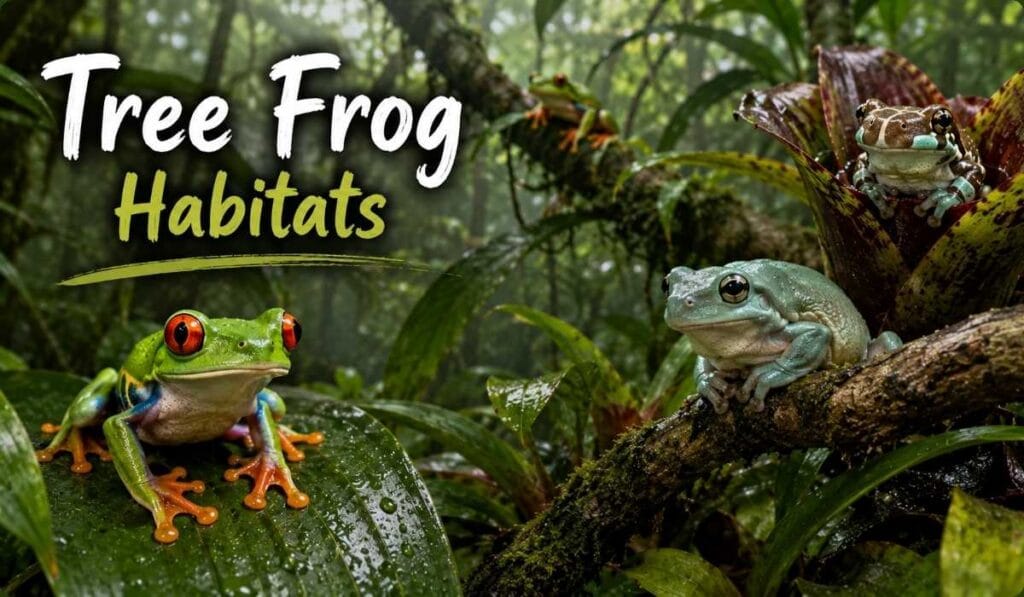
Tree frogs occupy shrubs, reeds, vines, branches, and forest canopies. Living above the ground helps them reach prey, avoid certain predators, and use breeding resources unavailable to terrestrial frogs. different types of tree frogs
Why Tree Frogs Live Above the Ground
Leaves and branches provide abundant insects, protected resting sites, calling perches, and escape routes. Arboreal life can also reduce competition with species feeding on the forest floor. Height does not mean tree frogs are independent of water. Many descend to ponds or select branches directly above breeding sites during the rainy season.
Leaves, Branches and Tree Hollows
Broad leaves offer shaded daytime shelters, while bark crevices and tree hollows provide protection from dry air and predators. Water-filled hollows may function as miniature aquatic habitats. Red-Eyed Tree Frogs inhabit humid forests near freshwater breeding sites. During hot or dry periods, they may shelter beneath broad leaves where conditions remain cooler and more humid.
Sticky Toe Pads and Climbing Adaptations
Many tree frogs have enlarged toe pads, flexible joints, long limbs, and claw-shaped terminal bones that improve their grip. The pads use moisture and microscopic surface structures to create friction against leaves and bark.
Toe pads are common among arboreal hylid frogs, although not every member of the family lives in trees and not every climbing frog belongs to Hylidae.
Water Stored in Leaves and Plants
Bromeliads and other plants can hold rainwater between their leaves. These tiny pools may provide drinking water, tadpole habitat, refuge, or breeding sites. Some frogs deposit eggs or tadpoles inside individual plants, creating highly specialized relationships. Because each pool is small, tadpoles may face limited food, low oxygen, and competition.
Where Tree Frogs Lay Their Eggs
Tree-frog breeding strategies vary widely. Some lay eggs directly in ponds, while others attach them to leaves above water, produce foam nests, or use water-filled tree cavities.
Red-Eyed Tree Frogs place egg clutches on vegetation above ponds. When the eggs hatch, the tadpoles drop into the water below. Some hylid frogs use bromeliads, while glass frogs commonly place eggs on streamside vegetation.
Desert and Dry-Region Frog Habitats
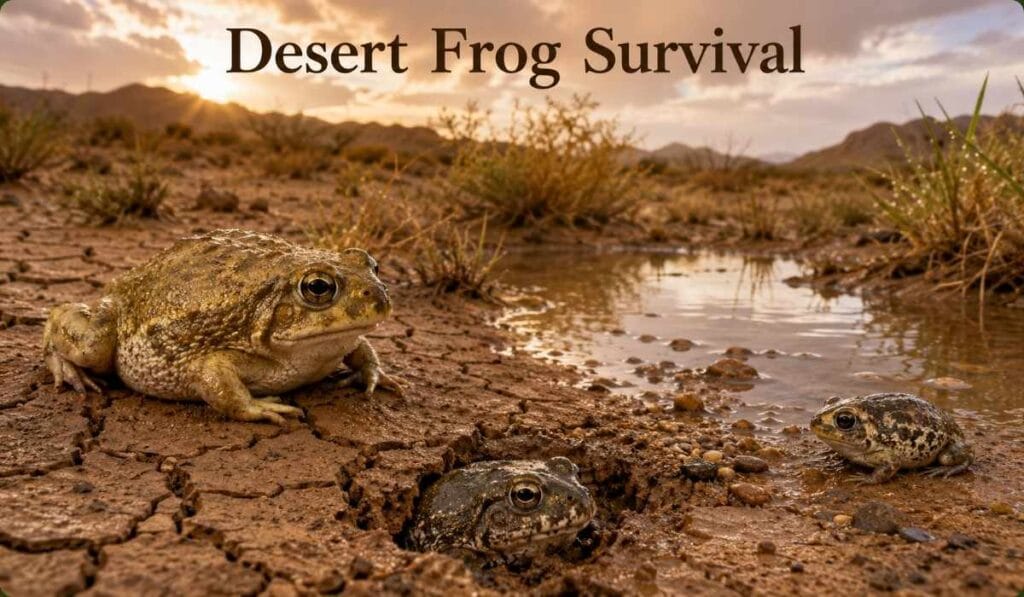
Deserts may seem unsuitable for amphibians, but several frog groups survive there by avoiding dry surface conditions rather than tolerating them continuously.
How Frogs Live Where Water Is Rare
Desert frogs remain inactive through much of the dry period. They feed, call, mate, and lay eggs during short windows following heavy rain. Many are nocturnal and emerge only when humidity rises. Their yearly activity may be concentrated into a few nights or weeks, while the rest of their lives are spent underground.
Underground Burrows as Dry-Season Shelters
Soil acts as insulation from heat and slows water loss. Burrowing frogs use hardened structures on their hind feet, muscular legs, or strong forelimbs to dig into sand, clay, or loose earth.
Spadefoot frogs are named for the hard, spade-like structure on each hind foot. They often remain buried until rainfall softens the ground and produces breeding pools.
Temporary Rain Pools
Heavy storms can transform dry depressions into shallow pools. Desert frogs quickly gather around these sites, where males call and females deposit eggs.
Development may be unusually rapid because the pool could disappear within days or weeks. Rapid growth reduces the danger of drying, although it can produce strong competition for food and oxygen.
Estivation During Drought
Estivation is a period of reduced activity during hot or dry conditions. The frog’s metabolism slows, reducing its need for food and water. Research on cocoon-forming Australian burrowing frogs found that individuals may remain underground for months. As the surrounding soil dries, layers of shed skin form a cocoon that greatly reduces evaporative water loss.
Water Storage and Protective Skin Layers
Water-holding frogs can store substantial water within the bladder and body tissues. Some form protective cocoons, while others press their moisture-absorbing pelvic region against damp soil. These adaptations do not allow frogs to live without water indefinitely. Instead, they slow dehydration until rainfall returns.
Desert Frog Examples
Australian Water-Holding Frogs burrow during dry periods, conserve stored water, and emerge after rain. Spadefoot species use strong digging feet and breed rapidly in temporary pools.
African desert rain frogs in the genus Breviceps are rounded burrowers adapted to sandy or seasonally dry habitats. Some live in coastal desert regions where fog and soil moisture provide more reliable humidity than rainfall alone.
Together, these species demonstrate that desert survival depends on timing, underground shelter, water conservation, and rapid reproduction rather than constant exposure to dry conditions.
Mountain, Cold and High-Altitude Frog Habitats

Mountain frogs live in some of the most physically demanding amphibian habitats. Cold temperatures, short breeding seasons, strong ultraviolet exposure, rapidly changing weather, steep terrain, and isolated water bodies can limit where they feed, reproduce, and overwinter.
Mountain Streams and Cloud Forests
Mountain frog habitats include cold streams, mist-covered cloud forests, alpine wetlands, mossy rock faces, high-elevation ponds, and damp forest floors. Cloud forests are especially valuable because frequent mist keeps vegetation, soil, and leaf litter moist even when rainfall is irregular.
Many mountain-stream frogs shelter beneath rocks, roots, moss, or overhanging vegetation. Stream specialists may have flattened bodies, strong limbs, enlarged toe discs, or tadpoles capable of gripping rocks in moving water. Their survival often depends on both clean streams and intact vegetation along the banks.
Surviving Low Temperatures
Cold temperatures slow a frog’s metabolism, digestion, movement, and development. Mountain frogs may respond by becoming active only during warmer periods, sheltering beneath insulating vegetation, overwintering underwater, or retreating below the frost line.
Short summers also create limited feeding and breeding opportunities. Some high-elevation tadpoles require more than one season to complete development because cold water slows growth.
Reduced Oxygen at High Elevations
Air pressure and oxygen availability decrease with elevation. Cold mountain ponds may also experience low oxygen beneath winter ice. Frogs living in these environments must balance oxygen demand with low temperatures and restricted activity.
Research on high-altitude amphibians suggests that their adaptations are complex and may involve changes in metabolism, energy storage, circulation, behavior, and development rather than one universal response to low oxygen. Some mountain frogs reduce energy use during cold periods, while others select oxygen-rich streams or shallow water.
Freeze Tolerance in Certain Frogs
The Wood Frog, Lithobates sylvaticus, is one of the best-known freeze-tolerant frogs. During winter, ice can form around much of its body while cryoprotective compounds help limit cellular damage. The frog’s heart and breathing temporarily stop before normal activity resumes after thawing.
Freeze tolerance does not eliminate the need for suitable shelter. Wood Frogs select insulated hibernation sites associated with deep leaf litter, logs, stumps, snow cover, and stable microclimates. These features protect them from extreme or rapidly changing temperatures.
Why Mountain Frogs Are Highly Vulnerable
Many mountain frogs occupy narrow elevation ranges or isolated watersheds. They may be unable to move easily when temperatures rise, streams dry, forests shift uphill, or diseases enter their habitat.
Climate change can reduce snowpack, alter rainfall, increase drought, warm streams, and change breeding seasons. Because suitable habitat becomes increasingly limited near mountain summits, high-elevation species may have nowhere cooler to move. Amphibians with restricted ranges are therefore especially vulnerable to rapid environmental change.
Underground and Burrowing Frog Habitats
For burrowing frogs, underground habitat is not merely a temporary hiding place. It is a complete survival system that helps them conserve water, regulate temperature, avoid predators, and remain inactive during unfavorable seasons.
Why Some Frogs Spend Most of Their Lives Underground
Burrowing frogs commonly live in deserts, savannas, grasslands, open woodlands, and seasonally flooded areas. Surface conditions in these habitats may become dangerously hot, cold, or dry.
By remaining underground, frogs avoid direct sunlight, dry wind, predators, and rapid temperature changes. Some species spend eight to ten months inside soil burrows and return to the surface only after heavy seasonal rain.
Soil Type and Burrow Depth
Suitable soil must be soft enough to excavate but stable enough to prevent collapse. Sandy, gravelly, muddy, or loose clay soils commonly support burrowing species.
Burrow depth varies with the species, soil moisture, temperature, and season. A shallow retreat may be sufficient for daily shelter, while deeper burrows provide protection during prolonged drought or winter. Mexican Spadefoot Frogs have been recorded in soil-filled burrows approximately 20–90 centimeters deep.
Spade-Like Feet for Digging
Many burrowing frogs possess a hardened metatarsal tubercle on each hind foot. This wedge-shaped structure acts like a small shovel as the frog pushes soil backward.
Other species dig forward using strong forelimbs and a pointed snout. The Mexican Burrowing Toad, for example, has a compact body, short powerful limbs, and a pointed head adapted for entering loose soil.
Underground Moisture and Temperature Control
Soil temperatures are usually more stable than surface temperatures. Damp underground layers also reduce evaporative water loss from a frog’s permeable skin.
Some burrowing frogs accumulate urea in their body fluids, helping them absorb moisture from surrounding soil. Others produce protective layers from shed skin or reduce their metabolic rate during estivation. These adaptations allow them to survive long periods without feeding or visiting open water.
When Burrowing Frogs Return to the Surface
Rainfall is the main trigger for surface activity in many burrowing species. Moist soil becomes easier to penetrate, insects become abundant, and temporary breeding pools begin to form.
Males may emerge quickly and call beside newly filled pools. Females lay eggs, tadpoles develop rapidly, and adults often return underground as the landscape dries. Some species, such as the Moaning Frog, breed inside burrows that later flood and release tadpoles into nearby water.
Frog Habitat Needs at Every Life Stage

A habitat that supports an adult frog may not automatically support its eggs, tadpoles, or newly transformed froglets. Successful conservation must protect the complete life cycle.
| Life Stage | Main Habitat Need | Major Risk |
| Eggs | Moist, protected breeding site | Drying, flooding or predation |
| Tadpoles | Clean water, oxygen, shelter and food | Pollution, predators and early pond drying |
| Froglets | Shallow margins and nearby ground cover | Dehydration and exposure |
| Adults | Food, shelter, seasonal refuges and breeding access | Habitat loss and fragmentation |
Egg-Laying Sites
Frog eggs lack a hard protective shell and can dry out easily. Depending on the species, eggs may be laid in ponds, streams, foam nests, wet soil, underground chambers, tree holes, or on leaves above water.
The safest location must remain moist without exposing the eggs to destructive currents, excessive heat, pollution, or too many predators.
Tadpole Habitats
Most tadpoles require water containing suitable oxygen, temperature, food, shelter, and enough time for metamorphosis. Aquatic plants and shallow margins provide feeding surfaces and protection from fish, insects, birds, and larger tadpoles.
Temporary pools may reduce fish predation but create a greater risk of drying. Permanent ponds last longer but often contain more aquatic predators.
Froglet Transition from Water to Land
During metamorphosis, froglets develop legs, absorb their tails, begin using lungs more actively, and shift toward an adult diet. They need shallow water and gently sloping banks that allow them to leave safely.
Nearby grass, leaf litter, logs, stones, and low vegetation provide moisture and protection. Newly transformed froglets are especially vulnerable because their small bodies lose water quickly.
Adult Feeding and Shelter Areas
Adult frogs may move far beyond their breeding water to feed, hide, hibernate, or estivate. Their habitat may include forest, meadow, grassland, garden vegetation, underground retreats, or streamside cover.
Roads and cleared land can block these movements. Amphibians are particularly vulnerable because many travel between separate aquatic and terrestrial habitats, often during rainy nights when road mortality is high.
Species That Develop Without Open Water
Direct-developing frogs do not have a free-swimming tadpole stage. Their eggs are usually deposited in moist terrestrial locations, and miniature froglets hatch directly from them.
This strategy allows frogs such as many Pristimantis species to reproduce away from ponds. However, their eggs still require humid, protected microhabitats and may be highly sensitive to forest drying.
Why One Habitat May Not Support the Entire Life Cycle
A clean pond cannot sustain a population if surrounding feeding and overwintering habitat has been removed. Similarly, an intact forest may not support pond-breeding frogs if breeding pools are polluted, drained, or separated by roads.
Frog conservation therefore requires connected habitat networks rather than isolated protected spots.
How Frogs Survive in Different Habitats

Frog anatomy, physiology, and behavior are closely connected to habitat. Different adaptations allow species to swim, climb, dig, hide, conserve water, or survive seasonal extremes.
Moist Skin and Water Absorption
Frogs absorb much of their water through specialized skin, particularly around the pelvic region. Their permeable skin also contributes to respiration, making moisture essential but increasing sensitivity to pollutants.
Species living away from open water use damp shelters, nighttime activity, protective secretions, and reduced movement to limit dehydration.
Camouflage and Warning Colors
Camouflage allows frogs to resemble bark, moss, leaves, mud, stones, or aquatic vegetation. It helps both predators avoid detection and frogs approach prey.
Bright warning colors may signal toxic or unpleasant skin chemicals. However, color must be interpreted carefully because not every bright frog is toxic and not every toxic frog is brightly colored.
Webbed Feet for Swimming
Webbing increases the surface area of the feet and improves propulsion in water. Highly aquatic frogs usually have extensive webbing, streamlined bodies, and strong hind limbs.
Stream frogs may combine partial webbing with strong toe discs or textured feet that help them maintain contact with wet surfaces.
Toe Pads for Climbing
Tree frogs use enlarged toe pads to grip leaves, branches, bark, and other smooth surfaces. Their lightweight bodies and flexible limbs support movement through vegetation.
Climbing ability allows them to reach insects, escape ground predators, shelter inside tree hollows, and place eggs above ponds or streams.
Powerful Legs for Escaping
Long, muscular hind limbs help many frogs jump away from predators or enter water quickly. Aquatic species use similar power for swimming, while ground frogs may rely on short explosive jumps.
Burrowing species often have shorter, stronger legs designed for digging rather than long-distance jumping.
Hibernation and Estivation
Hibernation reduces activity during cold conditions, while estivation serves a similar function during heat and drought. Frogs lower their metabolism and remain inside water, leaf litter, logs, soil, or burrows until conditions improve.
These strategies conserve energy and water, but success depends on appropriate temperature, moisture, oxygen, and shelter.
Changing Activity Times to Avoid Heat
Many frogs become nocturnal during warm or dry weather. Cooler nighttime temperatures and higher humidity reduce water loss.
Others emerge mainly after rain, call only during particular seasons, or move between sun and shade to regulate body temperature.
Habitat Loss, Climate Change and Frog Conservation
Frogs are threatened when breeding water, terrestrial shelter, food sources, and migration routes are damaged at the same time.
Wetland Drainage and Deforestation
Wetland drainage removes egg-laying and tadpole habitats. Deforestation reduces shade, leaf litter, humidity, food, and stream protection.
Agriculture is currently the most widespread cause of habitat loss and degradation affecting threatened amphibians. Globally, about 41% of assessed amphibian species are listed as Vulnerable, Endangered, or Critically Endangered.
Water Pollution and Pesticides
Fertilizers, pesticides, sewage, oil, sediment, and industrial chemicals can enter breeding water or contact frogs on land. Because chemicals may pass through their skin, frogs can be exposed during both aquatic and terrestrial life stages.
Research has linked pesticide exposure with physiological stress and broader amphibian declines, making careful chemical use around ponds and wetlands important.
Roads and Habitat Fragmentation
Roads divide breeding ponds from forests, grasslands, and overwintering sites. Frogs crossing during seasonal migrations may be killed by vehicles.
Wildlife tunnels, raised road passages, guiding fences, and protected movement corridors can reduce mortality and reconnect essential habitats.
Drought and Changing Rainfall
Longer droughts can dry breeding pools before tadpoles complete metamorphosis. Heavy storms may wash away eggs, while changing rainfall can disrupt seasonal breeding signals.
Climate change has become a major driver of increasing amphibian extinction risk, particularly for species with small ranges or specialized moisture requirements.
Disease in Disturbed Habitats
Habitat stress can weaken populations and may interact with diseases such as chytridiomycosis. Movement of animals, water, soil, or contaminated equipment can transport pathogens between locations.
Wild frogs should not be collected or relocated without expert guidance, and field equipment should be cleaned according to local biosecurity recommendations.
Protecting Breeding and Migration Routes
Effective conservation protects breeding pools, streamside vegetation, terrestrial feeding grounds, seasonal refuges, and the routes connecting them.
A network of ponds, wetlands, forest patches, and safe crossings is generally more valuable than a single isolated pond.
How to Create a Frog-Friendly Habitat
A frog-friendly garden can include native plants, tall grass, leaf litter, logs, stones, and pesticide-free shelter. A small pond should have clean water, varied depths, shallow sloping edges, aquatic vegetation, and an easy route between water and land.
Avoid adding fish because they may eat frog eggs and tadpoles. Keep fertilizers, herbicides, and pesticides away from the pond, preserve fallen logs, and allow some areas to remain naturally untidy. Local frogs should arrive on their own rather than being collected and released.
Frog Habitats at a Glance
Frogs live in many different environments, and each habitat requires specific physical or behavioral adaptations. The following table provides a quick comparison of major frog habitats, their environmental conditions, common survival adaptations, and representative species.
| Habitat Type | Main Conditions | Common Frog Adaptation | Example Frog |
| Rainforest | Warm, humid, and densely vegetated | Adhesive toe pads for climbing wet leaves and branches | Red-Eyed Tree Frog |
| Pond | Still or slow-moving freshwater | Webbed feet and powerful hind legs for swimming | American Bullfrog |
| Stream | Cool, clean, fast-flowing water | Strong gripping feet and flattened body | Torrent Frog |
| Desert | Dry conditions with brief seasonal rainfall | Burrowing, water conservation, and estivation | Water-Holding Frog |
| Forest Floor | Moist leaf litter, shade, and fallen wood | Camouflage and use of humid ground shelters | Wood Frog |
| Underground | Stable moisture and protected temperatures | Strong digging feet and compact body shape | Spadefoot Frog |
| Mountain | Cool temperatures, short breeding seasons, and high elevation | Cold tolerance and seasonal inactivity | High-Altitude Frog |
This table provides a general overview rather than a strict rule. Frogs living in the same habitat may use different survival strategies, while one species may move between ponds, forests, burrows, or grasslands during different stages of its life cycle.
Frequently Asked Questions
Where do most frogs live?
Most frog species live in warm, humid tropical regions, particularly rainforests, wetlands, river valleys, and cloud forests. South America, Central America, Southeast Asia, Madagascar, Central Africa, and New Guinea contain especially high frog diversity. However, frogs also inhabit temperate forests, grasslands, mountains, deserts, farms, and urban gardens.
Do all frogs live in water?
No. Many frogs enter water mainly to breed and spend most of their adult lives on land, in trees, or underground. Tree frogs live primarily among leaves and branches, while burrowing frogs may remain beneath the soil for months. Fully aquatic frogs are only one part of global frog diversity.
Can frogs live far away from ponds?
Yes. Some adult frogs travel considerable distances from breeding ponds to find food, shelter, summer habitat, or winter refuges. Direct-developing species may complete their entire life cycle without using a pond. However, frogs with aquatic tadpoles must eventually reach suitable breeding water.
Where do frogs sleep during the day?
Most nocturnal frogs rest in cool, protected microhabitats during daylight. They may hide beneath leaves, logs, rocks, moss, tree bark, aquatic plants, or loose soil. Tree frogs often shelter beneath broad leaves or inside tree hollows, where humidity remains higher and predators are less likely to find them.
How do frogs survive dry weather?
Frogs survive dry conditions by reducing activity, becoming nocturnal, hiding in moist shelters, or burrowing underground. Some species enter estivation, a dormant state that lowers metabolism and reduces water loss. Certain burrowing frogs also form protective layers of shed skin around their bodies.
Where do frogs go in winter?
Frog winter habitats vary by species. Some terrestrial frogs shelter beneath deep leaf litter, logs, soil, or snow. Aquatic frogs may overwinter at the bottom of ponds where the water does not completely freeze. During this period, their metabolism slows dramatically, allowing them to survive with little food.
Can frogs live in deserts?
Yes. Desert frogs survive by spending most of the dry season underground and emerging after heavy rain. Temporary pools provide short-lived breeding sites. Water-Holding Frogs, spadefoot frogs, and desert rain frogs use burrowing, estivation, rapid tadpole development, and water-conservation strategies to survive in dry regions.
Why do frogs need moist habitats?
Frogs have thin, permeable skin through which they absorb water and exchange gases. Moisture prevents excessive dehydration and supports normal skin function. Eggs and tadpoles are often even more dependent on water. However, excessive moisture alone is insufficient without suitable food, shelter, temperature, and breeding conditions.
Where do tree frogs lay their eggs?
Some tree frogs lay eggs directly in ponds, while others attach egg masses to leaves above water. After hatching, the tadpoles fall into the pond or stream below. Other species use foam nests, tree hollows, bamboo stems, or rainwater collected inside bromeliads and other plants.
Can frogs live in saltwater?
Most frogs cannot live permanently in seawater because their permeable skin makes controlling salt and water balance difficult. However, a few species can tolerate brackish water in mangroves, coastal wetlands, and estuaries. These frogs possess specialized physiological adaptations, but they are not truly marine animals.
What makes a backyard suitable for frogs?
A frog-friendly backyard should provide clean water, native plants, insects, shade, damp shelter, and safe movement routes. A shallow fish-free pond with gently sloping edges is especially useful. Fallen leaves, logs, rocks, tall grass, and dense vegetation provide hiding places. Pesticides, chemical fertilizers, and excessive outdoor lighting should be minimized.
How does habitat loss affect frogs?
Habitat loss removes breeding pools, feeding areas, shelter, and migration routes. Deforestation can make the ground hotter and drier, while wetland drainage eliminates egg and tadpole habitats. Roads and development may isolate populations or kill migrating frogs. Because different life stages often require different habitats, damage to only one essential area can cause an entire population to decline.
Final Thoughts
Frogs live in far more habitats than ponds alone. Depending on the species and life stage, they may rely on rainforests, wetlands, streams, grasslands, mountains, deserts, tree canopies, underground burrows, or seasonal pools. Their survival depends on a combination of moisture, food, shelter, suitable temperature, clean breeding water, and safe movement routes.
Frog adaptations reveal how closely each species is connected to its environment. Webbed feet support swimming, sticky toe pads enable climbing, camouflage provides protection, and burrowing helps frogs survive heat and drought. Eggs, tadpoles, froglets, and adults may also require completely different parts of the landscape.
Protecting frogs therefore means protecting entire habitat networks rather than isolated ponds. Conserving wetlands, native vegetation, clean waterways, forest cover, and natural shelters can support both frogs and many other animals. By creating frog-friendly spaces and reducing pollution and pesticide use, people can help these remarkable amphibians survive.
Related Guides
- Frog Species Around the World: Identification Guide
- Types of Tree Frogs: Identification, Habitat and Facts
- What Do Frogs Eat? Complete Diet and Food Guide
- Why Are Frogs Slimy? How Their Skin Helps Them Survive
- Glass Frog Species: Habitat, Appearance and Unique Features
- Poison Dart Frog Species: Identification and Safety Guide