

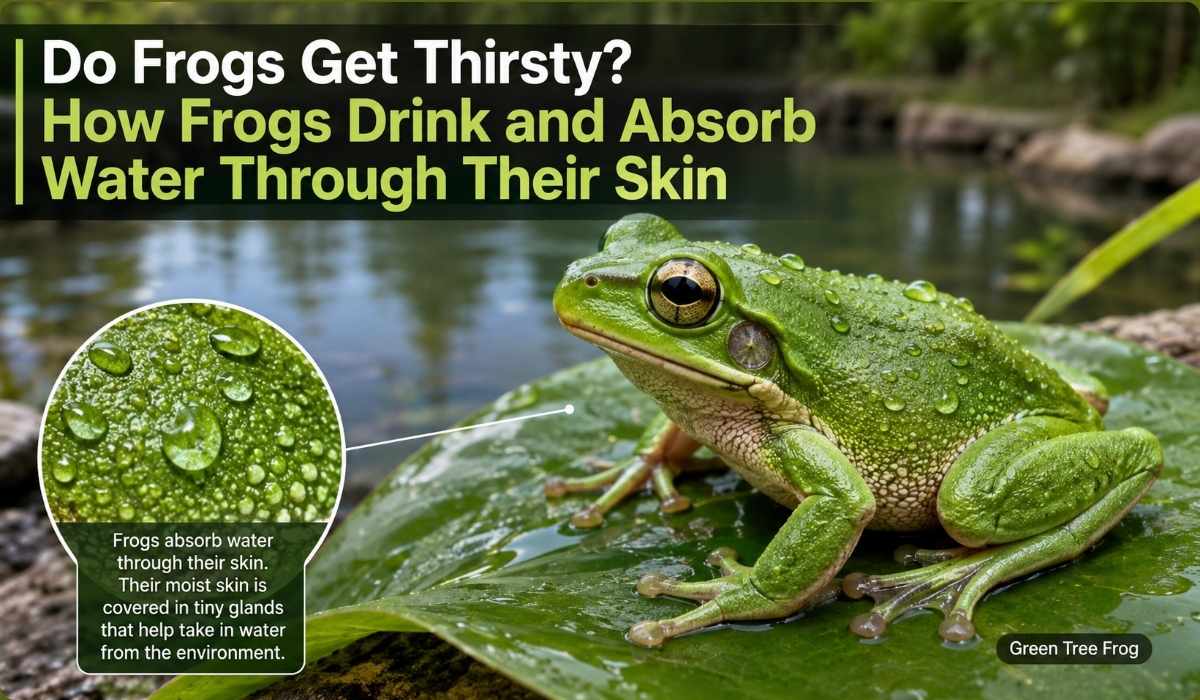
Do frogs get thirsty, and do they drink water the same way humans and other animals do? Frogs need water to survive, but most species do not usually drink by swallowing water through their mouths. Instead, they absorb moisture directly through their thin, permeable skin. A specialized area on the underside of a frog’s body, often called the pelvic patch or drinking patch, allows water to pass into its body. Frogs may sit on wet soil, rest in shallow water, or press their bellies against damp surfaces to stay hydrated. This unique method of water absorption helps them maintain proper fluid balance, support normal body functions, and survive in different habitats. Frog Life Cycle: From Egg to Adult Frog.
Do Frogs Get Thirsty?

Frogs do experience the need for water, but their sense of thirst works differently from humans and many other animals. Instead of regularly drinking water through their mouths, frogs mainly maintain hydration by absorbing moisture through their skin. Because their skin is highly permeable, frogs must constantly manage their body water levels and seek out moist environments when they begin to lose water. Understanding how frogs respond to dehydration helps explain why these amphibians are closely connected to ponds, wetlands, forests, and other humid habitats. Frogs do not drink water like humans. Instead, they absorb most of their water through their skin, which also helps them exchange gases. This unique adaptation allows frogs to stay hydrated and survive in moist environments. Learn more about how frogs breathe through their skin and how their skin supports survival.
Can Frogs Feel Thirst Like Humans?
Frogs do not experience thirst in exactly the same way humans do. Humans usually feel thirsty when the brain detects a decrease in body water levels and creates a strong desire to drink. Frogs, however, rely more on physiological signals and environmental cues to maintain hydration. When a frog loses too much water through its skin, its body detects changes in water balance. This triggers behaviors that encourage the frog to search for moisture, such as moving toward damp soil, hiding under leaves, entering shallow water, or staying in humid areas. These actions are similar to seeking relief from thirst, even though frogs do not typically drink large amounts of water from their mouths. A frog’s skin plays the most important role in hydration. Since water can move directly through the skin, frogs do not need to actively drink like mammals. Their body is designed to absorb the moisture they need from their surroundings.
How Frogs Know When They Need Water
Frogs depend on internal signals and environmental conditions to determine when they need more water. Because their skin continuously allows water loss, especially in dry or hot conditions, they must regularly find suitable moist places. When a frog begins to lose water, it may show several behaviors:
- Moving toward ponds, streams, wet soil, or shaded areas
- Becoming less active to reduce water loss
- Hiding under rocks, logs, leaves, or underground shelters
- Remaining still during dry periods
- Increasing contact between its skin and moist surfaces
Many frogs are most active at night because cooler temperatures and higher humidity reduce water loss. This behavior allows them to move, hunt, and explore while conserving body moisture. Some frogs can also detect changes in humidity and moisture levels in their environment. These abilities help them choose locations where they can absorb enough water and avoid dangerous dehydration.
Why Frogs Need Water to Survive
Water is essential for almost every part of a frog’s life cycle. Unlike many animals, frogs have extremely thin and sensitive skin that allows water and gases to pass through easily. This adaptation helps them breathe through their skin, but it also causes them to lose water quickly.
Frogs need water for several important reasons:
| Function | Why Water Is Important |
| Hydration | Maintains proper body fluid levels and prevents dehydration |
| Skin breathing | Allows oxygen exchange through the moist skin |
| Temperature regulation | Helps frogs control body temperature |
| Reproduction | Frog eggs and tadpoles usually develop in water |
| Body functions | Supports digestion, movement, and metabolism |
Without enough moisture, frogs can become dehydrated because their bodies lose water faster than many other animals. Severe dehydration can affect their movement, ability to hunt, immune system, and survival. This strong dependence on water is one reason frogs are considered important indicators of ecosystem health. A healthy frog population usually suggests that an environment has suitable moisture, clean water sources, and balanced conditions.
How Do Frogs Drink Water?
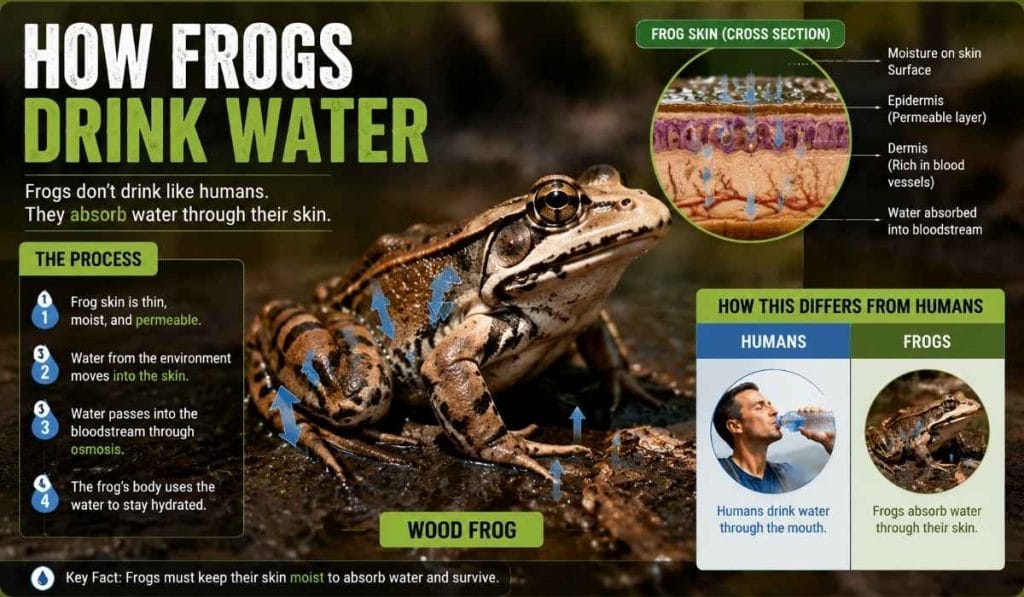
Frogs have a unique way of staying hydrated that is very different from humans and many other animals. Instead of drinking water by swallowing it through their mouths, most frogs absorb water directly through their skin. Their thin, moist skin works like a natural water-absorbing surface, allowing them to take in moisture from ponds, wet soil, and humid environments. This special adaptation helps frogs survive in habitats where access to drinking water may change throughout the day. Can Frogs Breathe Underwater? How Frog Respiration Works
Frogs Do Not Drink Water Like Humans
Unlike humans, frogs usually do not drink water by opening their mouths and swallowing large amounts of liquid. A frog sitting in a pond or near a water source may look like it is drinking, but it is actually absorbing water through its skin. When humans feel thirsty, they drink water using their mouth and digestive system. Frogs follow a different process because their bodies are designed for skin absorption. Their skin contains tiny spaces that allow water molecules to move into their body tissues. A frog may still open its mouth and swallow water occasionally, especially while eating prey or during certain behaviors, but this is not the main method of hydration. Most of the water needed for survival enters through specialized areas of the skin. This adaptation is especially useful because frogs often live in environments where water is present as moisture rather than as a large drinking source. A frog hiding under a wet leaf, sitting on damp ground, or resting near a stream can absorb enough water without actively drinking.
Water Absorption Through Frog Skin (Osmosis Process)
The main reason frogs can absorb water through their skin is a process called osmosis. Osmosis is the movement of water molecules across a partially permeable membrane from an area with higher water concentration to an area with lower water concentration. A frog’s skin acts as a semi-permeable membrane. When the outside environment contains more available water than the frog’s body fluids, water moves through the skin and enters the frog’s tissues. This helps maintain the correct balance of fluids inside the body. The process works because frog skin contains:
- Thin layers of cells that allow water movement
- Blood vessels close to the skin surface that transport absorbed water throughout the body
- Moist mucus layers that keep the skin suitable for water exchange
However, this same feature also creates a disadvantage. Because frog skin is highly permeable, frogs can lose water quickly through evaporation, especially in hot, dry conditions. This is why many frogs avoid direct sunlight, remain active at night, and seek humid environments. Water absorption through the skin also allows frogs to perform another important function: cutaneous respiration. Since oxygen can pass through their moist skin, frogs can breathe partly through their skin while absorbing water.
The Role of the Pelvic Patch in Water Absorption
The pelvic patch is one of the most important structures involved in frog hydration. It is a specialized area of skin located on the underside of a frog’s body, near the hind legs and belly region. This area is highly effective at absorbing water from the surrounding environment. When a frog sits on wet ground or shallow water, the pelvic patch makes direct contact with moisture. Water then moves through this region of the skin and enters the frog’s body. The pelvic patch is especially useful because frogs often use a behavior called water absorption posture. During this behavior, a frog lowers its body and presses its belly against a moist surface, allowing the pelvic patch to collect water efficiently. The effectiveness of the pelvic patch helps frogs survive in many different habitats, including:
| Habitat | How Frogs Obtain Water |
| Wetlands | Absorb water while sitting in shallow water or mud |
| Forests | Take moisture from damp leaves and soil |
| Gardens | Use wet grass, soil, and shaded areas |
| Deserts | Absorb limited moisture from humid nighttime conditions |
This unique adaptation shows how frogs are specially designed for life in environments where maintaining water balance is essential. Their ability to absorb water through their skin allows them to survive without drinking like mammals, but it also makes them highly dependent on clean and suitable habitats.
How Frogs Absorb Water Through Their Skin

Frogs have one of the most unique hydration systems among animals because they can absorb water directly through their skin. Their skin is thin, moist, and specially adapted to allow water movement from the environment into their bodies. This ability helps frogs survive without drinking water in the same way humans do. However, because their skin is highly sensitive, frogs must maintain moisture and live in environments with suitable humidity and clean water sources. How Frogs Absorb Water Through Their Skin.
Frog Skin Structure and Water Movement
A frog’s skin is much different from the thick, protective skin of mammals. It is thin, smooth, and contains many tiny blood vessels located close to the surface. This structure allows water and gases to move easily through the skin. The outer layer of frog skin contains a protective mucus coating. This mucus keeps the skin moist, reduces water loss, and helps create the conditions needed for water absorption. Beneath the surface, a network of capillaries quickly transports absorbed water throughout the frog’s body.
How Osmosis Helps Frogs Stay Hydrated
The main mechanism that allows frogs to absorb water through their skin is osmosis. Osmosis is the natural movement of water molecules across a semi-permeable membrane from an area with higher water availability to an area with lower water availability. When a frog sits on damp soil or in shallow water, the water concentration outside its body is often higher than inside its tissues. As a result, water moves through the skin and enters the frog’s body.
This process helps frogs maintain:
- Proper body fluid levels
- Normal cell function
- Healthy metabolism
- Ability to move and hunt
- Protection against dehydration
However, osmosis works both ways. If the surrounding environment is dry, water can move out of the frog’s body through its skin. This is why frogs are vulnerable to dehydration and usually avoid hot, dry places. Frogs have developed several behaviors to reduce water loss, including hiding during the day, staying under vegetation, becoming less active in dry conditions, and searching for humid areas.
Why Moist Skin Is Essential for Frogs
Moist skin is not only important for hydration but also for survival. Frogs depend on their skin for several essential biological functions, including breathing, temperature regulation, and protection. Unlike humans, many frogs can absorb oxygen directly through their skin through a process called cutaneous respiration. For this process to work effectively, the skin must remain wet because oxygen can only pass through a moist surface. If a frog’s skin becomes too dry, it cannot absorb enough water or exchange gases properly. This can lead to stress, reduced activity, illness, and even death. For this reason, frogs are strongly connected to healthy ecosystems with clean water, shaded areas, and sufficient humidity. Their dependence on moist skin makes them excellent indicators of environmental changes and habitat quality.
Identification: Signs a Frog Needs Water

A dehydrated frog may become less active, hide more often, or move away from dry areas in search of moisture. Changes in habitat conditions can also affect frog populations. Learn more about why frogs disappear from gardens and how environmental changes impact frogs.
- Dry or less shiny skin: A healthy frog usually has moist, smooth skin. If the skin appears dry, dull, or less slippery than normal, it may indicate dehydration.
- Reduced activity and movement: A dehydrated frog may become less active, move slowly, or remain hidden for longer periods to conserve water.
- Searching for damp areas: Frogs that need water often move toward ponds, wet soil, shaded areas, or places with higher humidity.
- Sitting low against moist surfaces: A frog may press its belly and underside against wet ground to increase water absorption through its pelvic patch.
- Sunken-looking eyes: Dehydration can cause a frog’s eyes to appear less full or slightly sunken compared with a healthy frog.
- Loss of appetite: A frog that lacks enough water may eat less because dehydration affects digestion, movement, and overall body function.
- Weak jumping ability: Water loss can reduce muscle function, causing a frog to jump less frequently or with less strength.
- Lethargic behavior: A dehydrated frog may stay still for long periods and show little response to nearby movement or changes in its environment.
- Avoiding dry, exposed areas: Frogs needing moisture usually try to escape dry locations and seek shelter under leaves, rocks, logs, or vegetation.
- Abnormal posture: Some frogs may flatten their bodies against damp surfaces or position themselves to maximize contact with available moisture.
- Dry habitat conditions: A lack of recent rainfall, dry soil, low humidity, or an empty water source can increase the chance that frogs are experiencing water stress.
- Increased skin mucus changes: Changes in the normal moist mucus coating of the skin can indicate that a frog is struggling to maintain hydration.
Do All Frogs Absorb Water Through Their Skin?
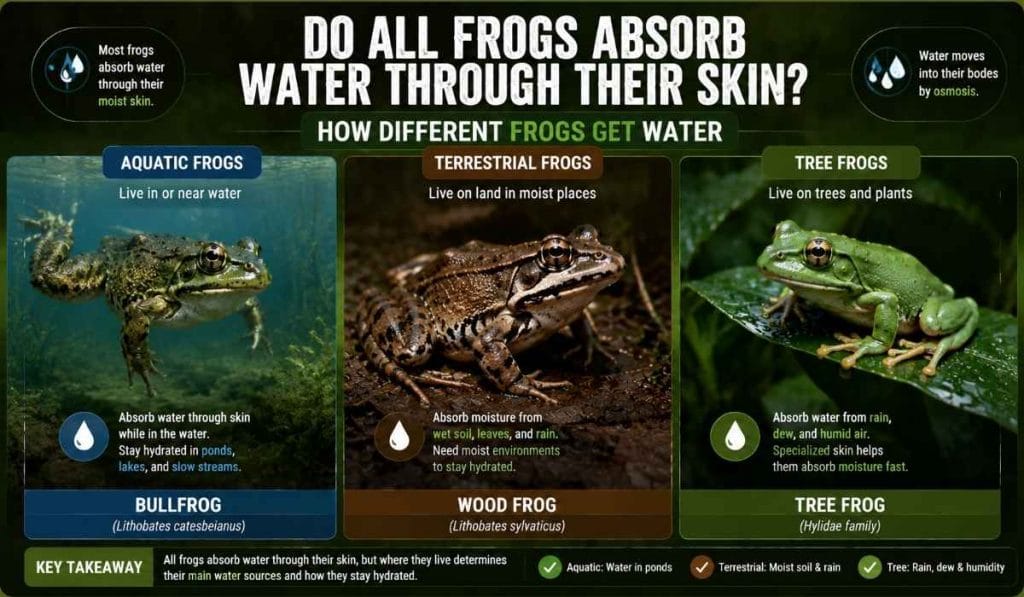
Almost all frogs have the ability to absorb water through their skin, but the amount and importance of this process can vary depending on their habitat and lifestyle. Frogs have evolved different adaptations to survive in aquatic environments, forests, deserts, and trees. While some species spend most of their lives near water and absorb moisture easily, others have special behaviors and skin features that help them conserve water in drier conditions. Most frogs absorb water through their skin, but the level of dependence varies among species. Different habitats and adaptations influence how frogs obtain and conserve water. Explore different types of frogs and discover how species differ from one another.
Aquatic Frogs
Aquatic frogs spend most of their lives in or around water, making skin absorption a major part of their hydration process. Because they are constantly surrounded by moisture, these frogs can easily absorb water through their skin without needing to search for separate water sources. Species that live in ponds, lakes, streams, and wetlands often have highly permeable skin that allows continuous water exchange with their environment. This adaptation helps them maintain hydration and supports other functions such as skin respiration. Examples of aquatic frogs include:
- African clawed frog, which spends most of its life underwater
- American bullfrog, which commonly lives near ponds, lakes, and slow-moving water
Aquatic frogs still need to regulate their body fluids because their skin allows substances to move both into and out of their bodies. Poor water quality, pollution, or chemical contamination can therefore directly affect their health.
Terrestrial Frogs
Terrestrial frogs live mainly on land, but they still depend heavily on moisture from their surroundings. Instead of staying in water continuously, these frogs absorb moisture from damp soil, leaf litter, moss, and humid environments. Because land habitats can become dry, terrestrial frogs have developed behaviors that help reduce water loss. They often:
- Hide under rocks, logs, or leaves during dry periods
- Become active at night when humidity is higher
- Choose shaded and moist areas for shelter
- Reduce movement to conserve body water
Many terrestrial frogs rely on their pelvic patch to absorb water quickly when they encounter a wet surface. This adaptation allows them to survive away from permanent water sources. Examples of terrestrial frogs include forest-dwelling and ground-dwelling species that spend much of their time hunting on land but return to moist areas for hydration and reproduction.
Tree Frogs and Moisture Adaptations
Tree frogs have unique adaptations that allow them to absorb water while living above the ground. Although many tree frogs spend their lives in trees and vegetation, they still require moisture to survive. These frogs often absorb water from:
- Wet leaves
- Rain droplets
- Humid air
- Moist tree bark
- Rainforest vegetation
Tree frogs usually have specialized skin that helps them retain moisture. Their mucus layer reduces water loss, while their climbing ability allows them to find humid locations high above the forest floor. Species such as White’s tree frog can survive in environments where moisture availability changes by storing water and reducing water loss through their skin. Tree frogs are also commonly active at night because cooler temperatures and higher humidity reduce evaporation. This behavior allows them to stay hydrated while searching for food and avoiding dehydration. Although aquatic frogs, terrestrial frogs, and tree frogs live in very different environments, they all share one important feature: their skin plays a vital role in maintaining water balance and supporting survival.
How Frogs Prevent Dehydration
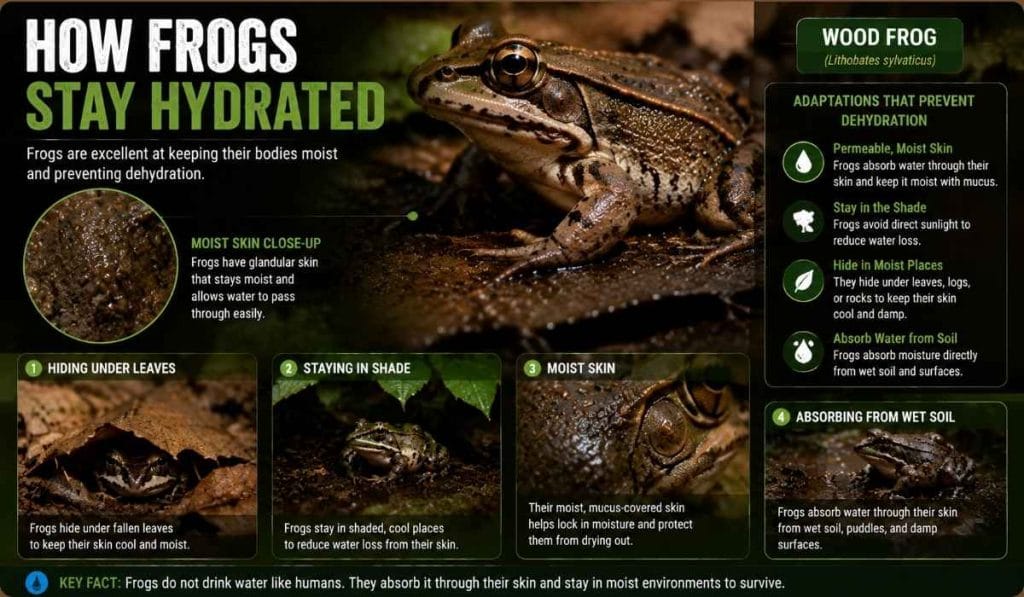
Frogs face a constant challenge of losing water because their thin, permeable skin allows moisture to move easily between their bodies and the environment. To survive, frogs have developed several behavioral and physical adaptations that help them conserve water and maintain hydration. These adaptations allow different frog species to live in habitats ranging from wet forests and ponds to dry seasonal environments. Frogs use several strategies to prevent dehydration, including hiding in moist places, reducing activity, and resting during unfavorable conditions. Their natural resting patterns help them conserve energy and moisture. Learn more about frog sleeping habits and their behavior during inactive periods.
Behavioral Adaptations
Frogs use several behaviors to reduce water loss and avoid dehydration. Since their skin can quickly lose moisture in dry conditions, they carefully choose when and where to move, rest, and search for food. Common behavioral adaptations include:
- Seeking moist environments: Frogs move toward ponds, streams, wet soil, and humid areas when they need to restore lost water.
- Hiding during dry periods: Many frogs shelter under rocks, logs, fallen leaves, or underground spaces to avoid direct sunlight and reduce evaporation.
- Being active at night: Nocturnal activity helps frogs avoid high daytime temperatures. Cooler nighttime air usually has higher humidity, which reduces water loss.
- Reducing movement: During hot or dry conditions, frogs may remain still for long periods to conserve energy and prevent excessive water loss.
- Using protective shelters: Natural hiding places such as leaf litter, tree holes, and moist vegetation provide a humid microenvironment where frogs can maintain moisture.
- Seasonal behaviors: Some frogs change their activity patterns during dry seasons by becoming less active or entering periods of dormancy until moisture levels improve.
- These behaviors are especially important for terrestrial and tree-dwelling frogs that cannot remain in water continuously.
Physical Adaptations
Frogs also have several physical features that help them retain water and survive in different environments. Their bodies are specially designed to balance the need for water absorption with protection against excessive water loss. Important physical adaptations include:
| Physical Adaptation | How It Helps Prevent Dehydration |
| Moist, permeable skin | Allows water absorption from the environment |
| Mucus coating | Creates a protective layer that slows water loss |
| Pelvic patch | Specialized skin area that efficiently absorbs water |
| Skin structure | Allows controlled movement of water and gases |
| Body posture | Helps increase contact with moist surfaces |
The mucus layer covering frog skin is particularly important. It keeps the skin moist, supports oxygen exchange, and reduces dehydration by slowing evaporation. Some frog species living in dry environments have additional adaptations. They may have thicker skin, reduced activity levels, or behaviors that allow them to survive periods with limited water availability. Certain frogs can also burrow underground, where moisture levels are higher and temperatures are more stable. Together, these behavioral and physical adaptations allow frogs to maintain their water balance despite living in environments where moisture conditions can change significantly. However, because frogs depend so strongly on water, changes in habitat quality, pollution, and climate conditions can greatly affect their survival.
What Happens When Frogs Lose Too Much Water?

Frogs depend heavily on water because their bodies are designed to absorb moisture through their skin. When a frog loses too much water, its normal body functions begin to slow down, and it may struggle to survive. Since frogs cannot rely on drinking water like humans, severe dehydration can quickly affect their movement, breathing, feeding behavior, and overall health. When frogs lose too much water, their skin can become dry, making it difficult to absorb moisture and exchange gases. Because frogs depend heavily on their skin for survival, dehydration can become dangerous. Learn more about frog skin respiration and why moist skin is essential.
Dehydration Symptoms in Frogs
A dehydrated frog often shows visible changes in appearance and behavior. These signs indicate that the frog is losing more water than it can replace from its environment. Common dehydration symptoms include:
- Dry or dull-looking skin: Healthy frogs usually have moist and shiny skin. When dehydrated, their skin may become dry, rough, or less flexible.
- Reduced movement: A frog with low water levels may become weak, slow, and less active because dehydration affects muscle function and energy levels.
- Lethargy and hiding behavior: Dehydrated frogs often remain still for long periods and hide in protected areas to reduce further water loss.
- Sunken eyes: Loss of body fluids can cause the eyes to appear less full or slightly sunken.
- Loss of appetite: A dehydrated frog may stop eating because digestion and metabolism require proper water balance.
- Difficulty jumping or climbing: Water loss can reduce muscle performance, making normal movements more difficult.
- Increased mucus changes: The protective mucus layer on the skin may become reduced or abnormal, affecting the frog’s ability to retain moisture.
- Seeking wet surfaces: A frog experiencing dehydration may repeatedly move toward water sources, damp soil, or humid areas to absorb moisture.
Severe dehydration may cause a frog to become extremely weak and unable to escape predators or search for food.
How Dehydration Affects Frog Health
Water loss affects nearly every important biological process in a frog’s body. Because frogs rely on their skin for both hydration and breathing, dehydration can create multiple health problems at the same time. The major effects of dehydration include:
| Health Effect | Impact on Frogs |
| Impaired skin function | Reduces water absorption and makes skin less effective for gas exchange |
| Breathing problems | Dry skin limits oxygen movement through the skin |
| Reduced energy | Affects movement, hunting, and escape responses |
| Weak immune system | Makes frogs more vulnerable to diseases and infections |
| Poor body regulation | Disrupts temperature control and internal balance |
When a frog becomes severely dehydrated, its blood volume and body fluids decrease. This can affect circulation and reduce the ability of organs and tissues to function properly. Dehydration is especially dangerous for small frogs because they have a higher surface-area-to-body-mass ratio, meaning they can lose water more quickly than larger species. Tadpoles and young frogs are also highly sensitive because their development depends on stable water conditions. Long-term water stress can reduce a frog’s ability to reproduce, find food, and avoid predators. In natural habitats, repeated dehydration caused by drought, habitat destruction, or climate changes can contribute to declining frog populations. Maintaining healthy wetlands, clean water sources, and humid habitats is therefore essential for protecting frogs and the ecosystems they support.
Where Do Frogs Get Water in Nature?

Frogs obtain water from their surrounding environment rather than depending only on drinking from open water sources. Because they absorb moisture through their skin, they search for places where humidity and water availability are high. Different frog species use different natural water sources depending on their habitat, including ponds, wetlands, rainfall, dew, moist soil, and forest environments. Where Do Frogs Get Water in Nature?.
Ponds and Wetlands
Ponds and wetlands are some of the most important water sources for frogs. These habitats provide a constant supply of moisture and support many stages of a frog’s life cycle, especially reproduction and development. Frogs living near ponds, lakes, marshes, and streams absorb water directly through their skin when they sit in shallow water or on wet surfaces. These environments also provide suitable conditions for laying eggs because frog eggs require water to survive and develop into tadpoles.
Wetland habitats provide frogs with:
| Water Source | Benefit for Frogs |
| Shallow water | Allows easy skin absorption and hydration |
| Muddy areas | Provides moist surfaces for the pelvic patch |
| Aquatic plants | Creates shade and reduces water loss |
| Streams and ponds | Support breeding and tadpole development |
Many aquatic and semi-aquatic frogs spend most of their time near these areas because they provide both hydration and food sources. However, the quality of the water is extremely important. Polluted water containing chemicals or pesticides can harm frogs because their sensitive skin easily absorbs substances from their surroundings.
Rainwater and Dew
Rainwater and dew are important temporary water sources, especially for frogs living in forests, grasslands, and areas without permanent water bodies. After rainfall, frogs often become more active because the increased moisture creates ideal conditions for movement, feeding, and hydration. Many frogs absorb rainwater through their skin by sitting on wet leaves, plants, or ground surfaces. Dew also provides a valuable source of moisture. During cooler nights, water droplets form on vegetation, creating small but important hydration opportunities for frogs.
Frogs may collect moisture from:
- Rain-covered leaves
- Wet grass
- Plant surfaces
- Tree bark
- Morning dew droplets
This ability allows frogs to survive in habitats where rainfall is seasonal and large water sources are not always available.
Moist Soil and Forest Habitats
Many terrestrial frogs depend on moist soil and forest environments to maintain hydration. Forest floors often contain layers of fallen leaves, moss, and organic material that hold moisture for long periods. Frogs use these damp areas by resting their bodies against wet surfaces and absorbing water through their skin. Shaded forest habitats are especially valuable because they reduce evaporation and maintain higher humidity. Important moisture sources in forest habitats include:
- Damp leaf litter
- Moss-covered ground
- Wet tree roots
- Stream edges
- Underground shelters
Some tree frogs also obtain water from humid air and moisture collected on vegetation. They often choose locations with high humidity, such as rainforest canopies or areas near streams, to reduce dehydration. Natural environments with sufficient moisture allow frogs to maintain their water balance, breathe through their skin, and successfully reproduce. This strong connection between frogs and water makes them sensitive indicators of environmental health and habitat changes.
Frog Water Requirements by Species

Different frog species have different water requirements depending on their natural habitat, skin structure, activity patterns, and lifestyle. Aquatic frogs usually need constant access to water, while terrestrial and tree frogs depend more on humidity, moist surfaces, and occasional water absorption through their skin. The table below compares the general water needs of some well-known frog species. Water requirements are different for each frog species. Aquatic frogs may spend most of their lives near water, while some tree frogs rely on humidity and moisture from their surroundings. Learn more about frog species and their habitats and their unique environmental needs.
| Frog Species | Natural Habitat | Water Requirement | How They Obtain Water |
| American bullfrog | Ponds, lakes, slow-moving streams, wetlands | High | Absorbs water through skin while sitting in or near water |
| African clawed frog | Freshwater lakes, rivers, ponds | Very high | Spends most of its life underwater and absorbs water through skin |
| White’s tree frog | Forests, woodlands, humid areas | Moderate | Absorbs moisture from wet surfaces, rain, and humid air |
| Red-eyed tree frog | Tropical rainforests | Moderate to high | Uses rainwater, wet leaves, and humid vegetation |
| Poison dart frog | Tropical rainforest floors | High | Absorbs moisture from wet soil, plants, and leaf litter |
| Wood frog | Forests, wetlands, cool regions | Moderate | Uses moist soil, ponds, and seasonal water sources |
| Pacman frog | Tropical forest floors | Moderate | Absorbs water from damp substrate and humid environments |
| Tomato frog | Tropical forests and moist areas | Moderate | Uses humid soil and shallow water sources |
| Goliath frog | Fast-flowing rivers and streams | Very high | Remains near water and absorbs moisture through skin |
| Desert rain frog | Coastal desert environments | Low to moderate | Uses nighttime fog, dew, and humid air for moisture |
Key Points About Frog Water Needs
- Aquatic frogs require frequent contact with water because they spend most of their lives in aquatic environments.
- Terrestrial frogs depend on moist soil, shaded areas, and humid habitats to prevent dehydration.
- Tree frogs usually obtain water from rain, dew, wet leaves, and moisture in the air.
- Desert-adapted frogs have special behaviors that allow them to survive with limited water availability.
- Regardless of habitat, almost all frogs rely on their skin for maintaining proper hydration.
The availability of clean water and suitable humidity is one of the most important factors determining where frogs can survive. Even species that do not live permanently in water still require regular access to moisture to support hydration, breathing, and overall health.
Frequently Asked Questions About Frog Drinking and Water Needs
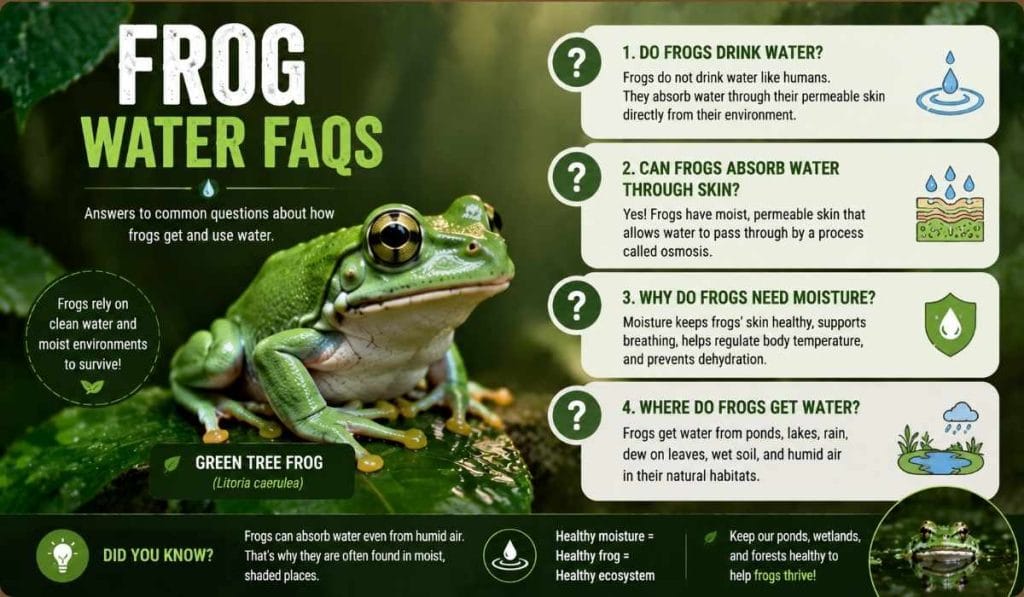
Frogs mainly absorb water through their skin rather than drinking it directly. Their skin also plays an important role in breathing. Learn more about how frogs breathe underwater and their special adaptations.
Do frogs get thirsty?
Yes, frogs need water to survive, but they do not experience thirst in the same way humans do. Unlike humans, frogs do not usually search for water to drink from a container or stream. Instead, they maintain their body water balance mainly through their skin. Frogs are amphibians, which means they depend heavily on moisture in their environment. Their thin, permeable skin allows them to absorb water directly from wet surfaces, soil, plants, and water bodies. When their bodies lose too much moisture, they move toward damp areas to restore hydration. Because frogs rely on their skin for water absorption, staying in a moist environment is essential for their survival.
How do frogs drink water?
Frogs do not typically drink water by opening their mouths and swallowing like humans or many other animals. Instead, they absorb most of the water they need through a specialized area of their skin called the pelvic patch. When a frog sits on wet soil, mud, or shallow water, water moves through its skin and enters the body. This process allows frogs to stay hydrated without actively drinking. Some frogs may occasionally take in water through their mouth while feeding or when surrounded by water, but skin absorption is their primary method of hydration.
Do frogs drink water through their skin?
Yes, frogs drink water mainly through their skin. Their skin is thin and highly permeable, allowing water molecules to pass into their bodies. A frog’s skin contains special cells that help absorb moisture from the surrounding environment. This ability is especially important because frogs often live in places where water availability changes throughout the year. However, this same adaptation also makes frogs vulnerable. Because their skin absorbs substances easily, pollution and chemicals in water can seriously harm them.
Can frogs absorb water through their skin?
Yes, frogs can absorb water through their skin, and this is one of their most important survival adaptations. The process is called cutaneous water absorption. The skin allows water to move directly into the frog’s body without needing to drink through the mouth. This ability helps frogs survive in forests, wetlands, ponds, and other moist environments. Some frogs can even rehydrate after losing body water by sitting on damp surfaces.
Where do frogs get water from?
Frogs get water from many natural sources, including:
- Ponds and lakes
- Streams and rivers
- Rainwater
- Wet soil
- Plant surfaces
- Morning dew
- Moist leaf litter
Different frog species use different water sources depending on their habitat. Tree frogs may collect moisture from leaves and rain, while aquatic frogs usually stay close to ponds and wetlands. Maintaining access to moisture is one of the main reasons frogs choose specific habitats.
How do frogs stay hydrated without drinking?
Frogs stay hydrated by absorbing water through their skin and reducing water loss from their bodies. Their skin contains a protective mucus layer that helps keep moisture inside. Many frogs also avoid dry conditions by hiding in shaded areas, burrows, under leaves, or near water sources. Some species are adapted to survive temporary dry periods by becoming inactive and reducing their metabolism. These strategies help frogs maintain enough moisture even when water is limited.
Do frogs need water to survive?
Yes, frogs need water to survive because water is essential for many body functions.
Water helps frogs:
- Maintain healthy skin
- Control body temperature
- Breathe through their skin
- Support metabolism
- Reproduce successfully
Unlike many animals, frogs cannot protect themselves from dehydration with thick skin or fur. Their sensitive skin requires a moist environment, which is why many frogs live near water sources.
Can frogs live without water?
Most frogs cannot survive for long without water because they lose moisture through their skin. However, the amount of time a frog can survive without water depends on its species, size, habitat, and environmental conditions. Some desert-adapted frogs have special behaviors that allow them to survive longer periods without direct water. Common frogs usually need regular access to moisture to prevent dehydration and maintain normal body functions.
Why do frogs need moist skin?
Frogs need moist skin because their skin plays several important roles in survival.
Their moist skin helps them:
- Absorb water
- Exchange oxygen and carbon dioxide
- Maintain hydration
- Protect their body from drying out
Unlike humans, frogs can breathe partly through their skin. If their skin becomes dry, they cannot absorb enough oxygen or water, which can become dangerous.
What happens if a frog’s skin dries out?
If a frog’s skin dries out, it can become severely dehydrated and may eventually die. Dry skin prevents frogs from absorbing water and reduces their ability to breathe through their skin. Since frogs depend heavily on skin respiration and hydration, moisture loss can quickly become a serious problem. This is why frogs often avoid direct sunlight, stay in humid environments, and hide during dry weather. Protecting wetlands and natural habitats is important because these environments provide the moisture frogs need to survive.
Final Thoughts

Frogs have a fascinating relationship with water that is completely different from humans and many other animals. Instead of drinking water through their mouths, most frogs maintain hydration by absorbing moisture through their highly permeable skin. This unique adaptation allows them to survive in ponds, wetlands, forests, gardens, and even some dry environments where direct access to water may be limited. The process of water absorption through frog skin depends on several important biological features, including osmosis, skin permeability, and the specialized pelvic patch. Water moves through the frog’s semi-permeable skin from moist environments into the body, helping maintain proper hydration and supporting essential functions such as movement, metabolism, and skin respiration. However, this adaptation also makes frogs extremely sensitive to environmental changes. Because their skin easily absorbs substances from their surroundings, pollution, pesticides, chemicals, and habitat destruction can seriously affect their health. Providing clean water sources, protecting wetlands, and maintaining natural habitats are essential for frog conservation.
Related Frog Guides
- 10 Types of Frogs in the World (With Pictures & Facts Guide)
- Do Frogs Sleep? Understanding Frog Sleeping Habits
- Why Have Frogs Disappeared From My Garden? Explained
- Can Frogs Breathe Underwater? How Frog Respiration Works
- Digestive Parts of Frog: Structure and Functions Explained
- Digestive Organs of a Frog: Complete Guide to Frog Digestion
- Digestive System of a Frog: Organs, Functions, and Process Explained